
Ep. 003: The poet working nights in an Irish plastic factory
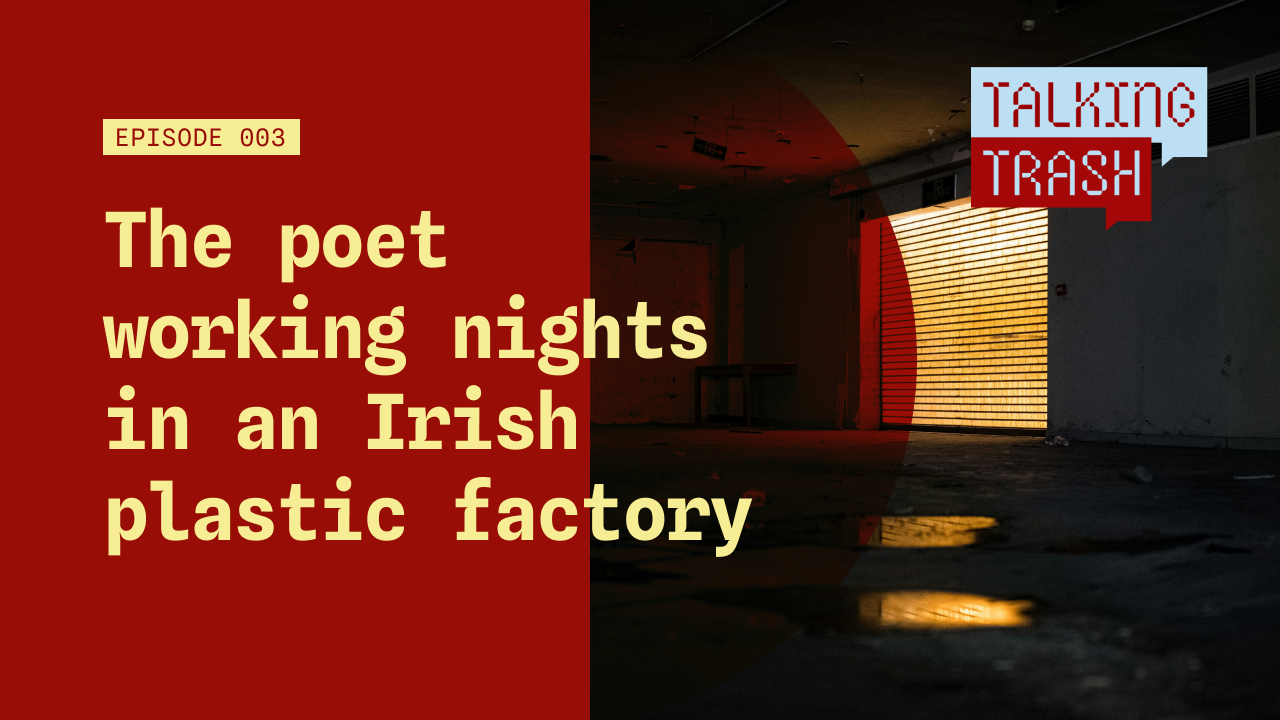
Cover art for Episode 003 on Belfast’s factory worker turned poet.
A decade on the factory floor, a book-length poem stamped like a night-shift clock, and the waste that never makes the ledger.
Every night, while the rest of us sleep, plastic injection molding machines keep running — and somebody has to run them. For a decade, that somebody was Matthew Rice: a poet from Belfast working 12-hour night shifts in the factories that make the plastic parts inside almost everything you own.
His new book, plastic: A Poem (Fitzcarraldo Editions / Soft Skull Press), compresses those years into a single shift, clock-in to clock-out — a night of urban legends, skull-and-crossbones warnings on bags of molding material, a hidden copy of Sir Gawain and the Green Knight, and the strange things that happen to the mind at 3 a.m.
Listen: Apple Podcasts, Spotify, Amazon Music, RSS
Not a "worthy" subject for poetry
When Matthew went looking for poets who had written from inside a factory, he found an American tradition — Philip Levine, Fred Voss, and to an extent Bukowski and Carver — but, at home in the north of Ireland, almost nothing. Irish poetry had the farms and fields of poets like Seamus Heaney. "Maybe they think that poetry needs to be a grander subject," he muses in the episode — an assumption he once shared, and one reason he spent years refusing to write about the place where he spent most of his waking hours. His book is the counter-argument: "The everyday working human condition is an essential part of life. And it's often overlooked... I wanted to bring some of that out of the shadows, into the contemporary poetry light... Factory workers can also be art critics."
The psychic toll of the night shift
Why do night shifts exist at all? Because once a molding machine is hot and running, the cheapest thing to do is keep it going — so the machines never sleep, and the workers can't either. Matthew spent a year on nights, eight to eight, and fought to keep his life intact around it. The episode traces what that costs:
The exhaustion that everyone else can see. He kept up football training, hit the gym after twelve-hour shifts, ate breakfast that was really his dinner — and still: "I always felt tired... My girlfriend said she could just see it in me."
The strange hours."People get weird," he says of the 2 and 3 a.m. points of the late night — inappropriate jokes, minds wandering loose, then the sun coming up and everyone feeling "a bit more human again."
The shadow. The book's first hour holds a suicide and a heart attack — drawn from factory urban legends — woven in, Matthew says, to honor the real toll of low-paid labor on workers' minds, including his own struggles with anxiety and depression in a culture that said suck it up.
Waste in the factory
This is Talking Trash, so we follow the waste — and while reading with waste in mind, Matthew’s book is full of it: purge scrap swirling out of machines when an order changes colors (the marbled mess that, as it happens, looks exactly like the book's cover), swarf shoveled into bins, rubbish spiraling out of the skip in a storm. Zoom out and the factory's waste footprint gets bigger: the colored pellets that feed the hoppers — nurdles — ship by the billions, and researchers estimate hundreds of thousands of tons escape into waterways every year before they're molded into anything at all. The parts that do get made outlive us, shedding into the microplastics now found everywhere scientists look.
Physical risks of the work
The factory waste threatened the workers, too. Matthew describes slicing open bags of molding material and noticing the skull and crossbones printed on the back — thinking "this can't be legal" — and dust so fine it was visible only in a shaft of sunlight. In a decade on factory floors, he was never provided a proper respirator; instead, he got a dust mask, if that, and sometimes just an open window at the back of the building. "That was definitely a worry I used to have all the time," he says. "Always worried about my lungs."
The episode follows the way out, too: the Open University degree his low factory wages made free, the PhD at the Seamus Heaney Centre where he finally found the distance to write about the factory. Along the way, there’s a famous poet who became his first reader — and the moment at 30,000 feet when Matthew realized he was sitting on his own handiwork.
Additional resources
Start with Matthew's book — everything else here orbits it. Then meet the tradition he joined (Levine, Heaney, Piercy, Morrison) and the industry he worked in, from the birth of celluloid to the observed effects that night shifts have on the human body. And if the nurdle numbers stuck with you, help scout for pellet pollution in your own area, supporting citizen beach surveys that feed real data into real supply-chain rules.
READ
Matthew Rice, plastic: A Poem (Fitzcarraldo Editions / Soft Skull Press, 2026) — and his debut collection, The Last Weather Observer (Summer Palace Press, 2021), highly commended for the Forward Prize for Best First Collection.
Adrian Rice's poetry, beginning with The Mason's Tongue — the collection Seamus Heaney blurbed.
W.S. Merwin's bilingual translation of Sir Gawain and the Green Knight (Knopf, 2002) — the edition Matthew recommends, Middle English on the left page, Merwin's English on the right.
The work-poetry shelf from the episode: Philip Levine's "What Work Is”, Seamus Heaney's "Digging," Marge Piercy's “The Secretary Chant”, and Toni Morrison's essay “The Work You Do, the Person You Are” (The New Yorker, 2017).
On the birth of plastic: the Science History Institute on celluloid and the ivory crisis — and the 160-year old mold-and-press technique that grew into modern injection molding.
The cost of the night shift: a Nature journal study on the "24/7 society" and circadian disruption, and Jonathan Crary's 24/7: Late Capitalism and the Ends of Sleep (Verso), on book on why the economy stopped sleeping.
WATCH
Matthew Rice speaking on the intangible, organic and mysterious element to writing verse — via the Seamus Heaney Centre.
Injection molding, explained in under 10 minutes, with technical but simplified diagrams, visuals, and sample objects – via Bill Hammack.
ACT
Join a nurdle hunt. The Great Nurdle Hunt and Nurdle Patrol run citizen-science beach surveys that map pellet pollution worldwide — data that's been used to push for tighter supply-chain rules.
Support Voicing the Void, the Belfast organization where Matthew now works with marginalized communities, refugees, and survivors of abuse, helping them tell their stories.
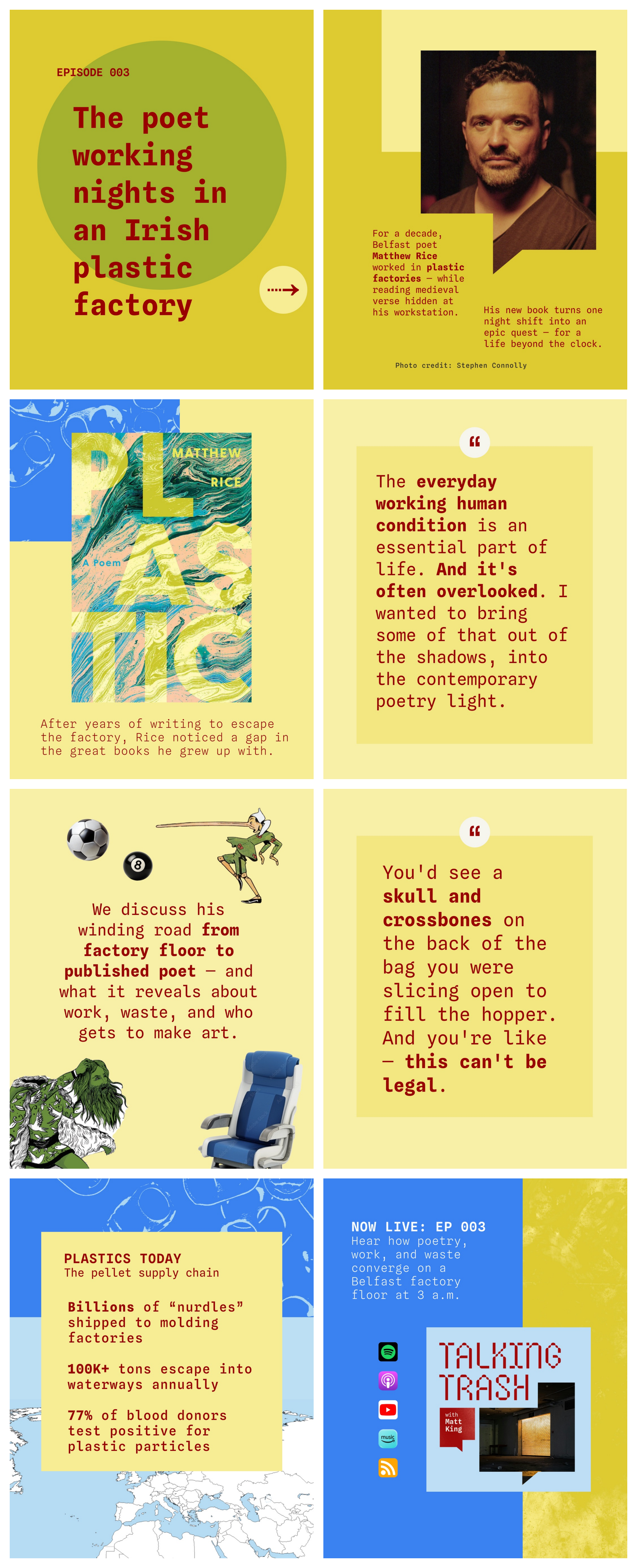
Episode 003 designs for Talking Trash | Art Director: Frances Miller
-
Matthew Rice: Anyone who's worked a 12-hour night shift, particularly in a factory setting or a warehouse — it does sort of feel like a strange journey. Especially when it gets to two and three in the morning. Strange things happen to the mind around those hours.
You would see a skull and crossbones on the back of the bag that you were slicing open, and you're like — this can't be legal.
I was writing my poetry to escape the factory.
Narrator (Matt King): Welcome to Talking Trash. I'm Matt King. That voice you heard belongs to Matthew Rice, a poet from Belfast who spent a decade working in factories and warehouses — many of them molding the plastic parts inside almost everything you own. In recent episodes, this show has studied the workers behind the waste we never see: the crews who cleaned up a river of toxic coal ash and then paid for it with their health; the hotel workers who took over an abandoned luxury tower. In his new book, plastic: A Poem, Rice takes us inside a single night shift, from clock-in to clock-out, each entry stamped with the time on the factory clock.
Matthew Rice: The factory in the book — it's an amalgamation of a variety of working experiences that I've had in different factories, warehouses, and even some offices. The inspiration for this book came from the factory floor, as in the omniscient factory floor — not necessarily one particular factory floor. But I did work in a number of plastic molding factories. So I thought that using that form — the fact that the plastic goes into a mold and comes out in a certain shape — I thought that would be an interesting way to look at the various forms throughout the book. And simultaneously, trying to explore how to project the chaotic thought processes of the worker, in real time, onto the page.
Narrator: Consider all the plastic objects around you: toothbrushes, forks, chairs, bottle caps, pens, TV remotes. Chances are they were all made through injection molding. The process traces back to billiard balls. In the 1860s, wealthy appetites for ivory were driving elephants toward extinction. The substitute was an early plastic, celluloid — plus a machine to shape it. The basic idea of injection molding has never changed: pellets pour from a hopper into a heated barrel, where a screw melts, then injects the liquid plastic — like a syringe — into a steel mold. Seconds later, pins push the part out, and it starts over.
Narrator: Once an injection machine is hot and running, the cheapest thing to do is keep it going — all night, every night. The machines don't sleep, which means neither can the workforce. And for a year, Matthew joined those 12-hour night shifts.
Matthew Rice: I had heard so many people would just get night shift, and they would just be sleeping all day, getting up, going to work at night, and then coming home, having something to eat, and going to bed — sleeping all day. You could start to see it in them. I didn't want to fall into that kind of routine. So I was determined to just continue living my life. I was still playing football — or soccer, as you guys would call it. I would get up around five, go down to football training at half five, train on my own for an hour, and then train with the team when they arrived. Then I would get a shower in the changing rooms and head to work for eight. And then I would go to the gym to do weights after a shift. Go home, have my breakfast — which was really my dinner — then go to bed.
But you always felt tired. I remember my girlfriend at the time was always saying, you know, the sooner you're off this night shift, the better. And I was like — what do you mean? Sure, we're still doing things at the weekend. She goes, I know, but you can just tell you're tired. She could just see it in me.
I didn't feel like I had much control when I was working night shift. Everyone else is going to the cinema and stuff at night, after being at work during the day — and I'm going to work.
Narrator: Exhaustion is one thing. But fatigue and stress could also lead to darker places.
Matt King: Especially in the first half of the book, there's a lot of death imagery — death is this subject that has a shadow over the setting. Sometimes literally: there are these accidents and incidents that happen. Is that something all the workers are thinking about? Or is that you, the poet's perspective, seeing it in this way?
Matthew Rice: Well, I can't speak for the workers. The workers in the book are fictionalized versions of various people that have inspired me in work settings over the years. My poems aren't all about death — but it definitely does rear its head quite frequently in my poems. I think the songwriter Noel Gallagher, from Oasis, was asked one time: if he doesn't believe in God, why does he write about him so much? And Noel Gallagher replied — because it's got the best imagery. There could be a similar sentiment for me, whenever I'm asked about death coming up.
But at the same time, there's a lot of urban legends flowering in factories. This guy killed himself on shift in this factory, or — a guy I went to school with did actually die of a heart attack when he worked in a factory. He was only about 18. So these are things that you take and use as inspiration, in a way, to pay homage to — I don't know — somebody out there in the universe. Because I'm sure that's happened to a lot of people. You're still referencing a real thing that happens.
Trying to pay homage to that, whilst also trying to tie it in with the seriousness, at times, of low-paid labor — the effect it can have on a worker's psyche. It certainly has affected me over the years, as somebody who does struggle with anxiety and depression. I'm not trying to make a big thing of it in the book. It's just what it is.
You sort of put a mask on sometimes, especially in those types of settings. It can be quite patriarchal. It's probably a little different now — I think now there's a lot of mental health programs in place, not just in office work but in blue-collar work. Maybe there's less of a stigma now. Ten, twelve years ago, it was like: just suck it up, basically.
Narrator: To survive those grueling hours, Matthew smuggled in a secret companion — a book he read across a series of night shifts, hidden at his workstation. A six-hundred-year-old poem about a knight on an impossible quest.
Matthew Rice: There's a constant refrain, a motif that runs through the book, of Sir Gawain and the Green Knight. And that's very important to the narrative of the book — because as the narrator is anonymous, so was the writer of Sir Gawain. We don't know who wrote Gawain. They're always just referred to as Anonymous. So Gawain becomes like a little avatar for the speaker. Sir Gawain and the Green Knight is an epic quest, and I wanted there to be an element of a quest in the book — because anyone who's worked a 12-hour night shift, it does sort of feel like a strange journey. Especially when it gets to two and three in the morning. People get weird. There's a bit in it where the speaker's talking about Pinocchio on Pleasure Island. You find yourself joining in with the most inappropriate jokes or conversations, because it's three in the morning, you're tired, and there's no one else around to hear you. Strange things happen to the mind around those hours. Then you come back out of it — the closer it gets to finish time, the sun starts to come up, and you start to feel a bit more human again. And you're looking forward to going home.
Narrator: By the deepest hours of the shift, even language starts to wobble. Here's Matthew, reading from the book's 3:20 a.m. section.
Matthew Rice (reading from plastic): Every factory has the same lexicon: cavity, barrel, latch, button, cycle, part, material, scales, spindle, cutter, drill, press, tool, pump, machine, nozzle, bench, bracket, store, shift, spanner, valve, timer, time, clock, run, break, program, swarf, dust, coolant, metal, plastic, purge. Which is to say my tongue moves aimlessly in its mouth.
Narrator: That final word — purge — is the factory's term for flushing old material out of a machine when an order changes colors. The mismatched scrap that pours out looks, as it happens, exactly like the cover of Matthew's book: a marbled blur of pink and blue hues mixing together.
Matthew Rice: I didn't have any input into the design — I was just offered two sets of color schemes, and I picked that one. But it's actually a very astute cover. It actually prompted me to write an extra section for the book, because it reminded me of when you're injection molding and you've been running a certain part in a certain color for a week, and then it comes a point to run the same part in a different color — you have to purge the original color out of the nozzle. So what you do is run the new color through, and run the parts as scrap. As the color is being flushed out, the scrap parts that come out have different colors that run together — that look kind of like that. I'm not sure if the person who designed the cover has experience of that. But if not, it was a good coincidence.
Narrator: A book about factory work, wearing its waste on its cover. When most of us think of a factory, we might picture an assembly line: raw material on one end and a finished product rolling out the other. But for most factories today, that's little more than an archaic cartoon. Modern manufacturing is atomized across continents and supply chains — each plant making one small piece of a product it will never see whole. The factory in Matthew's book makes the component pieces of the parts of an airplane seat.
Matthew Rice: It was just the — I guess you would call it the main base, that would cover up the inner workings of the seat. Protective and decorative at the same time, just to conceal the metal of the seat. And then also the tables, and the latches that hold your table up. And the armrests — I forget the technical name for the armrest — in their infant form.
Matt King: It made me think of these Marxist theories around the alienation of labor — when everyone gets chopped up into doing these little parts, you lose that connection to the actual object you're helping to make.
Matthew Rice: And there's also the tendency to reduce someone to the role. If you're a technician in a factory, people just call you the spark. Or if you're working in a packing area, you get referred to as a packer. Your name kind of — your identity is merged with—
Matt King: Whatever role you're doing.
Narrator: Writers have long been fighting that reduction. Marge Piercy's famous satirical poem described a secretary whose body has fused with her job — it opens, "My hips are a desk," and ends with her filed away in a cabinet. Toni Morrison, remembering her own worst job, wrote about the need to separate the work you do and the person you are. In the opening pages of plastic, Matthew cycles through a litany of actions: "I clock in. I throw down. I tool up. I obey. I stand. I lie. I outlast. I barely last." He refuses, though, to be overly romantic or nihilistic about the work.
Matthew Rice: The people who would supervise me in those jobs actually knew what they were doing. They were able to program a machine to produce a particular part. And then there were the engineers. Someone in China wanted them to make an actual mold, to produce a signature part that hadn't yet been created — for them to be able to attach it to some sort of mechanism they were manufacturing. So the engineers would program the CNC machines with a brand-new program, unique to this part, that they themselves had used these specs to come up with. And that to me was really impressive — I would never have been cut out for that. I was just basically a kind of lackey. I was just pressing the button on the machines, taking parts out, deburring them, packing them. Equally as important, because if there was no one to run the machines, it doesn't matter what program you put into it.
I did find some of the work therapeutic. I used to love just being presented with a thousand end caps that need to be deburred by Friday afternoon at one o'clock. I'd be like — happy days. Earphones in.
Matt King: What is it — you're listening to music, or—
Matthew Rice: Podcasts. Sometimes you weren't allowed to, but I'd just sort of put my ear defenders over my ears and pretend. There were little tricks you could do. To me, I find that very therapeutic at times.
Narrator: One of my first jobs out of college had a similar mindless routine. At an advertising-technology startup in New York, I was a one-man widget factory — screenshotting popular news websites, then Photoshopping our clickbaity ad units into them, one after another, over and over. Dozens, sometimes over a hundred in a single day. For me, it was propulsive music — indie, rock, punk, psychedelic — that kept me going. But that flow state can also distract from the physical toll of repetitive work. Mine left me with strained eyes, neck pain, and the first tingles of carpal tunnel in my early twenties. In an industrial setting, the risks and exposures are far greater — existing even in the air itself, whether or not you can see it.
Matt King: In terms of these hazards around the workplace — you also talk about the chemicals you're possibly breathing in there. You have that great phrase, "sad sci-fi fumes," at one point.
Matthew Rice: "Sad sci-fi fumes are a cure for hunger."
Matt King: Yeah. So I guess that's another kind of persistent danger that's lurking while you're there.
Matthew Rice: That's something I was constantly worried about, in any factory I worked in. Some factories had better ventilation systems than others — others just opened the window at the back of the factory. And then you would see a skull and crossbones on the back of the bag that you were slicing open to fill up the hopper, and you're like — this can't be legal.
If you were working with something like Tufnol, which is a fireproof, fiberglass-wood type thing, the dust would go up into the air. If there's a shaft of sunlight coming through, you would just see all the dust — a big shaft of dusty sunlight — which you wouldn't see otherwise, because it's so fine. You would have a dust mask, and some sort of wee Hoover-type thing to suck away the heavy stuff, but it never got rid of all the fine stuff that you ultimately breathe in. I don't know how well those dust masks were working — I was never really provided with a proper respirator, which would've been a lot safer. That was definitely a worry that I used to have all the time. Always worried about my lungs.
Narrator: And the plastic factory's waste doesn't just stay put. Those pellets pouring into the hopper — also called nurdles — ship by the billions to plants all over the world. Each pellet is tiny, light, and unruly. Along the way, they escape at every step: torn sacks at loading docks, containers lost overboard, spills hosed into storm drains. Researchers estimate hundreds of thousands of tons wash into waterways every year. And the nurdles that do get made — into the latch, the panel, the fork — outlive us, shedding into microplastics that turn up everywhere scientists look.
Narrator: If you read Matthew's book with waste in mind, you'll notice it's everywhere: scrap parts swirling out of the skip in a storm, metal shavings shoveled into bins between machine cycles, burning-plastic smells drifting through the night air. And yet the book never once uses the word "waste." The factory has its own vocabulary for everything it discards: purge, swarf, scrap.
Narrator: During those years inside the factory, Matthew was already becoming a working poet — placing poems in literary magazines, building towards a first collection. But at first, he refused to write about the place where he spent the majority of his waking hours.
Matthew Rice: While I was grateful to have the work — in order to pay the rent and give myself a few beer tokens at the weekend, and all that good stuff — I never felt that I could, or wanted to, write about my situation working in a factory. I had people like my dad and my stepmom and a couple of friends saying, why don't you ever write about work? And I just — I wasn't happy in the direction my life was going while I was in those jobs. I was writing my poetry to escape the factory.
Narrator: In 2013, while working full-time, Matthew enrolled in the Open University, the UK's great distance-learning institution. And his factory wages were so low that he qualified to do the entire degree for free.
Matthew Rice: I did my undergraduate degree in English language and literature, part-time, through the Open University. It was fantastic — I really enjoyed it. But it was hard work, because I was doing it part-time over six and a half years. It gave people like me — who didn't really do very well in school, or who could have done well in school but had no interest, didn't try — I got two GCSEs, two Cs, in English and history, without even trying. That was only because I was interested in those subjects. Suddenly I found poetry, realized that I had a passion for it, that I had developed an ability for it — and realized that I wanted to pursue something that would be more in line with my interest.
Six and a half years later — June of 2020, right in the middle of the pandemic. I'm on furlough; I've been laid off from the factory job I had then, and I got a bit of a payoff. I graduated from the Open University, and I thought: right, I'm going to apply to do a Master's. So I did a Master's in poetry at the Seamus Heaney Centre at Queen's. And while I was doing the Master's, I applied to do a PhD as well. That is where I had the idea that I could finally write about the factory, and about work — because I had that distance.
Narrator: Writing to escape was one reason Matthew kept the factory out of his early poems. But there was another one, too: the factory had hardly surfaced in most of the great literature he read.
Matthew Rice: While you could argue there's a tradition in America for the factory-worker poet — the likes of Larry Levis and Phil Levine and Fred Voss, and to an extent Charles Bukowski and Raymond Carver, people like that — there's no identifiable, comparable tradition in the north of Ireland. It's more rural stuff, more like farm work. So when I started doing research, I realized that I would be writing something that would be slightly unique.
I think maybe poets — like I once thought — just don't think that it has been a worthy subject for poetry. And I'm not putting words in anyone's mouth; I'm just speaking for myself here, of what I think might be one of the reasons why. Maybe they think that poetry needs to be on a grander scale — a grander subject. What I've tried to do with this book is to speak to the fact that the everyday working human condition is an essential part of life. And it's often overlooked. I wanted to bring some of that out of the shadows, into the contemporary poetry light, if you like. It's basically trying to transmit the performativity of a curious mind, and try and break down some stereotypes. Factory workers can also be art critics.
Narrator: Philip Levine's most famous poem, "What Work Is," drops you into a hiring line outside a Ford plant in Detroit — men waiting hours in the rain. Its hero turns out to be the speaker's brother, who works the night shift, then wakes in the afternoon to sing opera. In the counter-tradition Matthew inherited at home, Seamus Heaney, in "Digging," watched his father work the potato drills below their home window — and decided that his own spade would be the pen. Which brings us to Matthew's father.
Matthew Rice: He's lived in North Carolina for 27 years — so somewhere over there, he's shaking in his boots, wondering what stories I'm going to tell here about him. But my dad, Adrian — he's a very well-known poet. It's very strange, because for my generation, for a number of my friends over here, my dad was their inspiration to start to get into poetry. He used to do a lot of workshops in schools. His first book was called The Mason's Tongue — and Seamus Heaney gave my dad his first book blurb, which was a big deal. And then my dad and Seamus got to be very friendly. I never met Seamus as a kid, but I did meet very, very famous Irish poets: Paul Durcan, who's no longer with us, sadly. Michael Longley, also no longer with us. Tom Paulin, whose new book has just come out — which is a fantastic piece of work. I was aware of these people as a child, but never appreciated them.
I think my dad seeded my interest in creative writing. When I was a child, I used to write a lot of poetry and short stories, paint a lot of pictures, and read a lot. And then puberty hits, and you fall out of that. And then in my mid-twenties, I rediscovered poetry — and realized, oh, I don't just admire this art form. I actually want to do it.
Matt King: I could imagine the son of a very successful poet feeling pressure to become a poet, or to do something with writing.
Matthew Rice: I think that's testament to my dad, that he never put pressure on me. But whenever I showed interest, he encouraged me — and he still does that. He's my first reader, 90 percent of the time, as well. His influence has not been insignificant.
Narrator: The passion was there in Matthew as a kid — and then it went dormant for twenty years. There's a poem in the book that describes this peculiar grief.
Matthew Rice (reading from plastic): Clocking out, a photo of me drops into my phone. Whatever happened to this bow-tied little dreamer? Three years old or thereabouts, hair all blond and ringlets, hand in pocket, heels together, ten-to-two, and who knows who I wanted to be in that past whose future never came.
Matt King: There's one point in the book where you're on a flight, and you realize the seat you're in includes parts from the factory where you—
Matthew Rice: That's a true story.
Matt King: —worked. But then the punchline is, you can't escape.
Matthew Rice: Yeah. I just shook my head, laughing. It was like — there's me on holiday, trying to get away from work, and there's work. I'm sitting on it. I'm sitting on work. But there was something kind of endearing about it too, because I knew that my hand had probably touched that part at some point. Whether it was pouring the wee material balls into the hopper, whether it was running the machine, taking it out, deburring it, or whether it was labeling and packing it, or even putting it on the pallet to be shipped out — my hand probably touched most of those parts on that plane at one point. So it was bittersweet. I was sort of saying to my mates, you know — here. I did that. I deburred that.
Matt King: Yeah — I don't know if it's quite pride, but... I mean, this is hard work.
Matthew Rice: Yeah.
Narrator: These days, literature has eclipsed the factory as Matthew's main occupation. He finished his PhD at the Seamus Heaney Centre. He reads at festivals across Europe. And his new day job is at a Belfast organization called Voicing the Void.
Matthew Rice: Working with marginalized groups and communities, and refugees, and people who've experienced abuse — helping them to tell their stories. So that's quite in keeping with my ethos as well. While the factory was serving an immediate purpose, my journey has taken me to a point where I feel like it's a purpose beyond me — which is a little bit more fulfilling. And I'm always careful to say that: it doesn't mean that I think I'm doing something better than somebody who works in the factory. All I'm saying is, it's more in line with what my passion is.
I've kind of learned to stop apologizing for it, is what I'm trying to say — for wanting to plot a course out of what was essentially, for me, given my circumstances, dead-end jobs. But it did take a lot of work. It was 12 years of study, as well as six and a half of those years working full-time in factories. I like to think I've paid some sort of dues.
Narrator: Matthew spent a decade running machines that turn liquid plastic into all kinds of forms. Now he sits with people whose stories have no shape yet — and helps them find one in words. His new book, plastic, begins outside the factory gates, before the night shift, with a kind of quiet prayer.
Matthew Rice (reading from plastic): Just as accidents wait for boredom, as illness waits for health, as comfort waits for unemployment, and salary cuts for wealth, so may I, driven to the industrial gate, look for the treasure buried in my father's field.
Narrator: Many thanks to Matthew Rice for inviting us along on his epic journey, from wandering night-shift worker to accomplished poet and teacher. His book is plastic: A Poem, out now from Fitzcarraldo Editions in the UK and Soft Skull Press in the US. For more on Matthew's poetry, the writers who inspired this conversation, and how injection molding shapes our world, check out our full episode page at talkingtrashpod.com.
Narrator: You can support Talking Trash by hitting subscribe in your favorite podcast app. And wherever this found you — the commute, the gym, or your own version of the night shift — send it to the one person who came to mind while you were listening. It's been fun having you along. See you next time.
