
Ep. 002: How Argentinian workers took over an abandoned luxury hotel
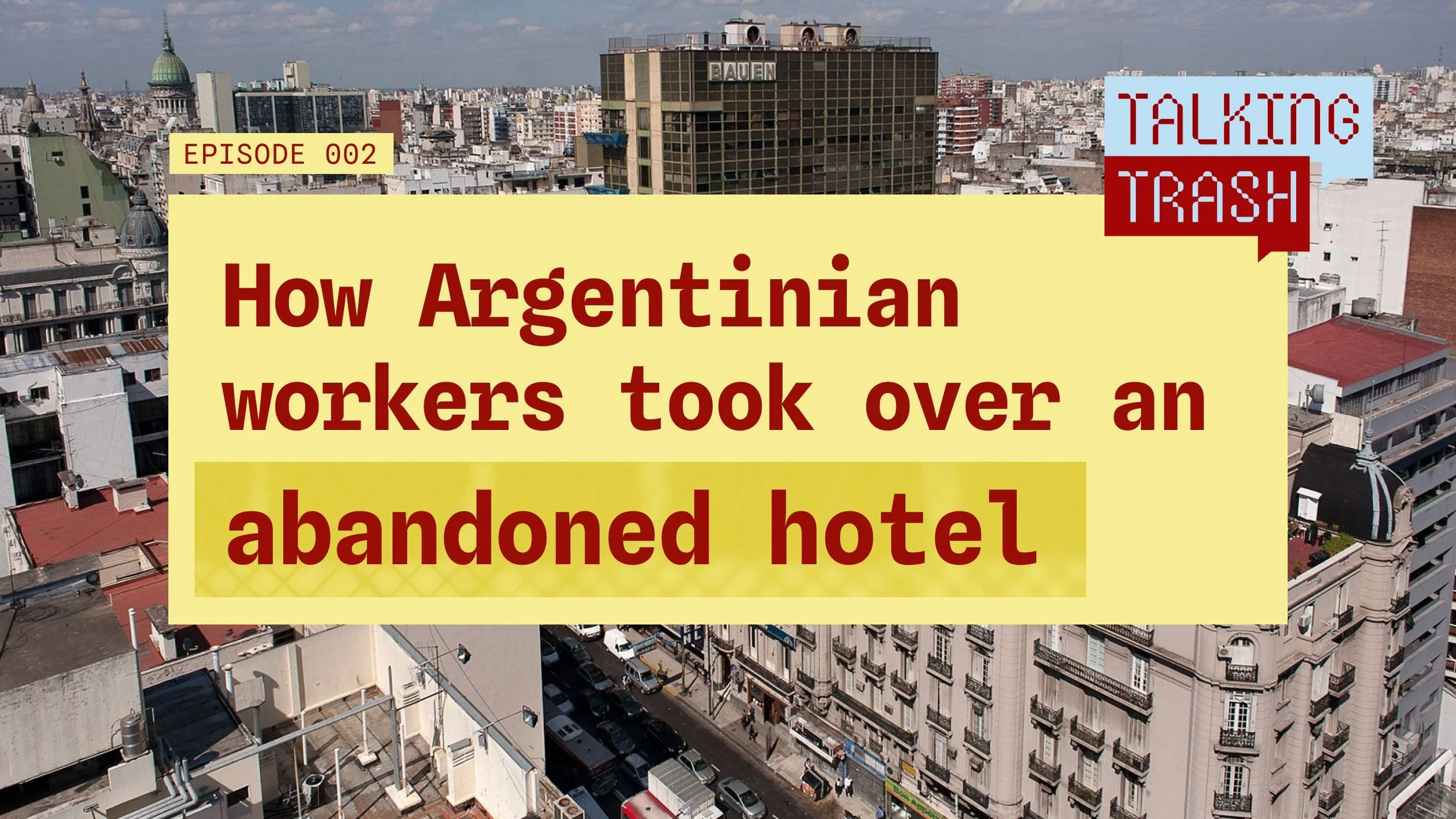
Cover art for Episode 002 on Argentina’s worker-owned businesses.
A 20-year experiment in salvaging what our economy discards — a shuttered hotel, reclaimed by workers, and why it matters now.
In March 2003, a group of former employees walked up to a dark, abandoned luxury hotel tower in the middle of Buenos Aires, broke a single padlock, and slipped in through the basement. They weren't there to loot the place. They were there to reopen and run it themselves.
For nearly two decades, they succeeded — running the twenty-two-story Hotel Bauen as a worker cooperative, with no owners and no bosses. This episode of Talking Trash tells the story of how they pulled it off, and what a five-star hotel in Argentina can tell us about a much bigger question: what happens to the buildings, businesses, and workforces that our systems decide to discard?
Our guide is ethnographer Katherine Sobering, author of The People's Hotel: Working for Justice in Argentina (Duke University Press, 2022), and an assistant professor of sociology at the University of North Texas. To understand the Bauen, she didn't just interview its workers over the course of a decade — she worked there herself, rotating between departments, and drinking more yerba mate than any person should.
Built for the World Cup, while masking a violent dictatorship
The Bauen was one of the hotels built to welcome the world for the 1978 World Cup — a tournament Argentina hosted and won at home, its first championship ever. It was a glittering arrival on the world stage: seven lounges, two restaurants, an auditorium, a pool, a nightclub, all draped in dark glass.
But the glamour had a dark foundation. At the time, Argentina was in the throes of a violent, US-backed military dictatorship that "disappeared" more than 30,000 people in five years — many of them organizers, labor activists, and dissidents. The regime wanted to clean up the city and impress the world for the games, and it backed the construction of hotels like the Bauen to do it. As Sobering puts it, the building was at once a luxury destination for international tourists and a monument to authoritarian power.
That origin turned out to matter enormously. The hotel was built with a state loan the original private owners never repaid — a detail the workers would later use to argue that a building financed by public money, and never paid back, belonged, in some sense, to the public.
Listen: Apple Podcasts, Spotify, Amazon Music, RSS
The rise of Argentina’s recuperated-business movement
Through the 1990s, Argentina deregulated its economy, manipulated its currency, and rewrote long-standing labor laws. By 2001, it all converged into one of the worst economic collapses of the modern era. Roughly 40% of the population was unemployed or below the poverty line; most people were locked out of their own bank accounts.
Out of that collapse came a movement: “empresas recuperadas” – worker-recuperated businesses. Across the country, workers whose employers had shut down began reopening those workplaces and running them themselves, this time without a boss. Factories. A hospital. A school. And, in the heart of downtown Buenos Aires, a luxury hotel.
The Bauen had been hollowed out for years before it closed. Owners subcontracted work, changed their name to strip workers of seniority and dodge taxes and labor obligations, all while smuggling profits outside the country. When it finally shut its doors in 2001, about 70 workers were left, down from hundreds at its height. They walked out assuming that was the end. Then the movement found them.
Sharing the work a hotel is designed to hide
Taking the hotel back was only the beginning. What made the Bauen remarkable was the democratic architecture that workers chose to run its everyday operations.
Members rotated through the hotel's departments rather than staying locked into a single role. The idea was that no one should be permanently stuck with the hardest or lowest-status work — and no one permanently above it. Sociologist Rosabeth Moss Kanter asks, “In utopia… who takes out the garbage?” At the Bauen, the answer was that everyone did it, in turn.
That job rotation was tied to an even more radical choice: everyone was paid the same. That said, there were democratically approved variations for things like overtime, back-to-school expenses, or long tenure. And because pay hovered near minimum wage, the co-op built other systems to support members — a time bank, emergency credit, and bulk-buying that passed grocery savings along — what Sobering calls "survival finance.”
These principles were the co-op's way of dismantling the hierarchies that most workplaces take for granted, where the labor we call "unskilled" is valued least, and paid less accordingly. At the Bauen, the argument ran the other way: without every job, the hotel doesn't function — so every job, and every person doing it, counts the same.
As a built environment, Sobering observes, a hotel is designed to make certain things visible and certain things invisible. There’s the polished lobby that welcomes guests, and behind and beneath it, the hidden spaces that keep the business running. At the Bauen, trash moved down through the service elevators to sub-levels and out through tunnels. The laundry — which hotels generate an enormous amount of — sat at the very top of the tower, above even the ballroom with its 360-degree views, reachable only by a set of stairs.
Another thing hidden? A daily social ritual that proved essential to Katie's fieldwork: the mate break. A shared gourd of loose-leaf, highly-caffeinated tea, passed hand to hand and refilled from a thermos. It was too informal to happen in front of guests, so it circulated in the break rooms, the back offices, the spaces behind the reception desk. It was there people talked freely, and Katie learned the ins and outs of the workplace, while battling sleep problems.
Building equality, from Buenos Aires to Baltimore
Working at the Bauen changed people, often in ways they never expected. Members who'd been apolitical or comfortably middle-class before the crisis became deeply invested in the co-op's mission, and one worker who hadn't finished elementary school was elected to a seat on the administrative council, bringing his daughter to work to see what he'd become. But Sobering is careful not to make it a fairy tale: some people took the job and quit, meetings were often dominated by overpowering veterans, and the job rotation had limits that broke down along familiar gender lines. It was far from a realized utopia.
She studies the Bauen as an "equality project": an organized, deliberate, imperfect effort to build more equal relationships inside a workplace. The word project matters: to project is to throw something forward, into the future. Equality, in her telling, isn't a thing you find lying around and protect; it's something you imagine first and build toward, knowing you might not arrive. And it points to a real gap in the research, she notes — we've studied inequality exhaustively, but spent far less effort on the opposite question of how to proactively build equality. Hotel Bauen is one imperfect, time-bound answer.
After running as a cooperative for the better part of two decades, the workers couldn't finance the building's mounting repairs — and in 2020, a state-mandated, COVID-era closure shut the doors for good. The cooperative outlived the address: some members went on to start a café nearby, and the recuperated-business movement continues, with roughly 400 worker-run businesses operating in Argentina today and some 15,000 people involved.
Around the world, as downtowns struggle and a generation of small-business owners retire, the same question surfaces: when an owner walks away, who inherits what’s left? I first discovered Katie’s book at the worker-owned Red Emma’s bookstore and cafe in downtown Baltimore, which has proved this model can work for over two decades running. In recent years, local stores like The Wine Source and Common Ground Cafe have seen workers buy out retiring or negligent owners. The Bauen's workers had to break a padlock to get there. Others can start a conversation with owners, while the door's still open.
When I raised these examples, Sobering pointed to a much larger shift — what economists call the "silver tsunami." Roughly half of America's small businesses are owned by people over 55, and by some estimates more than two million of them will change hands over the next decade as their founders retire. Many have no succession plan, no interested heir, and no obvious buyer — which means the default outcome for a huge number of beloved local businesses is simply to close, or to be absorbed by a chain or a private-equity roll-up.
But inside that looming loss is a rare generational opening: the people who already know how to run these businesses — and who've produced their value, shift after shift — have a real shot at finally owning the value of their labor.
Additional resources
If this episode left you curious to learn more, start with Katie’s book and the documentary work on Argentina's empresas recuperadas movement. Then, dig further into reporting on the American co-op wave and fights over abandoned buildings around the world. Most importantly, use the directories below to support worker-owned businesses near you that are keeping profits within the community.
READ
Katherine Sobering’s The People's Hotel: Working for Justice in Argentina (Duke University Press, 2022) — the ethnography this episode is built on.
The University of Buenos Aires Open Faculty Program, whose researchers have documented the empresas recuperadas movement for more than twenty years.
The Georgetown Journal on Poverty Law & Policy on "Riding the Silver Tsunami in Pursuit of Economic Democracy" — connecting baby-boomer retirements, inequality, and worker cooperatives.
In These Times on "The Baristas Who Took Over Their Café" and the Baltimore Beat on "the abrupt closure of Baby's on Fire" — a tour of one American city's growing co-op ecosystem, from Red Emma's to Thread Coffee, Taharka Brothers, and Mera Kitchen Collective.
WATCH
DiFilm's Hotel BAUEN, Taken Over by Its Workers (2006) — a news report filmed inside the occupied hotel, with archival footage of the workers who took it over.
Avi Lewis and Naomi Klein's The Take (2004) — a documentary following Argentina's worker-recuperated factories in the wake of the 2001 collapse.
Denise Zmekhol's Skin of Glass (2023) — a documentary on an abandoned São Paulo glass tower, designed by her own architect father, occupied by homeless families — where seizing an empty building was legal, housing being a constitutional right in Brazil.
ACT
Find and support a co-op near you. workerowned.info maps worker-owned cafés and restaurants by city, and the U.S. Federation of Worker Cooperatives directory lists hundreds more nationwide — spending your money at one is the lowest-effort way to back the model.
Help a retiring owner sell to their workers. Project Equity guides business owners through employee buyouts — a first stop if you know a local business facing the "silver tsunami."
Learn how to start or convert a co-op. The Democracy at Work Institute offers national tools and resources for launching a worker cooperative or transitioning an existing business into one.
Back the incubators doing local work. Groups like the Baltimore Roundtable for Economic Democracy (BRED) seed and support worker co-ops city by city — a model for what a local cooperative ecosystem can look like.
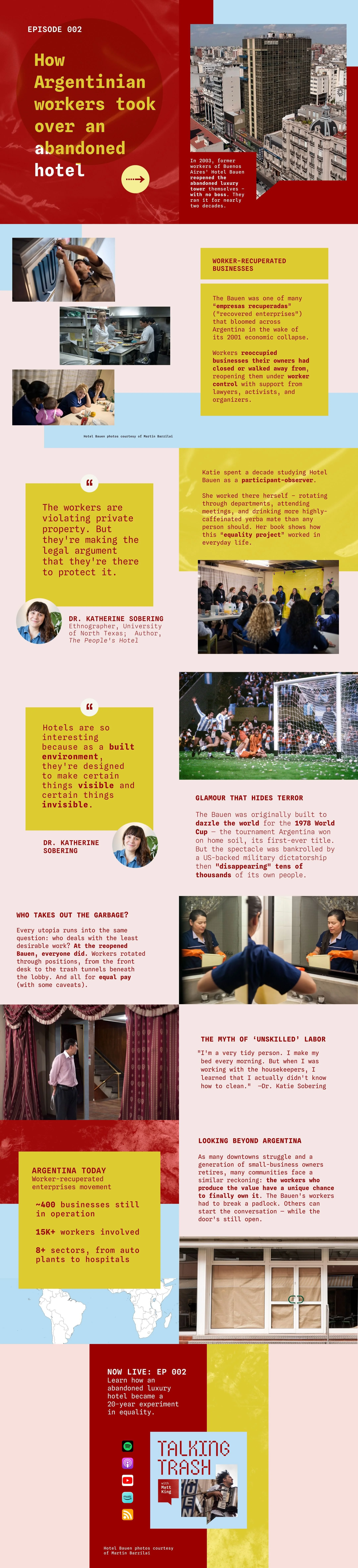
Episode 002 designs for Talking Trash | Art Director: Frances Miller | Photography courtesy of Martin Barzilai: https://martin-barzilai.com/
-
Katherine Sobering: The workers broke into the hotel. They broke one padlock and entered through the basement. It was a time when occupations were happening all over the country, so they expected the police to come. They're violating private property — they're not the owners of this building. But on the other hand, they're making the legal argument that they're there to protect it.
Narrator (Matt King): At one point, Hotel Bauen was among Argentina's most luxurious destinations. It was built to dazzle international visitors when the country hosted the World Cup in 1978. But years later, after its owners left it dark and abandoned, the workers walked inside to take it back.
Welcome to Talking Trash. I'm Matt King.
This is a show about the waste we never see, and the systems that shape our lives. Usually that means the toxic messes industry leaves behind. But waste isn't always a substance. Sometimes it's a whole building, a workforce, a piece of prime downtown real estate that owners simply stopped caring about.
Today, many downtowns in America are still struggling, even years after the pandemic. Storefronts papered over, office towers half empty — all while these same cities face historic housing shortages. We have the space and the need, yet these properties sit there useless. What if there was a way for people to reclaim these abandoned structures to solve our biggest social problems?
My guest this episode is Dr. Katherine Sobering, an ethnographer who spent 15 years studying one such case: Hotel Bauen, a luxury hotel in Buenos Aires that its own workers seized, reopened, and ran themselves for nearly two decades.
[Mashup of news clip coverage]
Narrator: In 2001, Argentina came apart in one of the worst economic collapses of the modern era. The government froze people's bank accounts. The streets filled with protestors banging pots and pans.
Katherine Sobering: Argentina experienced this hyper-capitalist moment where they were deregulating their economy, manipulating their currency, and changing labor laws that were very long-established in that country — that all built up throughout the nineties into this kind of massive crisis period.
Narrator: Katherine is the author of The People's Hotel: Working for Justice in Argentina. The book combines ethnographic and archival research with her own experiences working at Hotel Bauen years after this collapse. She teaches at the University of North Texas, where her research more broadly examines how inequality is produced and disrupted in everyday life.
Katherine Sobering: When you think about like 40% of people becoming unemployed, living below the poverty line — it's just hard to wrap your head around. Or the majority of people in the country being locked out of their bank accounts. Like, what would happen here if we went to the ATM and it was like, nope?
So in these sort of extreme moments, people were like, what do we do? And they took to the streets. And I think that also pushed people to rely more on their communities — to develop alternative currencies, to barter, to share, to collectivize things. Like, what else are you gonna do if you can't support your family?
Narrator: Out of that collapse came a new movement: empresas recuperadas. Worker-recuperated businesses. Across the country, people whose workplaces had shut down began to reopen them — this time without the boss. Factories, a hospital, a school, and a luxury hotel.
Katherine Sobering: Argentina was in the middle of a military dictatorship that was backed by the US at that time. And unlike some countries around the globe that had military dictatorships, in Argentina it was particularly violent. In five years, social movements estimate that over 30,000 people were disappeared — taken off the streets and pretty violently treated and murdered. These are people who were speaking out against the dictatorship, people who were organizing, labor organizers. It was a really dark time in Argentina's history.
And it overlapped with the country hosting the World Cup. What the leaders wanted to do was clean up the city, prepare for this big international event. So they started supporting the construction of hotels like the Hotel Bauen, and other places in the city where the World Cup would happen.
Narrator: A 22-story, five-star hotel draped in dark glass. Seven lounges, two restaurants, an auditorium, a pool, and a nightclub — all built with state loans at the end of the 1970s. Katie's book sits with the contradiction of this building: a glittering symbol built to welcome the world, financed by a dictatorship that was disappearing thousands of its own people. That state-backed financing matters because of what the workers would later discover.
Katherine Sobering: What they come to find out is that this loan that was given to the original owners was never paid back. The National Development Bank that gave it dissolved. There's a murky paper trail of how that property was financed, which helped over time the collective that was working in the Hotel Bauen start to articulate a case to expropriate it — because it was built using public funds that were never repaid.
Narrator: Over the years, the previous owners had changed names multiple times to avoid paying taxes or complying with full labor rights. At the same time, they were smuggling profits out of the country while hollowing out the hotel from the inside.
Katherine Sobering: Pieces of the hotel were subcontracted out. The company changed the name of the organization a couple of times so that long-time workers would lose their seniority — all these kinds of mechanisms to input precarity into the workforce there. So by 2000, there hasn't been the needed investment in the hotel. The subcontracting and precaritization of the workforce has left sort of a skeleton staff. And in 2001, at the surge of these social protests, when hundreds of thousands of people were flooding the streets, the hotel closed.
When it closed, there was something like 70 workers left. At its height it was employing hundreds of people. So it had been declining over those last couple years.
Narrator: So the workers walked out of Hotel Bauen, assuming that was the end of it. But it wasn't long before the recuperated-business movement found them.
Katherine Sobering: At this time, this movement is surging — other workers who are assessing the fact that our workplaces are now closed, they're abandoned, and we're left jobless. What do we do? In Argentina, this is called the movement of worker-recuperated businesses. Empresas recuperadas. There's a movement forming of lawyers and activists and supporters. And it was folks from this movement that contacted former workers of the Bauen.
Not everyone was into it, but enough people were. Almost everyone I talked to, when they lost their job at the Hotel Bauen, had a really hard time finding another job. Some people retired early — it was a difficult economy to enter. And I think some other people in that group were interested in the possibility of contributing to these movements that were coming out of these big protests. Like, how can we respond?
Narrator: As former workers compared notes, they stumbled across some disturbing details.
Katherine Sobering: It took months of planning, obviously lots of conversations with lawyers. At the same time, people who had been fired are discovering inconsistencies in their pay. One of the people I talked to went on for a while about how her retirement hadn't been paid properly to the state — like her pensions. There were all sorts of things that people found out that were making them feel less and less good.
Narrator: So in 2003, they decided to break back into the hotel.
Katherine Sobering: There were lawyers there. Part of the argument was around looting. People had been observing the owners taking stuff out of the hotel — and during bankruptcy negotiations, you're not supposed to do that. It wasn't just any items; they were taking out the most valuable items. So when the workers occupied the hotel, they said, we're here to keep this space safe during these bankruptcy proceedings.
So one of the interesting points that these workers experience over and over again is that, on the one hand, they're violating private property. They're not the owners of this building. But on the other hand, they're making the legal argument that they're there to protect it. In the book, I call it a legal gray zone — because it's this very confusing place to be, where on one hand you're violating the law, and on the other hand you're making the argument that you're upholding it.
Matt King: I don't want to go too much into "could this happen in the US," but — I don't know, if there was an abandoned hotel in downtown Baltimore, would a legal argument like that even stand a chance? Or is the way we prioritize private property here so much more intense?
Katherine Sobering: I think it's really interesting to talk about, because the laws around expropriation between the US and Argentina, they're not exactly the same, but they're pretty similar, actually. And the US expropriates land all the time. We could use the example of the border wall — something that's especially contentious in Texas right now. People across the political spectrum in South Texas are not okay with the way that land is being expropriated for this end.
Of course, this is not the state expropriating your land — this is a collectivity doing it. But there are examples of this in our history as well.
Narrator: So the workers are back inside. They've reopened a five-star hotel they don't legally own, financed by a debt its original owners never repaid. And now they have to run the place themselves, with no boss, all under constant threat of eviction. It helped that the hotel straddled a major downtown intersection — any attempt by police to throw the workers out would happen in full view of the cameras and passing public.
The early waves of guests that followed were an eclectic crowd: international tourists, artists, intellectuals, and workers' rights activists, drawn as much to the hotel's radical project as to a room for the night.
The highest authority became a workers' assembly — one member, one vote — though in practice it was much messier: long meetings, dominant veterans, members wary of crossing the council.
Katie first visited the hotel in 2008, and she returned year after year, for the better part of a decade, watching the collective swell from around 30 founding members to a peak of roughly 160 by 2013. During this time, she also joined their ranks.
Katherine Sobering: I'm a sociologist. I'm trained as an ethnographer. So what this means is someone who goes and collects data by observing how people actually talk, walk, behave in real life. You're a participant-observer. I spent multiple visits getting to know people, learning about the hotel, attending events, sitting in the lobby for long periods of time, in the cafe. But at a certain point I was like, this is pretty limited. If I want to do an ethnography of this hotel, I need to participate — and the way that people participate here is by working in this cooperative.
Narrator: In the years after the takeover, Hotel Bauen had become somewhat famous in certain news media and academic circles — its story told so many times it hardened into a script.
Katherine Sobering: The first couple times I was in the Hotel Bauen, there was a group of people who had been charged with talking to the press, talking to students, talking to politicians, talking to the lawyers, and helping coordinate their campaign. I would read my interview transcripts, and then I would read an article in the newspaper, and I'd be like, oh, that's very similar. They were telling these stories in a way because they had also been told before — and this is no judgment. They told the story in the same way because it was really provocative. It was compelling.
And also I wanted to know how the organization operated in its everyday manifestations. I was incredibly nervous at the beginning to ask. I didn't previously have any experience in hotels. I also had never worked in Argentina, so there were layers of reasons why I was like, certainly, I'm the most unqualified person who's ever asked to work here. But I asked the workers, and we negotiated the terms of what that would look like. We plotted a scheme for me to rotate between all the different sectors in the hotel. I ended up spending a couple weeks in each sector — I worked in housekeeping, the reception desk, events, sales. I worked with the council members, I worked in administration, in the laundry.
Narrator: That kind of movement between jobs wasn't special treatment for a visiting researcher. It was how the cooperative worked. Members rotated departments instead of being fixed into one role. But Katie also found that rotation had limits.
Katherine Sobering: There were some dirtier jobs that I noticed they were less excited for me to do. I had to ask multiple times to be rotated into maintenance — and I actually didn't formally rotate into maintenance ever. It was a fully male-dominated sector. Most new members who identified as women were hired into housekeeping, and most new members who were men were hired into custodial services.
Once people got into the cooperative and they had the ability to rotate jobs, there was a lot more movement. And — I feel kind of silly for saying this — I didn't really realize that the cooperative already had this job-rotation scheme when I made this proposal.
Narrator: This job rotation was tied to an even more radical choice, about pay.
Katherine Sobering: In the Bauen cooperative, they also made the choice to pay people equally. And they were very open about that. All the compañeros, all the people who are members of this cooperative, are paid the same. For a variety of reasons, that was central to reasserting that everyone is valued the same — materially, in terms of how much you're paid, but symbolically, in terms of how we're talking about the contribution.
Narrator: Equal pay didn't always mean identical paychecks. When Katie dug into the actual numbers, she found deliberate variations.
Katherine Sobering: I was super fascinated with, what does equal pay look like? Show me the spreadsheets, show me the pay stubs. And one of the things that I found was that there were actually all sorts of pay variations that had been democratically approved by the cooperative over time. These pay differences are things that the cooperative had collectively determined to be fair. If you worked overtime, you got paid more — you put in more hours. At the beginning of the school year, people with kids got a little bonus, because they had more expenses with back-to-school stuff. And if you were a founder of the cooperative, if you'd been there for a long time, they thought it was fair to acknowledge those people financially.
Narrator: As people rotated jobs, from housekeeper to manager, it raised deeper questions about what's considered "skilled labor."
Katherine Sobering: One of the things that I talk about a lot in the book — in the chapter on job rotation — is how they really pushed back against this idea that there was such a thing as unskilled work. And it was something that, when I put my body next to people and worked alongside folks, I realized there was a lot of stuff that was harder than I expected.
For example, I'm a very tidy person. I clean my house all the time. I make my bed every morning. But when I was working with housekeepers, I learned that I actually didn't know how to clean. Cleaning in a hotel has a completely different routine. You use different tools, different processes for how you use different chemicals and cleaners, how you make beds — because the sheets are different. It was a whole process of relearning how to clean in a hotel. And that really underlined for me the skill that's required for jobs that we sometimes see as unskilled, or less skilled, or less valuable.
Narrator: In most corporate environments, that label — "unskilled" — becomes its own justification.
Katherine Sobering: These narratives around what is skilled and what is unskilled work relate to pay. Oftentimes, these hierarchies of jobs are used to justify hierarchies of pay. The whole point of the job rotation was part of this radical revisioning of what's important in an organization. It was very common to hear people say, we're not gonna have people come here if the hotel's dirty.
Narrator: If people don't have a good stay, then they're not gonna have an event there. These discourses about the interconnection of all these different types of hospitality work were doing the cultural work of revaluing different types of jobs.
Everyone's pay was relatively equal, but it also wasn't much higher than the country's minimum wage. At a time when nearly one in four adults were unemployed, that's still a major achievement. But the co-op also found additional ways to support its workers, beyond a paycheck.
Katherine Sobering: I also found that they had all sorts of interesting schemes around supporting their members. It wasn't just take-home pay — they also paid people in time. They didn't call it a time bank, but people would contribute and then be compensated in non-monetary ways. They also offered access to credit, like an emergency-credit type of thing. And they had spent so much time negotiating good rates for their food for the cooperative that they were like, why don't we pass on these savings to our members? I think for a lot of people that made a big difference.
Narrator: In her chapter on job rotation, Katie opens with a line from sociologist Rosabeth Moss Kanter. It's the question every utopia eventually runs into: who takes out the garbage?
Katherine Sobering: Hotels have a lot of waste. There's a lot of trash. You walked into this lobby, and then you went down a level. Underneath the hotel there were all of these sub-levels and tunnels — the ways that you get trash out without having people see it. There weren't trash chutes on each floor; people brought the trash down in the service elevators to the lower levels, the sub-levels of the hotel, and then it was dealt with.
And the laundry — because hotels create a ton of laundry — was also up top. You go to the very top of the hotel; you can't even get there from the elevator. You take the elevator as high as it goes, and at the very top there was a ballroom that was beautiful, with these 360 views of the city. And then you keep going up, and the laundry was on top of that.
Matt King: Was that stairs to get up from the ballroom to the laundry area, or was there some other little elevator?
Katherine Sobering: No, it was stairs. I ended up walking up and down flights of stairs a lot. I didn't want to use a regular elevator, which were being used by paying customers, and I didn't want to use the service elevators that folks were using for transporting sheets and things like that.
Narrator: Another thing kept out of sight? A daily ritual in Argentina that proved essential to Katie's fieldwork: the matebreak.
Matt King: It comes up a few times, and there's some guilt around it — like, we're kind of drinking this when we shouldn't be. Is it like someone having coffee on a break in a US office, or is there a different culture around it?
Katherine Sobering: That's such a good question. For those who are not familiar with the way people in Argentina drink yerba mate — it's a loose-leaf tea, poured into a little gourd with a metal straw in it, and you have a thermos filled with hot water. It's highly caffeinated and it's social. If there are people around, you pour more water in and you pass the mate. People in this cooperative drink mate a lot. Because it's social and informal, it wasn't something you would do in front of customers or clients, so it usually took place out of sight.
Hotels are so interesting because, as a built environment, they're designed to make certain things visible and certain things invisible. We talked about how the trash is taken out through tunnels. A reception desk is very visible, and then there's an office to go into behind it. So mate was often shared on breaks, kind of out of sight. It circulated at all the meetings. And I was very caffeinated — sleep became an issue.
Matt King: Your caffeine tolerance went off the charts.
Katherine Sobering: I spent a lot of time going into meetings. Whereas someone who worked in the cooperative might go to one meeting a day, I would go to more — and so I would have more mate. I was looking for spaces where people were talking informally, which would lead me to the places where folks were drinking mate. But it's definitely a bonding experience. You can put all sorts of little things in it — sugar, other herbs. I always had to watch out for the people who were putting digestive herbs in the mate, because you want to know what you're signing up for.
Narrator: I wondered what it does to a person to work in a collective like this. Katie kept meeting people whose lives and worldviews had been reshaped by Hotel Bauen, often in ways they never saw coming. Two of them stuck with me.
Matt King: Pilar worked at the hotel with the previous owners. In that past time, when she would see a protest on the street, she would maybe think of it as a nuisance. Luis is this character who, before he joins the cooperative, is interested in finding a good-paying job, nice consumer goods, nice labels on his clothes. And both of these characters go through a transformation while working at the co-op, where they become quite invested in this radical mission.
Katherine Sobering: It was an incredibly powerful shift — powerful for them personally, but also uncomfortable. They were both pretty honest about how, before, when it was a luxury hotel, when they were rising middle class, they bought cars, they went on vacations. They didn't feel any sort of solidarity with labor organizers or protesters. That wasn't their position in society at all. So it was a pretty significant change for them to be unemployed when they lost their jobs in the hotel, to be occupying a business, to not have the financial means to support their families.
But I think that kind of contrast was not something unique to them. A lot of people in Argentina had an awakening. They became involved in 2001 in a way that they hadn't been before, because they needed to — they had to survive, or they wanted to support their neighbors.
Matt King: These personal transformations extended beyond just politics. Many workers found in the co-op a rare ladder for social mobility.
Katherine Sobering: There was one member of the cooperative that I spent quite a bit of time with, who had been elected into a pretty important role in the administrative council. And he hadn't finished elementary school. He didn't have a lot of formal education. He was obviously a very motivated, energetic, smart person who wanted to be involved in things — and he wouldn't have had the opportunity, because of his lack of credentials, to do the things that he did in this cooperative. When I talked to him in private — tell me about your experience, tell me what this kind of thing means to you — he's like, I know I work harder, I know I have so much more to learn in this place, but look what I can do. This particular member would bring his daughter to work, and she would see him, and that was so much different than what would've happened before he was working in this cooperative.
And some people took the job and didn't like it, and they would quit. I also don't want to romanticize it and be like, oh, it was so good, everyone loved it and they stayed forever. That was not the case. Personalities, preferences, all sorts of things played out in this cooperative.
Narrator: Before the original Hotel Bauen closed, someone like Pilar had what looked like a good job — a steady paycheck at an upscale hotel. But Argentina's economic collapse revealed the precarity hiding underneath that perceived affluence. What replaced it was a smaller paycheck, but a larger idea of what a workplace and a community can do for its people: the job rotation, the equal pay, the credit lines, the discounted groceries, the chance to become someone new.
Katherine Sobering: In the book, I talk about it as a case of what I call an equality project. I define that as an organizational effort to create relations of equality between people. And the obvious question is, what is equality? I make the argument that it's locally defined — we determine what is fair and unfair, what is equal, by our assessments of the world around us.
And so I think that in that way, it goes beyond a worker cooperative. It goes beyond Argentina. We can study almost any organization as an equality project. There's a lack of scholarship, a lack of attention, a lack of consideration on: how do we create more distributive processes in businesses? How do we more broadly share profits rather than keep them? If we flip these common questions about inequality, I think we can open up a lot of generative spaces to think about — how do we do better? How do we support each other in a way that contributes to the group?
We have this imaginary of what businesses are. A lot of times it's very entrepreneurial, very capitalist, very profit-oriented. But when you actually pay attention, there's an incredible variety of businesses around us — and a lot of opportunities for people who want to support those sorts of things with their resources, or participate in them with their time.
Narrator: We've studied inequality exhaustively — measured it, mapped it, written libraries about it. But we've spent far less effort on the opposite question.
That word Katie uses — project — carries multiple meanings. To project is to throw something forward into the future. Equality, in her telling, isn't a thing you find lying around in the world and protect. It's something you imagine first and then build toward, knowing you might not arrive. The Hotel Bauen is one imperfect, time-bound answer we can learn from.
I want to end where Katie and I did — with what this has to do with us today. Because the Hotel Bauen itself doesn't get a triumphant ending. After reopening the hotel as a cooperative in 2003, the workers successfully ran it for the better part of two decades. But the building needed structural repairs they could never finance. Inflation was climbing even before the pandemic, and in 2020, a state-mandated, COVID-era closure finally shut the doors.
Katherine Sobering: When they closed the building, they didn't close the cooperative. The cooperative existed outside of that particular physical address. So when the workers vacated Hotel Bauen, they said they were looking for a new facility, but they haven't found one — TBD. A group of people who were working in the cooperative started a new cooperative, a cafe that runs nearby.
People continue to recuperate businesses in Argentina. At last count, it was something like 400 currently operating. Certainly it's not thousands and thousands, but it's no small amount — it's 15,000 people involved in this movement.
Narrator: By the end, the Bauen had become less a hotel than what Katie calls a "cooperative complex" — a hub that sustained not just its own workers, but a whole web of other self-managed organizations around it.
I've noticed similar efforts in my own neighborhood in Baltimore. I first stumbled across Katie's book on the shelves of Red Emma's, a worker-owned bookstore and cafe that's spent two decades proving this business model can work. A few blocks away, the workers at places like the Wine Source and Common Ground Cafe have recently bought out retiring or departing owners, with help from a local co-op incubator called BRED. And just earlier this year, Baltimore City Council approved its first funding for cooperative conversions — something cities like New York and Cleveland have done for years.
When I brought this up, Katie pointed to an even bigger shift underway.
Katherine Sobering: Most of these businesses are pretty small. Some of them are tied to how the baby boomers retiring is impacting the economy. One of the cool inroads for folks working in the cooperative sector is identifying businesses that maybe have a single owner, or are a partnership, and have the ability to consider selling to their workers and creating a model of shared ownership. When you look at the numbers of how many businesses stand to close or get sold as baby boomers retire, the numbers are pretty staggering.
This is especially interesting if we consider what the alternative is. Maybe the business goes away. It might be bought by a private-equity firm, or it's consolidated. In a lot of cases, keeping the businesses in a community, distributing equity among the people who work there — these are strategies not just to support the businesses that we love and rely on, but also the people who've worked there for a long time.
Narrator: We tend to hear a dystopian story about America's main streets today. Retail shops have shuttered at the hands of Amazon and online shopping. Other small businesses, from plumbers to HVAC suppliers, are being gobbled up by private equity, who can cut pay and juice prices. But there's a quieter possibility, where the people who do the work end up owning it.
Hotel Bauen's workers had to break a padlock to get there. But other workers can start a conversation with owners about their legacy — while the door's still open.
Thanks again to Katie Sobering, who drank more mate than any doctor can recommend to bring us this story. Her book is The People's Hotel: Working for Justice in Argentina. For more on Hotel Bauen and the recuperated-business movement, visit our episode page at talkingtrashpod.com. You can support Talking Trash by hitting subscribe in your favorite podcast app — and if you want to really help us out, recommend it to the one person who came to mind while you were listening.
It's been fun having you along. See you next time.
