
Ep. 004: Exposing the French Caribbean's toxic banana farming scandal
Cover art for Episode 004 on the Caribbean’s banana pesticide crisis.
Two tropical islands, a banned pesticide with 700 years of contamination, and the graphic novel that pulled it into the light.
In 2018, Jessica Oublié left Paris and moved to her family’s home in Guadeloupe. Days after arriving, she turned on the television and discovered her new home was contaminated by chlordecone — a pesticide used for decades on banana plantations. Roughly 90 percent of adults on the islands carry traces in their blood. The islands have among the highest prostate cancer rates in the world. And the contamination will persist in the soil for an estimated seven hundred years.
Building on her work as a comic book author, Jessica conducted over 130 interviews — tracing how the chemical got there — from the factory floors of Virginia, where it was first manufactured, to the banana fields of the Caribbean, where French authorities allowed for the continued spraying of the pesticide for decades. The result is Toxic Tropics: A Horror Story of Environmental Injustice, a work of comics journalism that blends documentary investigation with illustration and photography. The English translation, by Irène Vázquez, is out now from Street Noise Books.
Listen: Apple Podcasts, Spotify, Amazon Music, RSS
Colonial economics of the banana trade
The banana isn't native to the Caribbean. Spanish colonists introduced it in the 1500s, and by the nineteenth century it was big business. American fruit companies toppled Central American governments to protect their plantations — a dynamic that inspired short story writer O. Henry to coin the term “banana republic.” France ran its own version, turning Guadeloupe and Martinique into export engines whose harvests fed the mainland. Even today, eighty percent of the islands' banana harvest is shipped to mainland France. Thirty percent of agricultural land grows a fruit the locals don't eat. As Jessica asks, “Why do we continue to produce bananas for people who don't live here?"
To protect those banana crops, French planters used chlordecone — a pesticide so toxic that the United States banned it in the 1970s. But France kept authorizing its use on its Caribbean territories for nearly two decades. Even after the official ban in 1993, many farms kept stockpiles of the chemical. Meanwhile, agricultural workers had almost no protection — and until the 2000s, not even access to bathrooms or changing rooms. They washed in the river at the end of their shifts.
Today, the people most exposed to chlordecone aren't the exporters or the shoppers in Parisian supermarkets. They're the subsistence farmers growing root vegetables in contaminated soil, the families buying from roadside stands, and the fishermen pulling from polluted coastal waters.
Making pollution visible – and undeniable
After sifting through policy reports and scientific articles, Jessica decided to bring the story to life using the graphic novel — over 200 pages of illustrated, deeply reported narrative, punctuated by photographs of the real people impacted. The choice was deliberate: chlordecone contamination is so vast and so abstract that she worried people wouldn't believe it was real. Jessica describes them using the French word “piqûre” — a sting or jolt of reality, proof that these people are real and their story could be yours.
Translating the book for American readers also posed its own unique challenges. Irène Vázquez, who is also a poet and journalist, describes the work as far more than a language translation. She had to bridge a historical and political gap in colonial history that most Americans don't know exists. Since the book's French publication in 2020, Jessica has taken it into schools across the islands, teaching children about contamination through games and workshops. Her phrase for the kids: "You are the personal gardener of your health."
A political tennis match with no winner
In 2018, President Macron visited Martinique and called the contamination "an environmental scandal." Then, he alluded to a "collective responsibility," scattering the blame across the state, farmers, and local officials. Jessica frames the accountability debate in her book as a tennis match: French institutions say they were following orders; local officials say bananas are the economic lifeline and no one offered an alternative. The ball goes back and forth. Nobody takes responsibility. And the public watches from the stands.
A parliamentary commission in late 2019 called chlordecone "a scandal of the state." But no binding decree followed. Over the decades, key government documents went missing in what Jessica compares to a French Watergate — seventeen years of archives at the Agricultural Ministry, the paperwork that would have named exactly which experts authorized the chemical's continued use. What people need, Jessica says, isn't just knowledge. It's acknowledgment — official recognition that something cruel was done, and that the people who were harmed deserve more than a shrug.
The true cost of industrial farming
Near the end of her book, Jessica poses a question that extends well beyond the Caribbean: What if the true cost of a banana included the ecological damage it caused? In that case, a banana grown with pesticides would actually cost more than an organic one, reflecting the full costs of hundreds of years of soil remediation, water cleanup, and health care treatment for locals with related cancers.
The fight continues. Researchers are experimenting with activated charcoal to bind chlordecone in the soil. Farmers are replacing herbicides with cover crops and focusing on fruits that grow higher off the ground. Activists are pushing a "Zero Chlordecone" certification to rebuild trust in local food. And in classrooms across the islands, a generation of kids is learning they have the power to protect themselves.
Additional resources
Jessica's book offers an immersive and deeply researched view of the French West Indies’ chlordecone scandal. From there, you can trace the chemical back to Virginia, the banana to its colonial roots, and the graphic novel to its roots in social criticism and advocacy. If the numbers in this episode stuck with you, the resources below can help you follow the legal fight, shift your grocery dollars, and support the next generation of reporting.
READ
Jessica Oublié, Toxic Tropics: A Horror Story of Environmental Injustice (Street Noise Books, 2024) — illustrated by Nicola Gobbi, color by Kathrine Avraam, photography by Vinciane Lebrun, translated by Irène Vázquez.
Gregory S. Wilson, Poison Powder: The Kepone Disaster in Virginia and Its Legacy (University of Georgia Press, 2023) — the definitive history of the American side of this story: Allied Chemical, Life Science Products, the James River, and the workers who paid.
The science, explained — The Lancet (2023). Short, authoritative medical overview of the contamination pathway and health effects.
The banana's American literary history: O. Henry's Cabbages and Kings (1904) gave us the term "banana republic"; John Dos Passos' The 42nd Parallel (1930) weaves American fruit company imperialism into a scathing literary collage; and Dan Koeppel's Banana: The Fate of the Fruit That Changed the World (2008) traces the full economic and cultural history, from United Fruit to modern monoculture.
Comics journalism classics such as Joe Sacco's Palestine — widely considered the first true work of comics journalism and the obvious lineage for Toxic Tropics; and Alison Bechdel's Fun Home — a personal favorite of the graphic nonfiction genre, dealing with family secrets, sexuality, and a funeral home in rural Pennsylvania — later adapted into a Broadway musical.
WATCH
Harry Belafonte’s classic song — "Day-O (The Banana Boat Song)" live performance — the song that opens our episode. Written from the perspective of Jamaican dock workers loading banana boats through the night.
"Martinique: Years later, the fight against Chlordecone persists" — France 24 English (2023). Accessible English-language video report on the ongoing crisis and the court case dismissal.
Jessica Oublié’s presentation at a scientific symposium on chlordecone in June 2026, advocating for the use of art and collective governance to bridge the gap between scientific data and the public’s lived reality of the crisis, with live translation.
Circle of Poison (2015) — A documentary on the export of US-banned pesticides to poorer nations and their return on imported food, directed by Evan Mascagni & Shannon Post.
ACT
Learn about Chlordicus — the educational board game on chlordecone that Jessica developed with students in Martinique, now distributed to schools across the island.
Follow the legal fight: the FIDH human-rights complaint against France before the European Committee of Social Rights, demanding clean water and health protections for the islands.
Support Pesticide Action Network (PAN North America) — the US hub of a global network working to phase out hazardous pesticides.
Buy ethical bananas: Equal Exchange sources from small-farmer cooperatives under Fairtrade standards — a concrete way to shift your grocery dollars.
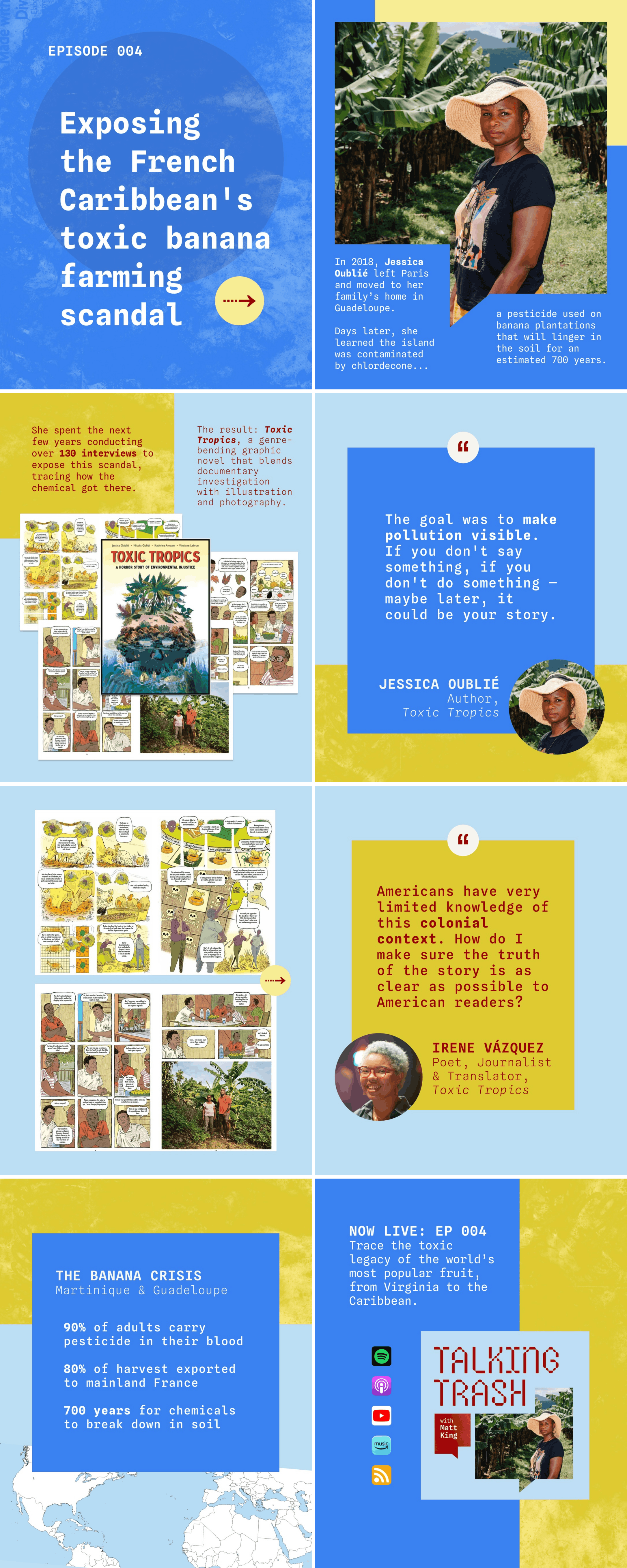
Episode 004 designs for Talking Trash | Art Director: Frances Miller
-
Jessica Oublié: The duration of contamination is 6 or 700 years. And it's completely crazy. The pollution is in the water, in the fields, in the vegetables. Why do we continue to produce banana for people who don't live here?
Narrator: Welcome to Talking Trash. I'm Matt King. This is a show about the waste we never see and the systems that shape our lives. Today, we're traveling to the French Caribbean, where a pesticide used on banana crops has poisoned entire islands for generations. Our guest is Jessica Oublié, a comic book author whose book Toxic Tropics documents this scandal The book is a mixed genre tour de force, blending years of documentary Investigation with the visual power of a graphic novel. The English translation by Irene Vázquez is. out now from Street Noise Books
Narrator: The banana is the world's most traded fruit. Americans eat twenty-seven pounds of it per person every year, more than apples and oranges combined. And most bananas come from Latin America and the Caribbean, grown on vast single-crop plantations.
Narrator: But the banana isn't native to this region. Spanish colonists introduced it in the 1500s. By the 20th century, American fruit companies were toppling governments to protect their plantations, hence the term "banana republic." France turned its own West Indies colonies into banana exporters, supporting dangerous farming practices long after they'd been banned elsewhere.
Narrator: One pesticide in particular, chlordecone, was cheap, effective, and dusted directly onto the soil twice per year.
Narrator: Today, roughly ninety percent of adults on Guadeloupe and Martinique carry traces of the pesticide in their blood. The two eastern Caribbean islands have among the highest rates of prostate cancer anywhere in the world, and Jessica's family history is entwined with this toxic legacy.
Jessica Oublié: My mother is from Guadeloupe, and my father is from Martinique, both French West Indies island. And with my sister, we born in Paris and grew up in Paris. I think it was because my parents feel like migrants, foreign people. They're a French citizen. But because they are Black people and make a very long travel to come to mainland France, they interiorize the idea that they are foreign people and they have to make more effort And it was the same for me. When I was young, I had the feeling that my sister and I have to be perfect. We have to, make no noise. We have to have very good note to school. We don't have to speak Creole. It was like, yes, you can live, but don't be too much visible. I had a job. I was owner of very good flat in Paris, but it was not my real life. I was the shadow of myself in Paris and I just realized that I didn't know anything on my personal family history.
Narrator: In 2018, Jessica made a decision that reshaped her life. She left Paris and moved to Guadeloupe, her mother's island.
Jessica Oublié: It was really obvious to go in Guadeloupe and discover my own roots and share daily regular life with my grandfather, my cousin.It was the path that I needed at this time to feel really complete. And eight years after, I feel it's best choice of my life. It was like, I moved in my own postcard. My family, under the sea and under the sun. It was for me like a new page of my life.
Narrator: But that sunny new page didn't last long.
Jessica Oublié: I heard about the pollution just few days after I arrived here. I watched a documentary on the TV by a Martiniquais journalist. I was really terrified to understand that the pollution is in the water, in the fields, in the vegetables, in the meals, in eggs. And I was so angry because it was like a dream could not be true. And I was angry against myself too because it was like, wow, you decided to move here and you didn't know that there was something so huge like that.
Narrator: Independent radio stations in Martinique had been raising the alarm on ecological issues since the 1980s. But it wasn't until the early 2000s that this pollution was covered on local news. And even then, it hardly appeared in the media back in Paris and mainland France.
Jessica Oublié: It was so huge here that we talk about that every day in the media, but not in mainland France. And it was really weird the, the difference of treatment in the media. Like we are citizenship of not first class, but second or third class. And I heard the how do you say? Colère.
Irene Vázquez: Anger.
Jessica Oublié: Anger. I heard the anger of people here, and there was, at this time, a lot of manifestation, riots, social protestation in the street. It was for me like, I need to interview people to have a good point of view of the situation.
Narrator: Jessica reached out to Luc Multigner, the lead researcher on chlordecone's health effects, and asked if he'd help her understand the science for a graphic novel.
Jessica Oublié: Luc said, "Wow, you want to talk about chlordecone in a graphic novel? I did that for the media, in radio, journal, TV, but I didn't do that, so I would be really pleased to discuss with you. He helped me to open a lot of scientific doors, and understand some specific language. He never tried to instrumentalize me or my research. He always said, "Take your time, and have a long view of the situation." My narrative question for the book was how we can stay and live, each day, in a contaminated territory, for all of life and after? And what kind of heritage we want to give to our relative. The earth, the water are polluted uh, for a very, very, very long time. The first estimation of the duration of contamination is 6 or 700 years, and it's, completely crazy.
Narrator: Over the next two years, with Multigner as a guide, Jessica conducted more than 130 interviews with farmers, doctors, lawyers, consumers, government officials.
Narrator: To understand how a banned pesticide ended up in the French Caribbean, you have to start in Hopewell, Virginia, a small city previously known as the "Chemical capital of the South." In the early 1970s, workers there were manufacturing the pesticide under a brand name Kepone, with almost no safety controls.
Narrator: Manufacturing waste flowed straight into the city's sewage system and out into the James River. When workers started showing up at the hospital with blurred vision and tremors, the state shut the factory down and closed the river for over a decade, all because of one toxic chemical.
Narrator: But French banana planters had already been hooked. When American production stopped, a French factory picked up the supply, and Chlordecone kept flowing to the Caribbean. Jessica went to Virginia herself to see where it all started.
Jessica Oublié: People was really kind and really open. Old people who lived the situation, they said things like, " living in Hopewell when I, I was 18 means swimming in the James River, living, off the fishing and hobby activities linked to the sea. It was like a wonderful past, an El Dorado, like something they could not know again today. The young people who don't live this story, they know that something, huge happened. They feel that, in the family, there is some reticence, to work for this industry or this company or this company. But it's Virginia, and in Virginia there is a lot of chemical company. So, like you said in French.
Irene Vázquez: Uh, you don't bite the hands that feeds you.
Matt King: right.
Narrator: Yeah. So it's very complex again today. In this case, the hand that fed these workers also poisoned them. In one comic panel from Jessica's book, a lab manager tells a Hopewell worker that the wastewater is so safe he can drink it.
Jessica Oublié: When I was in a bar, I discussed with the owner, and he gave me, the coaster. And the coaster was a smiley, and it was written just, Happy in Hopewell." And I found this smiley on the bottle and on other package of products. And I thought maybe it's linked to this past and maybe they try to change the image that we have of Virginia.
Matt King: A community can rebound like that, but how do you not forget the toxic past? Uh, ' if you forget that history, you're gonna repeat it. You're gonna let some other factory do the same thing again.
Jessica Oublié: Yes, I really think we can happy to Hopewell today, but with this terrible past, like a shadow.
Narrator: Back in the Caribbean, Jessica was asking the same question about her own island's future.
Matt King: How did your family react to you going into researcher mode on this topic? Were they supportive of it? Were they questioning you?
Jessica Oublié: For my grandfather and my grandmother, writing comics book and graphic novel, it's not like a job. So it was really, um, strange for them. But they said, first of all, "Okay, she just arrived. She need to understand. But what we know, it's that France did that to us. That's what we know." For me, it was, like, a little bit simple. What can we do after we say that? For me, it was necessary to have a more large screen of the situation to understand, what kind of responsibility are we talking about? Do we use again pesticide in banana field? Why we are continue to- have a monoculture, for sugarcane and for banana. Maybe you know that, eighty percent of our production of banana go to mainland France. It's not for local consumption, it's to Europe and mainly for France. Thirty percent of our field, dedicated to agriculture is currently used to produce a fruit that we didn't eat here. For me it was like scandalous.
Narrator: And the contamination follows those lines of inequality. The people most exposed aren't the exporters or the shoppers in Paris. They're the subsistence farmers growing root vegetables in contaminated soil, the families buying from roadside stands, or the fishermen pulling from polluted coastal waters. In 2009, due to health concerns, the government banned the harvesting of crawfish, wiping out an entire industry that had been running since the 1970s.
Jessica Oublié: Why do we continue to produce banana for people who don't live here? It's something with capitalism, liberalism, very strange to understand when we live on a very small territory. We officially stopped and I say officially because whereas the interdiction was in 1993, 17 years after we found chlordecone again in some banana fields.
Narrator: Agricultural workers on the plantations had almost no protection, and until the 2000s, not even access to bathrooms or changing rooms. They washed in the river at the end of their shifts.
Narrator: These details echo something we heard in our very first episode of this show. Cleanup workers at the Kingston coal ash disaster denied protective equipment so the job wouldn't slow down.
Narrator: In 2018, Emmanuel Macron visited Martinique and used a word no French president had used before.
Jessica Oublié: Macron said in Martinique, "It's an environmental scandal." He said that for the first time. But he said after that, it's a collective responsibility. It's not a state responsibility. It's the farmer responsibility, the local deputy responsibility. For me, it's completely false, because it's a national political decision to use chlordecone, despite all scientific and medical information we had. In 1972, we all knew that it was toxic and dangerous for health. And, whereas you decide to cancel the utilization of kepone in your territories, they say, "Just let's go use it in the,, West Indies banana fields."
Matt King: I also just wanted to call out later in the book a very fun, infuriating sequence where you frame the public debate around responsibility for this crisis through the format of a tennis match. No one wants to take his own responsibility. I give the ball to you.
Jessica Oublié: You send the ball after to me, and no, no, no, I send the ball to another one. And the people in the stand is like the society, the local people, and they say, "Stop to treat us like a beast or people who don't have to know the truth on the situation. We want to know." The team of French institutions, they say, "Oh, we didn't know, we do that because the ministry said, 'It's okay, you can do that.' The local deputy said, 'We so need chlordecone because banana fields, it's the main economical ways in West Indies. So if you have not other solution to propose to us, we have to continue to use Chlordecone.'" The parliamentary commission. was a good start. But, I don't know it change a lot the situation, because we don't take any, strong decision like a, décret. [in French] — a decree, a ministerial order.
Irene Vázquez: There was no official decree or order that was said, like, "Okay, we're gonna stop doing this."
Jessica Oublié: We don't change our economical model, or, agriculture pattern. We are, always dependent of mainland France to have food. For me, it's an aberration.
Matt King: Yeah, it's such an important point one of your explanatory sections in the book talks about the concept of a scandal and how it moves into an affair, if we don't have party that's responsible and accountable, it's hard to generate public interest and anger to call for change. That's one of those dynamics that we see all over the place with different forms of industrial pollution. in some cases, the company that polluted a place might no longer exist. The executives who did that harm might be dead. How do we try to right this wrong when the timescales can be so long and distanced?
Jessica Oublié: People want to know who is the main responsible, and did it pay something to repair the situation? It's very difficult to observe progress on this question because the state is not a people. We cannot say state, you have to go to jail on the monopoly and stay in jail for 10 years or 20 years.
Narrator: Over the decades, key government documents went missing. Jessica compares it to a French version of Watergate. Seventeen years of archives at the Agricultural Ministry evaporated, the paperwork that would have shown exactly which experts authorized Chlordecone's continued use.
Narrator: What people need, Jessica told me, isn't just information, it's acknowledgement.
Jessica Oublié: It's fundamental.
Irene Vázquez: the knowledge that there's suffered, that something cruel happened in the past, that something cruel is still happen today.
Jessica Oublié: And that we are okay to name the situation in the same way. People have a demand of justice reparation.
Narrator: Toxic Tropics looks like a graphic novel, but it reads like an investigative report. Jessica developed the project with illustrator Nicola Gobbi and photographer Vinciane LeBrun.
Matt King: You're a writer and that's your background. W- when did you first realize, "I wanna work in the comic form"?
Jessica Oublié: I decide to make a graphic novel for the first time in 2015 when I was thinking about how I can tell and share my grandparents', history. For me, it was really important to show Black people the way they live in Guadeloupe, Martinique, Réunion, Guyane. So, I knew at this time that I want not just write, but show something. And for the chlordecone, it was the same thing. I wanted to talk about something very hard, complex, to a lot of different people, and young people, too.
Narrator: Her first graphic novel about France's program of relocating Caribbean people to the mainland won the France Culture Student Prize for political comics. For Toxic Tropics, she assembled a team and worked through the COVID lockdowns to meet a deadline.
Jessica Oublié: We worked around 10 hours per day on just one project. It was like, travail a la chaine. How you say, uh-.
Irene Vázquez: Assembly line.
Jessica Oublié: Each time I finish a chapter, I send it to Nicola, and Nicola finish it and send it to Catherine Avram, the colorist. If, all of us was not confined in place, it was not possible to make something like that. In September 2020, it was the conclusion of the parliamentary commission. For me, it was very important that the graphic novel was published on the same time to have like a counterpoint view of the situation.
Narrator: The book also uses inventive formats throughout. "Wiki Science Moments" pause the narrative so a researcher can explain the chemistry directly to a reader. Annotated maps and timelines detail the spread of contamination across the island. And at key points, the illustrations give way to photographs of the real people Jessica interviewed.
Matt King: Why was it so important to include that photographic element?
Jessica Oublié: I wanted to show to people that it's not a fantasy or fantastic story. The horror is so huge that some people could say, "Oh, no, it's so horrible that I can't imagine it's true." And for me, it was, yes, don't turn your head. It's not fantastic character. It's not people that, I invented. It's real people. And these real people, they want to talk to you. They have a claim of social justice, environmental justice. You, reader, you have a responsibility to, attest that they are true people and that what they lived, it's real story. And maybe later, it could be your story, if you don't say something, if you don't do something.
Narrator: Jessica describes the photographs using the French word for a sting.
Jessica Oublié: uh.
Irene Vázquez: Piqure. It's a jolt of reality, a stab of reality.
Matt King: Mm-hmm.
Narrator: Irene Vazquez, who translated the English edition, also had to bridge a historical gap.
Irene Vázquez: The work for me as the translator was to not just translate literally what was happening in the book, but Americans have very limited knowledge of this colonial context and political context that is informing a lot of the work of the book. So How do I make sure that I'm injecting enough cultural context so that the important work that Jessica's reporting on is clear as possible to American readers? Speaking truthfully, it was one of the most difficult projects I've worked on.
Jessica Oublié: but immensely rewarding. This is exactly the kind of work that I love doing, and I was really honored to be trusted with the story. Since the book's French publication in 2020, Jessica has taken it into schools across the islands to help educate students. She's designed games and workshops about contamination, drawing on a parallel her kids could immediately grasp. I said okay, it's not a virus, chlordecone, it's a molecule, and it's here in the water, in the sea, and, you have to protect yourself. They are the personal gardener of their health. And we talk about traceability. la traçabilité d'un produit.
Irene Vázquez: Traceability, like the ability to trace something and its origins.
Jessica Oublié: Yes, so, the origin that the products make to go to your own meal. For me it was the first thing to do with the teacher. It was to.
Irene Vázquez: Make pollution visible.
Jessica Oublié: Make pollution visible in the life of the children, because if we don't need mask like for the COVID, we need preventive behavior. The comic strip ha- has this particular characteristic, to talk, to everyone, with, small word, few images, you can have infor- information you will not read if it was an essay. When someone talk to me for an interview, I can see the potential images and I can say, "Oh, yes, it could be a good story in, comic strip." So, currently I'm think about film because the writing of a film and comic strip, it's not completely d- different. And, um, I have a, totally different project in Pointe-à-Pitre. It's not a documentary, it's a pure fiction. But, I really want to see my character in a very huge screen, so I, I try to think at maybe how I can go to graphic novel to another media.
Narrator: Jessica Oublié moved home to stop being invisible. What she found was a contamination hidden in plain sight in the soil, the water, the food. She made this damage visible through her comics journalism. But even after years of work, many locals, including some relatives, still prefer to forget, to keep the invisible invisible, because the truth is too daunting to consider.
Narrator: Near the end of her book, Jessica poses the question: What if the true cost of a product included the ecological damage it caused? What if a banana grown with pesticides cost more than an organic one because its price reflected the burden on the soil, the water, and the people who live downstream?
Narrator: Today, the fight continues. Researchers are experimenting with activated charcoal that can bind and remove chlordecone from the soil. Farmers are replacing herbicides with cover crops and focusing on fruits that grow higher off the ground. And thanks to Jessica's book and workshops, a generation of kids is learning how they can protect themselves.
Narrator: Many thanks again to Jessica Oublié for sharing her story and to Irene Vazquez for facilitating our conversation Jessica's book is Toxic Tropics: A Horror Story of Environmental Injustice, illustrated by Nicola Gobbi, and published by Street Noise Books.
Narrator: For more on Jessica's work, the history of chlordecone, and the Kepone disaster in Virginia, visit our episode page at talkingtrashpod.com. You can support Talking Trash by hitting subscribe in your favorite podcast app and leaving a review so others can discover these stories.
Narrator: Thanks so much for listening. We'll see you next time.
