
Cover art for Episode 007 on the history and future of forever chemicals.
How "miracle" chemicals became a nightmare, why PFAS can't be disposed, and the small towns that sparked a movement.
PFAS, better known as “forever chemicals,” are in our rain, our drinking water, and the blood of virtually every American. They made pans nonstick and jackets waterproof, and they helped power the space race and modern computing. They also almost never break down. How did these miracles of modern science end up everywhere, and who knew what, and when?
This week, I spoke with investigative journalist Mariah Blake, who has been reporting on PFAS for more than a decade. Her book, They Poisoned the World: Life and Death in the Age of Forever Chemicals (Crown), draws on eight years of reporting and roughly 600 interviews. It traces how manufacturers knew for decades that these chemicals were toxic, and follows the small-town activists in Hoosick Falls, New York, who helped turn a local water scare into a national movement.
Listen: Apple Podcasts, Spotify, Amazon Music, RSS
What the chemical industry knew
Blake walked us through what decades of internal company documents reveal:
1950s: PFAS go into mass commercial production.
1960s: The two main manufacturers, DuPont and 3M, know the chemicals are toxic.
1970s: The companies find them in the blood of people across the United States.
1981: After 3M finds eye defects in rats exposed to PFOA, DuPont quietly monitors pregnant workers in its Teflon division. Two of seven babies in the group are born with eye or facial defects.
1999: A 3M ecotoxicologist, Rich Purdy, resigns, calling one of the company's chemicals "the most insidious pollutant since PCB," and copies the EPA on his letter.
One of those babies, Bucky Bailey, was born in 1981 with one nostril and a deformed eye, a story later dramatized in the 2019 film Dark Waters. Rather than alert regulators, Blake says, DuPont dropped the study, even as it knew PFOA was reaching drinking water near its plants. Some early decisions grew out of real postwar idealism and a belief in scientific progress, she notes. But in recent decades, "the decisions were primarily, if not solely, economic."
Presumed safe until proven harmful
How did companies get away with this for so long? The answer is older than Teflon.
In the 1920s, as leaded gasoline drove the workers who made it mad, DuPont and General Motors funded a toxicology program run by industry scientist Robert Kehoe. His guiding idea, that a product is presumed safe until proven harmful, was written into US law in 1976, when the Toxic Substances Control Act grandfathered in tens of thousands of chemicals. Companies had to report evidence of risk, but they didn't have to go looking for it.
Europe works from the opposite assumption. Under what's called the precautionary principle, regulators can act when a chemical might cause serious harm, before the science is fully settled. This year, EU scientific committees backed restricting the entire class of PFAS, more than 10,000 substances, with targeted exemptions.
A game of regulatory whack-a-mole
By the early 2000s, the two most notorious forever chemicals, PFOA and PFOS, were finally under scrutiny. 3M phased out PFOS, and manufacturers pledged to drop PFOA by 2015. Problem solved? Not quite.
Industry swapped in shorter-chain PFAS it called safer. But DuPont's replacement, GenX, looks almost as toxic, and shorter chains spread faster through water and crops and are harder to filter out. Secrecy makes it worse: companies can hide chemical identities as "confidential business information," leaving independent scientists, as Blake puts it, "chasing a train that's left the station." They recently found one ultrashort PFAS, TFA, is now more abundant than all others combined.
That leaves many towns in a bind. Communities have spent millions on filtration systems built for yesterday's chemicals, only to find newer ones slipping through. And in most cases, it's ratepayers and taxpayers, not polluters, footing the bill.
“This legal battle is going to dwarf that between big tobacco and the states, or asbestos, or any other sprawling health and environment litigation... We are all exposed to PFAS.”
The enduring myth of disposal
Since the 1970s, Blake says, industry has kept the public focused on disposal: litter, recycling, personal responsibility. Think of the 1971 "Crying Indian" ad, funded by can and bottle makers through Keep America Beautiful. Forever chemicals show why that framing falls apart. Landfills leak, few incinerators get hot enough to destroy PFAS, and filters just leave a concentrated stew. "The entire notion of disposal is a ruse," sje says.
Yet that unsolvable problem is becoming a growth business. Major waste companies like Republic Services and Clean Harbors now count PFAS-related revenue in the hundreds of millions of dollars a year, and one industry executive called PFAS destruction a "recurring, durable market." In Ep. 001, we saw a similar dynamic after the Kingston coal ash spill, when TVA scrambled to recover the crystalized pieces it resells for billions each year.
In Ep. 005, filmmaker Melissa Langer revealed how "there is no away" for the trash cities produce; even when we burn it into ash, we still often don't know where to put it. With forever chemicals, away is everywhere. It's in the rain.
Why the fight keeps getting bigger
For all the bleak history, Blake sees real reason for hope. The momentum is coming from every direction:
The courts: A federal appeals court upheld PFOA and PFOS as hazardous substances, so polluters can be made to pay for cleanup. Water utilities have won more than $12 billion, and 3M just agreed to settle most personal-injury claims against it.
The states: A growing number are banning PFAS as an entire class, including Minnesota, home of 3M. Its law is named for Amara Strande, who grew up near a 3M disposal site and died of a rare liver cancer at 20.
Beyond US borders: An Italian court convicted 11 chemical executives for poisoning local water (the case is under appeal), and the EU is weighing a ban on all 10,000+ PFAS.
Ordinary citizens: In Hoosick Falls, New York, Michael Hickey paid to test his village's tap water himself, sparking a fight that won residents a $65 million settlement and a new clean water supply.
Additional resources
The topic of forever chemicals can feel overwhelming, but there’s a lot you can learn, and do. Below are the books, reporting, and films that shaped this episode, plus a few ways to find out what’s in your own water and support the people fighting for cleaner communities.
READ
From Mariah Blake: Her book, They Poisoned the World: Life and Death in the Age of Forever Chemicals, a deeply reported history of PFAS and the Hoosick Falls activists who took on the companies behind them, and her 2015 HuffPost Highline investigation, “Welcome to Beautiful Parkersburg, West Virginia,” on DuPont's Teflon pollution and its human toll.
The people fighting back: Nathaniel Rich's New York Times Magazine feature “The Lawyer Who Became DuPont's Worst Nightmare,” which inspired the film Dark Waters, and the Minnesota Reformer's profile of Amara Strande, the young activist whose name is now on Minnesota's landmark PFAS law.
The science: The 2022 study Outlook for perfluoroalkyl acids in the environment, which found PFAS in rainwater worldwide, even on the Tibetan Plateau; MIT Technology Review's “The race to destroy PFAS, the forever chemicals”; and the Society of Environmental Journalists' primer primer on the rapidly expanding PFAS story.
Background reading: Our Stolen Future (1996), the "scientific detective story" that brought hormone-disrupting chemicals into public view.
WATCH
The big picture: Bloomberg Originals' “The Poison in Us All,” on PFAS in everyday products and in our blood, with reporting from Minnesota and the Faroe Islands.
Communities on the front lines: FRONTLINE's Contaminated: The Carpet Industry's Toxic Legacy (2026), on stain-resistant carpet chemicals in Georgia, Alabama and South Carolina; No Defense, on contamination from a closed Air Force base in Oscoda, Michigan; and Forever Chemicals: North Carolina's Toxic Tap Water, on GenX in the Cape Fear River.
The DuPont story, dramatized: Dark Waters (2019), with Mark Ruffalo as Rob Bilott, and directed like many of Hollywood’s best legal thrillers.
From Mariah Blake: Her talk “Chemical Nation: How Americans Became Guinea Pigs in a Vast, Haphazard Chemistry Experiment,” on the history behind her book.
ACT
Check your water. Look up your utility's PFAS test results in the EPA's UCMR 5 Data Finder or EWG's Tap Water Database, or read your utility's annual water quality report.
See what's near you. The EPA's Superfund National Priorities List maps the country's most contaminated sites.
Follow state action. Safer States tracks PFAS bills and laws across the country, so you can see what your state is doing and contact your representatives.
Support local advocates. Groups like Cape Fear River Watch in North Carolina and Italy's Mamme No PFAS show how much ordinary people can change.Forever chemicals can feel overwhelming, but there’s a lot you can learn, and do. Below are the books, reporting, and films that shaped this episode, plus a few ways to find out what’s in your own water and support the people fighting for cleaner communities.
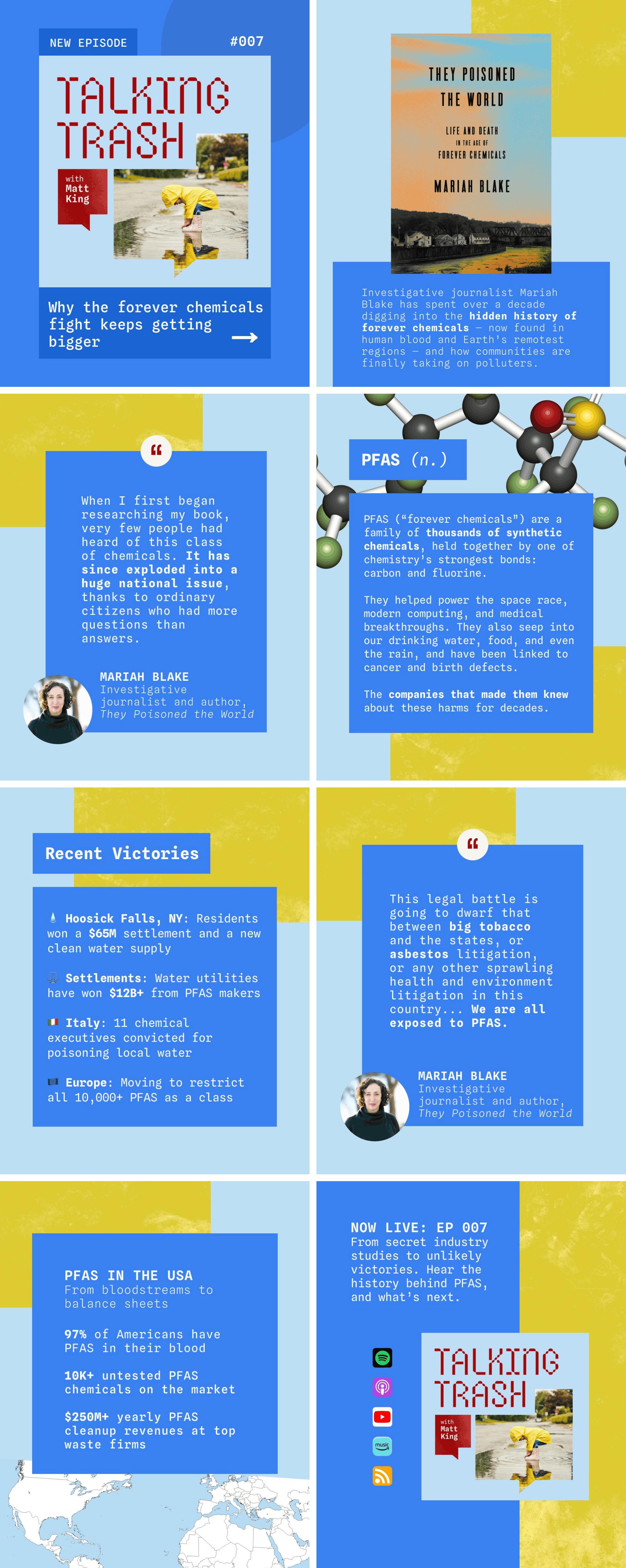
Episode 007 designs for Talking Trash | Art Director: Frances Miller
-
MARIAH BLAKE: There’s a certain PFAS molecule that industry estimates has a half-life of a million years, so that is way longer than plutonium. That’s a time scale that is more akin to nuclear waste.
When I first began researching my book, very few people had heard of this class of chemicals. It has since exploded into a huge national issue, and that is all thanks to ordinary citizens who had more questions than answers.
NARRATOR (MATT KING): Welcome to Talking Trash. I’m Matt King. This is a show about the waste we never see and the systems that shape our lives. That voice you heard belongs to Mariah Blake, an investigative journalist who has been reporting on forever chemicals for over a decade. Her book, They Poisoned the World: Life and Death in the Age of Forever Chemicals, covers the toxic history of these substances and the small-town activists who have recently sparked a national movement.
Her book starts from an alarming premise. America is now a place where every child is born pre-polluted. Most of the chemicals that pass from mother to newborn have never been tested for safety, and that includes PFAS, or per- and polyfluoroalkyl substances, a family of thousands of synthetic chemicals that share the strongest bond in chemistry: carbon and fluorine.
This is the bond that makes Teflon pans slick, rain jackets waterproof, and firefighting foam smother fuel fires.
During the post-war era, this chemical bond enabled a new epoch of space travel, computing, and medical breakthroughs, while also unleashing indestructible toxins everywhere that will never leave us. To understand the scale of what Blake is describing, we can start with the rain.
MARIAH BLAKE: This group of prominent European scientists in 2022 looked at the levels of just the two best-known and best-studied PFAS in rainwater all over the world.
And they found everywhere in the world, including the remotest regions, places like the Tibetan Plateau, the levels were high enough to endanger human health and the environment. And they concluded, based on this, that the entire planet was now outside what they call the planetary boundary for chemical contamination.
If it’s in the water, it’s in everything, especially with this class of chemicals, because they are hydrophilic, so they move through the upper atmosphere with rain. So you have a class of chemicals that are literally everywhere and that don’t break down in the environment. We now know that more than half of all Americans have these chemicals in their drinking water, and that virtually all Americans have them in their blood. And there are all kinds of systems and tools that have sprung up to help us deal with those.
MATT KING: I’m trying to understand the perspective of these executives at these companies who see evidence of harm and seem to not change anything.
MARIAH BLAKE: Let me just outline what industry knew when, because I think it’s important for people to understand the specifics. These chemicals first went into mass commercial production in the 1950s.
By the 1960s, the two main manufacturers, DuPont and 3M, knew that they were toxic. By the 1970s, they knew that they were in the blood of people all across the United States. They would eventually discover that this was a global problem. They tested thousands of blood samples from people all over the world, including remote rural China.
The only blood they could find that didn’t contain these chemicals was collected from Korean War vets before 1952.
So the blood findings, not surprisingly, set off some alarm bells inside the companies, and they began intensively studying their health and environmental effects.
They quickly discovered that they did not break down in the environment, that they had a devastating effect on lab animals, and that they were linked to a variety of serious diseases in workers, including leukemia, various other types of cancer, organ damage, dramatic drops in testosterone, and the list goes on. You know, in one case, 3M discovered that rats exposed to a certain molecule, PFOA, the Teflon chemical, developed facial birth defects. So DuPont decided to determine whether the same was true of its workers. DuPont began monitoring the pregnancies of workers in its Teflon factories, secretly monitoring.
So it did not alert women to the fact that it was doing this. It gave them questionnaires, but under the guise of routine medical questionnaires. And it determined that, in fact, the chemical did seem to cause birth defects in the children of workers, because two of five pregnant women who gave birth during the course of the study gave birth to children with facial deformities, very similar to those found in rats.
NARRATOR: If this sounds familiar, you may have seen it on screen. The 2019 film Dark Waters, starring Mark Ruffalo, follows lawyer Rob Bilott as he digs through boxes of DuPont’s internal files and uncovers this very study.
CLIP FROM DARK WATERS: “That chemical, what if you drank it?” “Drank it? That’s like saying, what if I swallowed a tire?” “What if whatever’s killing those cows is in the drinking water?”
NARRATOR: One of those babies was Bucky Bailey, born in 1981 to a worker in DuPont’s Teflon division in West Virginia.
He was born with one nostril and a deformed eye.
MARIAH BLAKE: Rather than inform regulators or the public or workers, DuPont simply canceled the study and continued exposing female workers to this chemical. But more importantly, I think, it continued exposing the rest of us to this chemical, because by that point, DuPont was aware that the chemical was getting into drinking water around its plants. And it had methods it could easily have deployed to prevent that from happening, but it opted not to install these emissions controls.
And the reasons, they’re spelled out very clearly in the DuPont documents. It had to do with dollars and cents. They determined they were already liable for all of the PFOA they’d already spread into the environment, and any additional liability would be incremental.
NARRATOR: Blake is careful not to flatten this story into cartoon villains. The earliest decisions, she says, also came out of a different mindset.
MARIAH BLAKE: After World War II, there was a profusion of chemicals and synthetic materials coming onto the market, and there were scientists who made decisions to withhold information.
They saw these materials as potentially transformative, the potential to transform our society for the better, and that any costs were outweighed by these enormous benefits that they would bring. There was real idealism surrounding plastics and synthetic materials.
Now, there was a certain paternalism to the way those choices were made, because those of us who were unknowingly exposed to these chemicals didn’t get to weigh in. But in terms of what I have seen in the records in more recent decades, the decisions were primarily, if not solely, economic.
NARRATOR: The regulatory system that let all of this happen is older than Teflon. Back in the 1920s, DuPont and GM became embroiled in a crisis over leaded gasoline, which was driving workers mad.
Lead made engines run smoother and more powerfully. Ethanol did the same job, but it couldn’t be patented. To prevent regulation, these companies funded a new toxicology program at the University of Cincinnati, and they put in charge industry scientist Robert Kehoe. His principle was that a product should be presumed safe until proven harmful.
Half a century later, it was written into law. The Toxic Substances Control Act of 1976 grandfathered in tens of thousands of chemicals already on the market. Companies were required to report evidence of serious risk, but they didn’t have to go looking for it.
MATT KING: Did you come across, like, any documents that hinted at doubts or moments of conflict? I’m also thinking of, like, scientists at those companies who were the ones running these studies and kind of found the dangers. And, like, how did they, as individuals, deal with it?
MARIAH BLAKE: There was this ecotoxicologist at 3M who had documented the buildup of certain PFAS in the food chain. He found that a chemical used by 3M known as PFOS was building up to dangerous levels in sea mammals and birds of prey.
And he was extremely concerned about this. And he sent memo after memo warning his supervisors, saying that this is data that should have been reported to the EPA. At some point, 3M just basically shut down his studies. The correspondence is quoted in my book, but he in no uncertain terms told them that he felt what was going on was unethical, and he ultimately sent this scathing resignation letter that he copied the EPA on.
And that was actually the moment that these chemicals registered on the EPA’s radar.
One of the things that he raised, and this was something that 3M consistently did: they would do just enough research to get a sense of the magnitude or scope of the problem, and then they would kill the studies, because they didn’t want to collect too much potentially damning data in case at some point they were forced to turn it over to regulators.
MATT KING: What’s the point of even doing the little bit? I guess just to have a sense of dangers, liabilities to potentially avoid? It’s like, why do any of it?
MARIAH BLAKE: It’s an interesting question, but all of these companies do it. There’s a long history of it in the chemical industry. It dates back to the Germans. Up until World War II, Germany had dominated the chemical industry. They called it industrial hygiene.
Largely they studied the effects of chemicals and whatnot on their workers, and it was about worker health, but there was also some environmental and medical research that went on as well. When I say medical research, they studied the effects of these chemicals on animals, not on people.
But it is a good question. It’s not something that I really have a good answer to, but it is something that has a long history, and all chemical companies seem to do it.
NARRATOR: By the early 2000s, public scrutiny had intensified around the two most notorious forever chemicals: PFOA, used to make Teflon, and PFOS, a key ingredient in 3M’s Scotchgard. 3M eventually phased out PFOS, and several other manufacturers pledged to drop PFOA by 2015.
Despite this progress, the toxic nightmare not only lingered but intensified.
MARIAH BLAKE: The longer-chain chemicals have been replaced by shorter-chain PFAS that industry claims were safer, because the shorter-chain ones tend to stay in our blood less long.
Most chemicals move through your body in a matter of minutes or hours. The longer-chain PFAS, they have a half-life of anywhere from, say, four to 14 years in your body. So people with high levels might carry these chemicals with them their entire lives.
The argument was that because the shorter-chain ones moved through the body more rapidly, they were less harmful, but now we’re actually discovering that may not be true. The most infamous of these chemicals is a chemical called PFOA that was used to manufacture Teflon. That has been replaced, at least in DuPont’s or Chemours’ formulation, with another chemical called GenX. It is now becoming clear that GenX is almost as toxic, if not more toxic, than PFOA, and in other ways it’s way more problematic. In fact, all of the shorter-chain PFAS, they move more readily through the environment.
They build up more quickly in crops, which leads to higher concentrations in foods, and they are more difficult to remove from drinking water.
NARRATOR: And for years, nobody outside the company even knew what GenX was.
MARIAH BLAKE: It wasn’t immediately clear what DuPont was using in place of PFOA.
And there are generic equivalents of Teflon, and so there are probably other chemicals being used, but a group of scientists spent years reverse engineering the formula, and they did this by collecting water samples downstream of a plant where Teflon was manufactured.
The scientists were only able to identify what the chemical was, what GenX was, sometime around 2015.
When companies register chemicals with the EPA, they can claim that it’s confidential business information, and so the identities aren’t available to the public and even most EPA staff.
The independent scientists are always behind industry in their understanding. I heard one scientist describe it as always chasing a train that’s left the station.
NARRATOR: In her book, Blake reports that the identities of more than 10,000 chemicals are shielded this way, and as tools to detect PFAS get better, scientists keep finding alternatives.
MARIAH BLAKE: Trifluoroacetic acid, or TFA: scientists recently discovered that it is more abundant in the environment than all other PFAS combined, but they just didn’t have the tools to detect it. And we already know that it’s toxic to reproduction.
NARRATOR: Even as many towns have installed new PFAS filtration systems, these defenses are useless against the newer kinds of forever chemicals.
MARIAH BLAKE: Some of them, it is impossible to remove from drinking water with any of the technologies that are available on a utility scale. So you can remove them with reverse osmosis, but there is no other way to effectively remove them from drinking water. So you have countless communities all over this country that invested millions, in some cases billions, of dollars in systems to remove PFAS from the drinking water, based on the science that was available at the time that they made these decisions, and they’re now discovering that their finished drinking water is still polluted.
NARRATOR: And in almost every case, from Delaware to Wisconsin to North Carolina, it’s the public, not the polluters, paying for those filters. Meanwhile, the federal targets are getting looser. In May, the EPA proposed keeping its strict limits on PFOA and PFOS, but giving some water systems until 2031 to comply. It also proposed scrapping limits on three other PFAS altogether. One of them is GenX.
Every industry that makes a mess eventually sells us a story about how to clean it up. Pick up your litter, rinse and recycle, install a filter, capture the carbon, burn the garbage. The problem is always downstream and for everyone else to manage.
MARIAH BLAKE: From the very beginning, the plastics industry has tried to keep the focus on disposal as the issue. And, you know, beginning in the 1970s, they really tried to shift the focus to litter, which puts the responsibility on the individuals using the products rather than on the companies manufacturing the products.
And, you know, they were involved in sponsoring the first Earth Day, and I don’t know, there’s that legendary commercial with a “Crying Indian” from the 1970s that was actually sponsored by the industry.
NARRATOR: You may have seen the old TV spot: a white actor in Native American dress paddling a canoe through a trash-strewn river, a single tear running down his cheek.
CLIP FROM 1971 KEEP AMERICA BEAUTIFUL AD: “People start pollution. People can stop it.”
NARRATOR: The ad came from a group called Keep America Beautiful, which sounded like a civic nonprofit, but it was bankrolled by some of the country’s biggest can and bottle makers.
MARIAH BLAKE: What we’re learning now about plastic and certain toxic chemicals is that you can’t dispose of them. There is no way to dispose of them. And I think forever chemicals, or PFAS, are in some ways the clearest illustration of that problem.
I found a document in the course of my research. There’s a certain PFAS molecule that industry estimates has a half-life of a million years, so that is way longer than plutonium. That’s a time scale that is more akin to nuclear waste. How do you dispose of a chemical that is everywhere, where some of these molecules will persist in the environment long after our grandchildren’s grandchildren are dead? The options now are to put them in a landfill, but all landfills eventually leak, and they’re actually discovering that PFAS belch out of landfills.
So landfills are a huge source of PFAS contamination. Or you incinerate them, but very few incinerators anywhere in the world get hot enough to actually destroy the defining characteristic, this carbon-fluorine bond. This is the strongest bond in chemistry. There are only two incinerators in the entire country that burn hot enough to destroy PFAS.
So the entire notion of disposal is a ruse.
You are able to filter some PFAS out of drinking water. Not all PFAS; the systems that are viable on a commercial scale actually do not remove all PFAS. So what do you end up with once you filter it out? You have a concentrated stew, and there’s really no viable way to dispose of it in a way that’s meaningful.
NARRATOR: Blake sees the same trap in the solutions most of us were taught to believe in.
MARIAH BLAKE: Recycling is a ruse, because almost nothing gets recycled. And if you look at things from the vantage of toxicity, recycling just makes the problem worse, because you mix together the types of plastic that are less likely to have toxic chemicals with the types of plastics that almost always have toxic chemicals in them. So recycled plastics are more likely to be toxic than non-recycled plastics. Bioplastics oftentimes have toxic chemicals in them.
So if you look at things through the lens of toxicity, then all of the supposed solutions just make the problem worse.
NARRATOR: This unsolvable problem has become a promising new growth engine for the waste industry. Giant companies like Republic Services and Clean Harbors are each reporting over $100 million a year in PFAS-related revenue and growing quickly, up to 20% annually.
At an industry summit, one executive described PFAS destruction as a, quote, “recurring, durable market.” The very first episode of this podcast looked at a similar dynamic in Tennessee. There, after the historic Kingston coal ash spill, the Tennessee Valley Authority’s top priority was recovering little blobs of crystallized coal ash that it resells for billions of dollars every year.
In an economy where one industry’s waste becomes another’s durable market, who is ever motivated to turn off the tap?
If you can’t throw these chemicals away, someone has to clean them up, and the fight over who pays has brought together some unlikely political interests.
MARIAH BLAKE: PFOA and PFOS were designated hazardous substances under the Biden administration, and that sounds technical, but it’s hugely important, because when something is designated a hazardous substance, then EPA has the authority to force the party responsible to map the extent of the contamination and clean it up.
Otherwise, the burden falls on the affected communities, and that’s what’s happening right now. The burden of installing these very expensive water filtration systems is falling on ratepayers and taxpayers. And oftentimes the broader remediation isn’t getting done because there’s not the resources for it.
The EPA has designated these two chemicals hazardous substances, and the Trump administration not only preserved that, but went to court to defend the hazardous substance designation. And I know this is technical, but this is really, really important. You don’t have the Trump administration going to court to defend climate regulation or really any other environmental regulation.
NARRATOR: That defense worked. In August, a federal appeals court in Washington upheld the designation, rejecting challenges from industry groups, including the US Chamber of Commerce. PFOA and PFOS became the first new hazardous substances added under the federal Superfund law since it passed in 1980.
MARIAH BLAKE: Interestingly, Lee Zeldin, the head of the EPA, he represented a PFAS-contaminated district in Long Island, and when he was in Congress, he was actually a vocal advocate of PFAS regulation and even sponsored laws.
He’s not very vocal about it at the moment, but this is an issue that cuts across partisan divides in a way that very few issues do at this particular moment.
NARRATOR: In our first episode, you heard Lee Zeldin tell a room of coal executives that their wish list was now complete.
But on PFAS, he’s been eager to take credit, sending money to states for water filtration cleanup, even as his EPA rolls back limits on several of the key forever chemicals.
Across the country, thousands of lawsuits have been filed over PFAS in firefighting foam. Water utilities have won billions from 3M and DuPont’s spin-off companies, and thousands of cancer claims are still pending.
MARIAH BLAKE: It’s red states and blue states. A large share of them are filed by states, municipalities, or water districts that are seeking compensation for drinking water contamination.
That legal battle is going to dwarf the battle between big tobacco and states. It’s gonna dwarf asbestos litigation. It’s gonna dwarf all the other sprawling health and environment litigation that has ever happened in this country. It’s going to be mammoth, especially now because it’s engulfing consumer brands. It’s unlike asbestos and tobacco, in that the applications of asbestos were limited; the conditions under which you could be exposed to it were limited.
The people exposed to smoke were those who opted to smoke, or in some cases lived with them. But, you know, we are all exposed to PFAS, and, you know, science tells us that there are health effects at ordinary population levels of exposure. The level that virtually every American is walking around with in their blood is associated with certain health effects.
NARRATOR: That’s the idea behind one of the most ambitious cases yet, brought by lawyer Rob Bilott from the film Dark Waters. Two decades ago, he won a landmark settlement for the community around DuPont’s Teflon plant in Parkersburg, West Virginia.
MARIAH BLAKE: Medical monitoring is just a certain kind of claim, and only some states recognize it, but if you’ve been exposed to a toxic chemical but haven’t yet fallen ill, you can file a claim seeking medical monitoring, so that you get regular checkups, and if you develop any of these diseases, it gets caught while it’s most treatable.
And Rob Bilott was able to secure that for a community of 70,000 people in Parkersburg, West Virginia.
NARRATOR: Then Bilott went bigger: a class action suit seeking medical monitoring for essentially everyone in Ohio, paid for by the manufacturers. In 2023, a federal appeals court threw out that suit, ruling the lead plaintiff couldn’t show which company’s chemicals were in his blood. Bilott refiled.
MARIAH BLAKE: The idea that you could have a class action that the entire state would bring against a group of companies, nothing like that has really ever happened before.
And we don’t know what the outcome of that case will be, but the sort of potential scale is just much larger than something like asbestos or big tobacco.
NARRATOR: But lawsuits only go so far. Companies spin off divisions, merge, and rename themselves. In Blake’s book, a lawyer who once handled PFAS cases for Saint-Gobain calls it a, quote, “generational passing of the buck.” Today’s executives leave the cleanup bill to their successors.
I asked Blake about the people who actually made these decisions.
MATT KING: There’s still these actual individuals that led those companies through the ’50s, ’60s, ’70s, you know, who made these decisions to kind of cover things up, to not take action.
And it’s like we still don’t know who they are, and they’re not gonna face any consequences for what they did.
MARIAH BLAKE: Oh, we know who they are.
MATT KING: You do?
MARIAH BLAKE: We do. I mean, it’s all in the records, but we’ve just made a choice as a country. I mean, there was a time when the Justice Department opened a criminal investigation into DuPont over suppressing its own internal data, but nothing ever came of it.
We as a country choose not to prosecute white-collar crime for the most part. In Italy, chemical industry executives are in prison over companies that manufactured and used PFAS in Italy and behaved similarly to US companies.
There are places that are choosing to hold executives criminally liable for this kind of behavior. We just aren’t one of those places.
NARRATOR: In June 2025, a court in Northern Italy convicted 11 former executives connected to a chemical plant called Miteni. They included managers from Mitsubishi and the investment group ICIG. Their sentences added up to 141 years in prison for contaminating water used by roughly 350,000 people.
While Washington loosens its grip, the states keep going further.
MARIAH BLAKE: This is the good news part of it, right? You have a number of states taking unprecedented steps.
30 US states have passed nearly 200 laws restricting PFAS, including at least a dozen full or partial bans on the entire class of substances in consumer goods or firefighting foam, some subset of products. And that is a very big deal, because that is not how we regulate chemicals in this country.
We normally regulate them one by one.
And I think this approach goes a long way towards solving the problem, this sort of game of whack-a-mole where you restrict one harmful chemical and another chemical that has a similar structure and properties crops up in its place. And, you know, in many cases, that replacement chemical will turn out to be just as harmful, but it takes a while to establish that. And in the case of a chemical like GenX, you know, by the time scientists have mastered the data, that chemical is gonna be everywhere.
It’s gonna be in the blood of every living being.
This trend has actually only accelerated since Trump took office. In some cases, deep red states are weighing these laws.
Because of the unique threat posed by PFAS, because they persist in the environment so long and are already so ubiquitous, regulators have decided this approach is warranted, and in some cases they are choosing to apply that same approach to other classes of toxic chemicals.
This is something that chemical safety advocates have long wanted: regulating chemicals as a class. So phthalates, for example.
NARRATOR: The strictest of these laws passed in Minnesota, home of 3M, the company that pioneered forever chemicals. Its first product bans took effect last year.
These laws aren’t absolute. Most carve out uses that are essential and currently irreplaceable, from medical products to the fluorinated coatings inside lithium-ion batteries.
Across the Atlantic, Europe works from the opposite of the Kehoe principle. When a chemical might cause serious harm, regulators act before the science is settled.
They call it the precautionary principle. This spring, the scientific committees of the European Chemicals Agency backed a ban on the entire class of PFAS, more than 10,000 substances, with targeted exceptions. A final decision is expected from the European Commission next year. It would be the most sweeping chemical restriction in the bloc’s history.
Europe may be leading the way now, but the fight against forever chemicals got its start in places like Parkersburg, West Virginia, and Hoosick Falls, New York, the village at the heart of Blake’s book.
MARIAH BLAKE: One thing we haven’t talked about is the incredible people that I followed for my book. But, you know, the book is this sort of David and Goliath story where this small group of unlikely activists in this upstate New York village take on some of the world’s most powerful corporations and wind up scoring these really kind of astonishing victories.
And as I was reporting this story in Hoosick Falls, New York, variations of that were sort of happening all over the country. So you started having these unlikely activists banding together and demanding change from their political leaders and fighting to hold polluters accountable.
And a lot of things that I’ve talked about in this podcast up until now are the result of that. So the proliferation of state-level laws…
It was ordinary citizens to a large extent that even put this issue on the radar. When I first began researching my book, very few people had heard of this class of chemicals. It has since exploded into a huge national issue, and that is all thanks to ordinary citizens who had more questions than answers.
NARRATOR: In Hoosick Falls, the fight began with Michael Hickey. His father had worked at the local Teflon-coating plant and died of kidney cancer. When Michael paid to test the village’s tap water himself, he set off a chain reaction.
New York became the first state to classify PFOA as a hazardous substance. In 2021, Saint-Gobain, Honeywell, and 3M agreed to a $65 million class action settlement with residents.
MARIAH BLAKE: So, yes, it’s a heavy topic, but I think there is reason for hope, and unlike other issues, we’re continuing to see progress even under the current Trump administration. I continue to think that this is an environmental crisis that rivals climate change in terms of its importance for human health and the long-term health of our planet, and one that hasn’t gotten the attention it deserves. So I’ll keep talking about it for as long as people keep inviting me to talk about it.
NARRATOR: Somewhere right now, in one of the most remote places on Earth, it’s raining. And in that rain are a few molecules of chemicals invented in New Jersey and Minnesota. That’s what makes forever chemicals different. There’s no upstream left to escape to. But the underlying political dynamic is far from new.
The story of Hoosick Falls reminded me of Henrik Ibsen’s famous 1882 play, An Enemy of the People. There, a small-town doctor discovers that the water feeding the local spa is poisoned, and the town turns on him to protect its economy. While Ibsen’s play ends as a tragedy, the examples we’ve heard today, of activists from Hoosick Falls to Minnesota to Northern Italy, offer the possibility of a different ending and a better future.
Many thanks again to Mariah Blake for walking us through more than 70 years of a slow-motion catastrophe and the ordinary people who refuse to look away.
Her book is They Poisoned the World: Life and Death in the Age of Forever Chemicals, out now from Crown Publishing. For more on this history of forever chemicals, the fight to regulate them, and how you can check your own tap water, visit our episode page at talkingtrashpod.com. You can support Talking Trash by hitting subscribe in your favorite podcast app and leaving a review so others can discover these stories.
And if there’s a book or film you think we should cover, let us know through the website. It’s been fun having you along. See you next time.
