
Ep. 001: Cleaning up the largest industrial disaster in US history
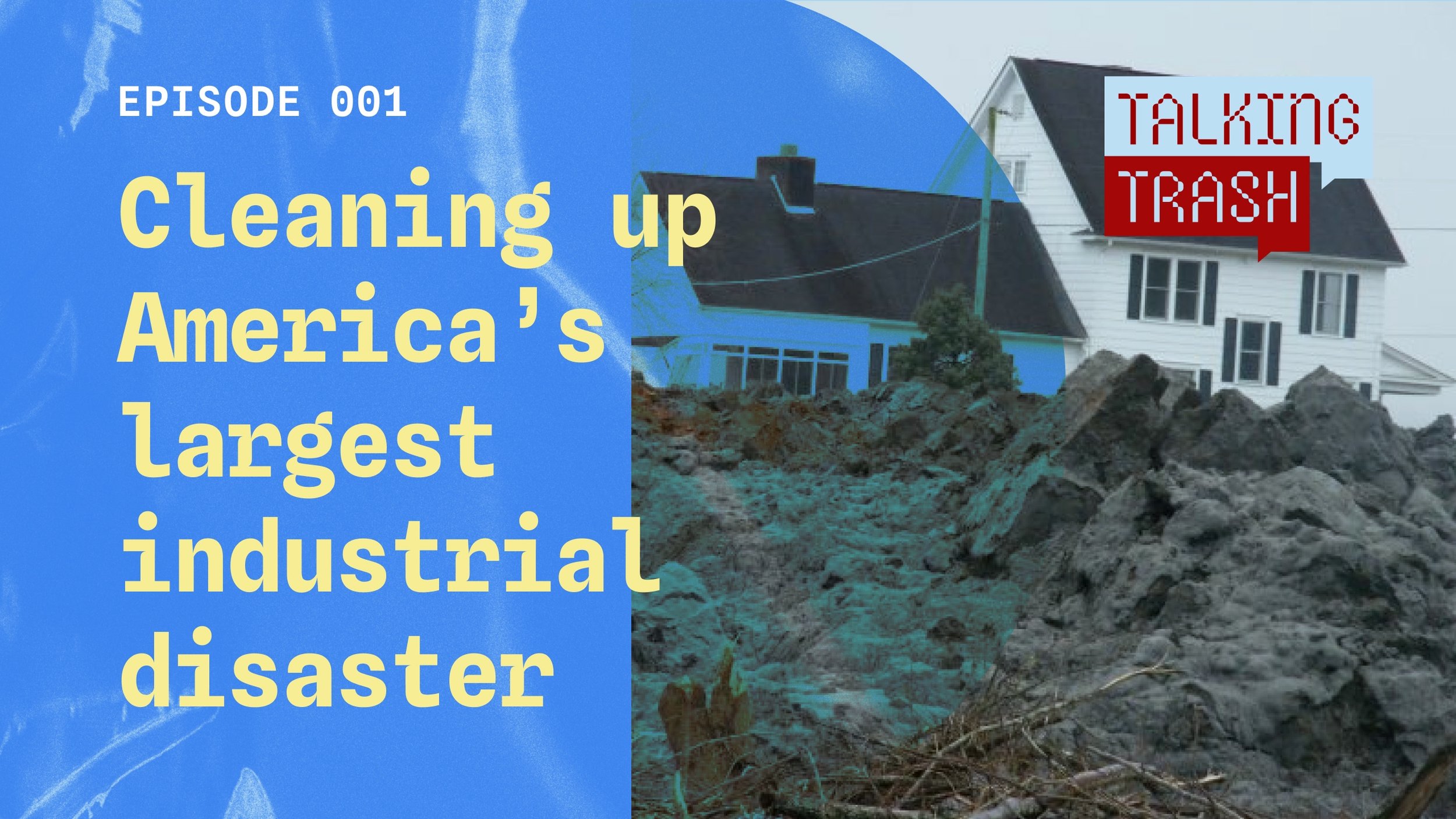
Cover art for Episode 001 on Kingston’s coal ash spill.
Over a billion gallons of coal ash sludge, hundreds of sick workers, and a disaster most Americans have never heard of.
In the early hours of a December morning in 2008, three days before Christmas, a 60-foot dike gave way at the Tennessee Valley Authority's Kingston Fossil Plant. Over a billion gallons of coal ash slurry — enough to fill 1,500 Niagara Falls — surged into the Emory River, covering 300 acres of East Tennessee under a wave of black soot. Homes were pushed off their foundations. One resident, asleep at the time, woke to find his house sitting in the middle of the road on top of coal ash.
It was, and remains, the largest industrial disaster in United States history. Nearly two decades later, most Americans have never heard of it.
Episode 1 of Talking Trash returns to Kingston to ask why — and to trace how a disaster of that scale could vanish from the national conversation while the workers who cleaned it up kept getting sicker, and dying.
What happened at Kingston
The coal ash pond behind TVA's Kingston plant had been accumulating waste since the 1950s. According to Wes Bunch, a former journalist and lifelong resident of the neighborhood, the pond had been leaking for years before the collapse — coal slurry running into the road after heavy rains. It had already suffered a smaller collapse two years earlier. Ansol Clark, who would later die of a rare blood cancer, had helped patch it.
When the dike finally gave way, 900 workers descended on the site from across the country. Many were told the coal ash was safe. One safety officer, according to journalist Jared Sullivan, told the workers directly: "I wouldn't be out here if I thought it was hazardous. I have a wife and family too, trust me on this."
Within months, they began coughing up a black, jellylike substance they called "the Kingston Crud." Then came the blackouts and heart failures. By 2013, they had a lawyer, and in 2018, a federal jury found that Jacobs had failed to protect them. It took another five years for the lawsuit to settle. As of July 2026, more than 60 of the workers are dead.
Listen: Apple Podcasts, Spotify, Amazon Music, RSS
Three systemic failures we discuss
1. Coal ash has never been meaningfully regulated
Coal ash carries arsenic, mercury, lead, radium, and cadmium — any one of which, in most other contexts, would trigger the strictest tier of federal hazardous waste rules. But coal ash is regulated under the federal law that covers non-hazardous solid waste — the same category as municipal trash. (When Congress passed its hazardous waste regulation in 1976, coal was spared through a special exception.)
New 2015 EPA rules, formed in the wake of Kingston, required power companies to monitor active dump sites for groundwater contamination. But they didn't touch the roughly 375 inactive sites across the country, or the underlying classification. The Biden administration extended these rules to inactive sites in 2024, but the Trump administration has pushed those cleanup deadlines into the 2030s.
The industry has profited from this ambiguity for decades. So long as coal ash sits outside the hazardous-waste framework, power companies can store it in unlined pits, sell it into consumer markets, and avoid the reporting requirements that would make the true scale of the problem visible.
2. There’s money in coal ash that industry can’t quit
Roughly half of the coal ash produced in the US every year — about 64 million tons — gets resold. It ends up in concrete, wallboard, roof tiles, road base, paint, cosmetics, and bowling balls. The global coal ash market is estimated at $7–$15 billion annually.
The Kingston cleanup site was officially known as "the Kingston Recovery Project" — because part of the work involved sifting the ash for saleable material: rare earth minerals, and tiny floating silica beads called cenospheres. TVA's CEO told a public meeting that recovering cenospheres from the river was a top priority. Restoring residents' properties, or protecting cleanup workers, was not.
As Dr. Lisa East, an environmental sociologist at UT-Knoxville, put it: "These are the technological gymnastics industries do to attempt to continue the lifecycle of fossil fuels." If coal ash was once a blight, it has since become a stable byproduct the industry has figured out how to profit from twice.
3. The “debate” over coal is largely manufactured
Lisa's research focuses on how the coal industry talks about itself; her master's thesis covered the "clean coal" PR campaign and the trade group behind it. In her classroom at UT-Knoxville, where many students have direct family ties to the cleanup, she rarely encounters students arguing for "the beauty of clean coal technology."
That's because, she argues, the polarized public debate we see on cable news doesn't reflect how most people actually think about coal. In the coal-dependent communities she's visited, people want a different future too — one where their relatives don't get sick from work, where their children can fish the rivers they grew up in.
Additional resources
Kingston is one story in a much larger web of coal ash reporting, regulatory research, and community organizing. You can start with the news segments below and Jared's book, which is the definitive account of the disaster cleanup, then expand outward the ongoing coverage and collective efforts today.
READ
Jared Sullivan’s narrative nonfiction book, Valley So Low: One Lawyer's Fight for Justice in the Wake of America's Great Coal Catastrophe(Knopf, 2025), which reads like a gripping legal thriller
Jamie Satterfield's investigative reporting on Kingston in the Knoxville News Sentinel — the coverage that first broke the workers' story open.
Tennessee Lookout's ongoing coverage of TVA and coal ash policy and the Roane County historical marker honoring the cleanup workers.
Hellbender Press on the ongoing coal ash story — Appalachian-focused environmental journalism that has followed Kingston and related cases.
Inside Climate News on how the Trump administration is funding coal plants with histories of Clean Air Act violations.
Bay Journal's reporting on the nearly 100 coal ash dumps ringing the Chesapeake Bay watershed alone.
Heatmap News on why the coal plants Trump is trying to save keep breaking down — and new data on energy equipment failure rates.
WATCH
Wes Bunch's photos and videos of the Kingston spill site — a firsthand collection curated by a lifelong resident of the area, and one of the voices in this episode.
Network news archival footage on Kingston – initial national coverage of the disaster, including 911 calls and local interviews.
60 Minutes, "Coal Ash" (2009) — Lesley Stahl's segment, featuring the "black tsunami" reporting and TVA's early response.
WBIR Knoxville's 10-year retrospective on Kingston — local news coverage that's more complete than the national outlets' work.
ACT
Check if you live near a coal ash site. Earthjustice's coal ash map tracks all 750+ known dump sites and their contamination status. Many are within a mile of populated areas and drinking water sources.
Sign onto EPA public comment periods when coal ash rules are up for revision. Comment portals here — public comments are legally required to be reviewed.
Support the organizations doing the on-the-ground work: Statewide Organizing for Community Empowerment (formerly Save Our Cumberland Mountains) and Appalachian Voices.
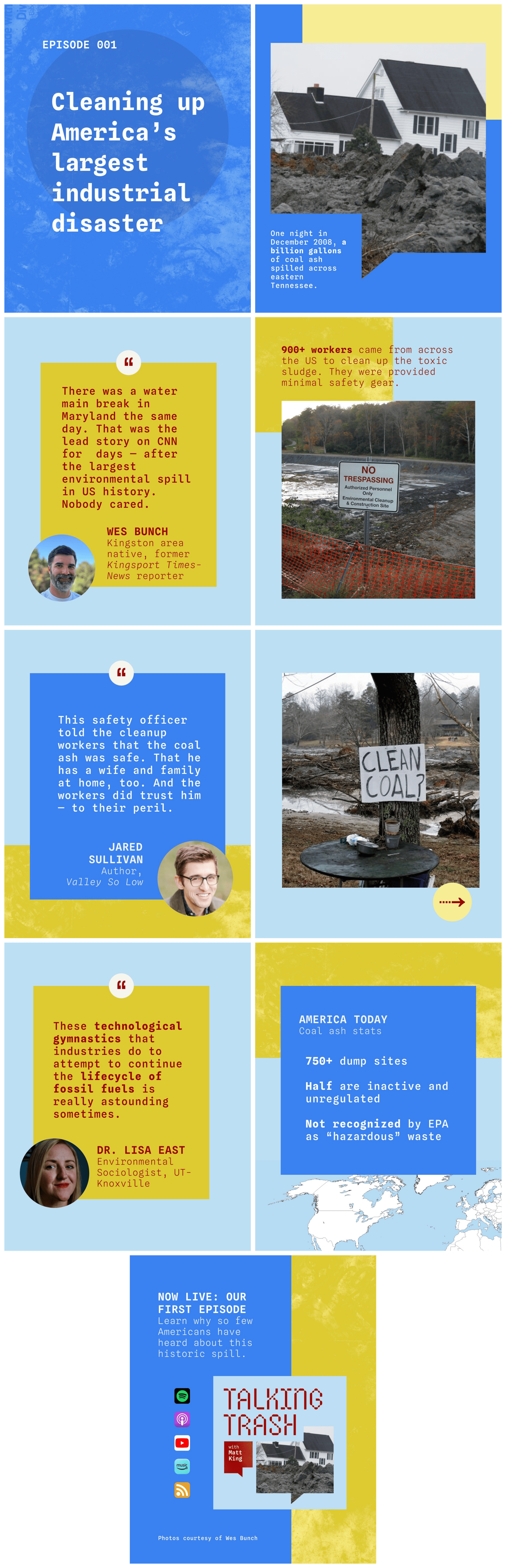
Episode 1 designs for Talking Trash | Art Director: Frances Miller
-
Narrator (Matt King): In December of 2008, three days before Christmas, a 60-foot-tall mound of coal ash collapsed in East Tennessee.
Jared Sullivan: In terms of sheer tonnage of material, it ranks among — as far as anyone can tell — the largest industrial disaster in US history. This big wave of black soot and muck flooded into the river, and went across the river too. It was a billion gallons. It was a hundred times larger, just in terms of the material released, than the Exxon Valdez.
Narrator: A hundred times larger than Alaska's historic oil spill. And most Americans have never heard of it: the Kingston coal ash disaster.
Welcome to the first episode of Talking Trash — stories about the waste we never see, and the hidden systems that shape our lives.
When it comes to helping the planet, there's no shortage of instructions...
[Archival soundbite montage]: We say no to junk mail. We say no to single-use plastics... This is how change starts. It starts with one person. It starts with one straw... With the things we buy, we can make choices to bring our individual carbon emissions to zero.
Narrator: Feel guilty yet? You really shouldn't.
The vast majority of waste comes not from your household bin, but far upstream — from the factories, mines, and power plants that support modern life. Most of it is hidden by design. And a single mine can dump more harmful waste in a day than you'd produce in a thousand lifetimes.
I'm Matt King. I'm a journalist, and I've been writing about waste for over a decade, covering topics like space junk, ocean plastic, abandoned skyscrapers, and recycling myths.
While Netflix films and TikTok influencers obsess over zero-waste lifestyles, others are using waste to ask bigger questions about power, race, and money.
On Talking Trash, you'll hear from them — journalists, artists, workers, and organizers unearthing the biggest messes industry has left behind, and how people are fighting back against corporate greed and political silence.
For our first episode, we're going back to December 2008, when a historic coal ash spill rocked the small town of Kingston, Tennessee — and then vanished from the national conversation almost as quickly as it arrived.
[Archival news montage]: This Christmas, bulldozers are digging around the clock in Harriman, Tennessee, in an effort to scoop up half a billion gallons of runaway sludge... Millions of tons of ash and sludge came pouring out when a dike at a coal plant gave way...
[911 caller]: There's a — heck of a mudslide or something that came through our backyard.
[Archival]: One observer called it a witch's brew.
Narrator: One of the people who was there for all of it was Wes Bunch. Wes grew up on the Emory River, three generations of his family on the same street. His parents' house sat just upstream from the Kingston coal plant.
Wes Bunch: My parents bought a lake lot out there. My grandfather had lived across the street since the late '60s, early '70s. We built the house in '87. I lived there until I finally moved out. So, you know, it was home.
When it happened, my dad slept through it. He didn't realize anything happened until the TVA guy came and knocked on the door the next day. It knocked off access via the road. The lake was filled up. The main channel in front of our house was probably 35 feet deep — and there was a pile of coal ash you could see, in some of the pictures, six or seven feet above the water level.
Narrator: Other houses down the street were destroyed when the dike broke. One of them belonged to Wes's neighbor, a man who lived alone.
Wes Bunch: This guy had just remodeled the house. Living there by himself, fixed it all up. The spill happened, and it pushed the house out into the middle of the road. He woke up with his house sitting in the middle of the road, on top of coal ash — with him asleep in it.
Narrator: Wes was a journalist at the time, working as a reporter for the Kingsport Times News about two hours away. When the disaster struck his childhood street, he had both a personal and a professional view of the coverage that followed.
Wes Bunch: For me it was weird because I'm from there. This big thing happens, and nobody paid attention for like a week. I remember the day it happened — you can go back and check — there was a water main break in Maryland the same day. That was the lead story on CNN for like three days after the largest environmental spill in US history.
One thing that cracked me up was all the people, locals who didn't live out there, who would come to gawk. And then the news media would come and interview them. And they'd be like, "Yeah, I'm out here, da da da..." I remember one guy — I knew him from high school, couldn't stand him — got on TV. I was like, you never even go out there.
Narrator: Wes started taking his own photos of the disaster site. And when reporters from the local Knoxville News Sentinel were turned away by security, he helped them find another way.
Wes Bunch: I met them in Harriman at this little church, threw all their stuff in the trunk, and told them to say they were my cousins. We took them to my parents' house, got them in through there, let them get some pictures, document it. The scope of the damage was mind-boggling.
Narrator: While the scale of the coal ash spill was staggering, it also wasn't a total surprise that the facility had serious structural problems.
Wes Bunch: For years, I remember driving around — the pond would leak. There would be coal slurry all out in the road if there was a big rain. Looking back, hindsight's always 20/20, but there were clues that there were problems there.
One spot where you were coming in on Swamp Pond Road, after a big rain, the whole road would flood out with just gray ash water. They would fix it some, but it was like — if it took ten to fix, they'd spend five on it. And it would keep happening.
From what I've read and researched, that pond started back in the '50s. I don't think it was properly lined at the bottom. It was one of those things they just kept putting stuff on top of, instead of trying to remediate it and fix things the correct way.
Narrator: A small town that had been living for years with warning signs. A coal ash pond that had never been properly lined. And a historic disaster that most Americans stopped hearing about within a week — if they heard about it at all.
Jared Sullivan is another Tennessee-born journalist whose recent book, Valley So Low, offers the definitive account of the disaster and its aftermath. Jared grew up around Nashville, just a few hours from Kingston.
Jared Sullivan: I was a senior in high school. I watched the evening news with my family most nights. And right before Christmas 2008, I saw the coverage of the disaster. It struck me at the time — I was like, this looks incredible. But TVA had their PR people get in front of cameras and, in effect, say, "We know this looks bad, but don't worry about it. This doesn't pose any sort of real public health risk."
I remember thinking, wow, that's kind of incredible luck — because this looks really awful. So I, like most other Tennesseans, kind of shrugged it off, and didn't think about it again for another decade.
There was so much else going on in the country. The economy was on its knees after the housing and stock markets collapsed. Obama had just been elected president. It was a wild time. So yeah, people quickly moved on.
I moved on too. And in large part, like I said, because TVA insisted that this coal ash stuff wasn't hazardous.
Narrator: The Tennessee Valley Authority began as a New Deal plan to electrify the rural South. Today, its grand Art Deco dams still dot the region. But as energy demands soared after World War II, the agency turned to coal — and for a time, Kingston was the largest coal plant in the world.
Coal ash is the byproduct that no one has ever known what to do with. The earliest power plants simply sent it up the smokestack with other toxic fumes. Later, filters and scrubbers helped catch the ash — but it still had to go somewhere. So plant operators dumped it in open pits, hoping it would stay put.
A decade after the spill, during a visit back home, Jared stumbled across a headline about sick cleanup workers.
Jared Sullivan: I caught wind that there was a ceremony at the disaster site. It was marking the 10th anniversary of the spill, at these soccer fields across the river from where the spill happened. I just kind of went on a lark. And I began to hear their stories, and just found it really compelling.
Narrator: On that winter day, ten years after the disaster, the contamination zone looked eerily normal. Pickup soccer games. Couples running along trails. Families fishing in the river.
Meanwhile, the people who cleaned up the mess kept getting sicker.
Jared Sullivan: 900 people descended on the job site after this spill, from all across the country. A lot of them were truck drivers. The Teamsters had a large presence at the spill site, because the primary objective, at least initially, was scooping tons and tons of coal ash out of the Emory River, which is where a lot of it flowed into after the coal ash pond collapsed.
They were driving articulated dump trucks, scooping ash out of the river and hauling it out to dry, then loading it onto trains. The trains would take the coal ash down to Alabama, to a lined landfill there — which is a whole other saga.
But there are all sorts of jobs out there. There's flaggers — they were some of the ones who got sick first, because their job, as the title makes clear, was to direct vehicles around with flags. Don't go here, go this way.
Narrator: At first, the workers' symptoms resembled those of a nasty cold: crushing fatigue, burning eyes. Then things turned scarier. Shortness of breath, nosebleeds, blackouts, heartbeats gone haywire. Many of the workers started coughing up a black, jelly-like substance. They called it the Kingston Crud.
Jared Sullivan: This Jacobs safety officer at Kingston — same guy who I should say later said he did nothing wrong — told them, "I wouldn't be out here if I thought it was hazardous. I have a wife and family too. Trust me on this." And the workers did — to their peril.
Narrator: By 2013, some of the sickest workers had found a lawyer.
Jared Sullivan: Jim Scott, the primary lawyer in my book — how he got initially involved in the Kingston disaster was through lawsuits around property damage. That's what a lot of the initial coverage was, because the community was very upset, years on a cleanup in their backyard. They were the focus initially of a lot of the attention.
When the workers approached Jim Scott in 2013 about being sick, he couldn't believe TVA and its primary safety contractor, Jacobs Engineering — which is a large government contractor, does work with NASA and all sorts of other government agencies — he was taken aback. He didn't really believe the workers, that TVA and Jacobs wouldn't give them dust masks or respirators. Because it's basic job site safety.
Narrator: Scott took the case despite long odds. TVA was untouchable. As a New Deal–era federal corporation, it enjoys a version of sovereign immunity dating back to old English common law. Scott had to target Jacobs instead — which had deep pockets and the best corporate lawyers.
He stuck with the case for more than a decade. Even as his marriage fell apart. Even as a series of suspicious incidents threatened his team's offices and his own sanity. Even as the central question of the lawsuit kept getting sharper.
Matt King: Someone's going to hear this story and be like — why wouldn't TVA and Jacobs protect these workers from the start? What concerns or liabilities would have even made them do that?
Jared Sullivan: Yeah, so there's not a smoking gun document that the lawyers uncover in this lawsuit. It's like — here's our conspiracy to deny these workers respirators. But I think two things were happening.
The first reason the workers were denied respirators was, after the disaster, all these landowners around the spill site started filing lawsuits over property damage. So they were already upset. And they would have been even more upset and litigious if they saw these workers out there stomping around in hazmat suits — which they should have had. I think that was part of it, the public perception. TVA and Jacobs didn't want to upset the public more than they already were. Which — I should say, TVA and Jacobs both deny any wrongdoing in all this.
But another, perhaps even more important reason: after the disaster, the EPA gave TVA very tight deadlines in which they needed to clean this stuff up. And every day they went over deadline, they'd get fined many thousands of dollars. It could quickly accumulate to millions of dollars in fines. So they had to work very fast.
Had these workers had hazmat suits, under federal OSHA workplace safety rules they would have had to take breaks to cool off, because hazmat suits are very hot. That would have meant the workers would have had to get on buses, leave the job site, take shuttles to a rest area outside the job site, disrobe, decontaminate — and then, after their break, get back on the bus and go back into the job site. It would have slowed the whole process tremendously.
At one point, TVA promised — in a public meeting — I found the transcript — TVA top brass tells a worker's wife at a public meeting in early 2009 that if the workers wanted hazmat suits, they'd provide them within the next two weeks. And that never happened.
Narrator: One of the first workers to come forward was a truck driver named Ansol Clark. The Kingston cleanup was his second coal ash job that year. In fact, Ansol had helped patch the same Kingston pond after a smaller breach two years earlier. With the overtime pay, he and his wife Janie felt like they'd won the lottery.
Years later, as Ansol succumbed to a rare blood cancer, Janie fought at every step.
Jared Sullivan: Janie, I think, is secretly the main character of the book. She grew up in the Knoxville area in the '50s, when Knoxville had some of the worst poverty in the United States. She had family members whose house got washed away when a makeshift dam — that had created a pond up in coal country, it was just debris, these coal miners had stacked up all these rocks and formed a kind of dam, and it formed a lake behind it — and then it collapsed, and unleashed this huge wall of water that rushed downstream and carried off these people's homes and killed several members of Janie's family.
And then a few years later, Janie's father passed away. He had worked at a train yard in Knoxville and had inhaled some sort of toxic fumes. He had to take early retirement, and then suffered some sort of cardiac arrest, and passed away when Janie was very young.
She's had a very hard life. But she has a lot of joy. She found a lot of joy in her marriage with Ansol. And she has been a real fighter to try to get TVA to change its ways, and to be accountable for what happened to the Kingston workers.
Narrator: Three generations of Janie's family, harmed by coal. A dam collapse. A train yard. A cleanup site. It's tempting to call that bad luck — if it weren't so clearly a pattern.
Matt King: It's infuriating, obviously, to hear all of this. There's that question of why wouldn't they protect workers from the start? And tied to that too is — why would the coal industry downplay the risks of coal ash as a substance? You provide some fascinating context in the book around how some of the ash that's disposed of does go to sit in a pond, lined or unlined — but some of those discards also become products that they sell to new customers, for other uses. Which has become a big revenue stream.
Jared Sullivan: Yeah, coal ash is a recyclable material. So a lot of it does get dumped, but a lot of it also ends up in concrete. The American Coal Ash Association estimates that 63.6 million tons of coal ash or similar byproducts were produced in 2024. About half of that stuff gets used in concrete, and also for building materials like wallboards. So there is a market for that.
The numbers are a little squishy, but estimates put the global coal ash market somewhere around $7 to $15 billion a year.
Matt King: So there's real money in this stuff. It would not be advantageous to power companies to have this stuff declared a hazardous material. One investigative thread I've explored across several pieces is this kind of double-dipping — where a polluter is finding a way to profit a second time from their own bad byproduct.
Jared Sullivan: I didn't really go into this in the book because I couldn't find great numbers to support how much money TVA made from this. But the cleanup site was technically called the Kingston Recovery Project. It's called the Recovery Project because they sifted through some of this coal ash to get some of the fine metals or materials out.
Early in the cleanup — once this coal ash collapsed into the river — TVA's CEO said at a public meeting that recovering cenospheres was a top priority. Cenospheres are these globs of coal ash that they could easily sell. He said that was the top priority — not cleaning residents' properties up. Getting these cenospheres off the water was a top priority. There are amazing pictures of these workers out there with big hoses sucking the stuff off the surface of the water. Because these cenospheres would float on the surface.
Narrator: Cenospheres are a special form of crystallized coal ash. Lightweight yet rich with minerals, these hollow spheres end up in products like paint, bowling balls, and even cosmetics. And in the first days of America's largest industrial disaster, the industry prioritized these lucrative globs over all else.
The Kingston disaster did eventually force some change. In 2015, the EPA issued its first real coal ash regulations, requiring power companies to monitor their active dump sites and clean up any that were leaching toxins into groundwater. A huge step — but a partial one. Of the roughly 750 coal ash sites across the country, half are inactive, and the 2015 rules don't cover them. The Biden administration closed that gap in 2024, extending the rules to inactive sites.
Then the second Trump administration came in and reversed course. Cleanup deadlines have been pushed into the 2030s. The federal government is putting nearly a billion dollars behind America's first new coal plants in more than a decade. And this past July, at a meeting of coal industry executives in Washington, DC, EPA Administrator Lee Zeldin celebrated this rollback of federal oversight, telling the room: "Many of the items that were on your wish list are now done."
Today, coal ash still isn't classified by the EPA as hazardous waste — even as it carries toxic metals that leak into communities' air and drinking water.
Jared Sullivan: I've got to say, even the EPA under Democrats — they whiffed at Kingston. They had people on site the whole time Obama was president, and they were totally, in my view, asleep on the job. They didn't make sure TVA was protecting the workers.
At kind of the wrap-up meeting for the site, another EPA guy blamed this disaster on this magical layer of slimes that destabilized the coal ash pond — which was TVA's argument in trial over property damage. When I found that, I was like, holy cow, I can't believe it.
Matt King: Tying the collapse of the slimes layer to like an act of God — or something you couldn't have expected to happen.
Jared Sullivan: Exactly. It was a way for them to say, this wasn't our fault. They blamed the disaster not on their negligence, not on their failing to properly fortify this coal ash pond — they blamed it on this slimes layer. A federal judge rejected that argument. But then a few years later, the EPA is saying the same thing at a meeting, blaming it on the slimes.
Another EPA guy on site early in the cleanup compared coal ash to sand at public meetings. He basically said the same thing that TVA did — that yeah, this stuff, it looks really bad, but it's basically sand. Don't sweat it.
Who knows what he actually meant by that. But what the public heard is basically: it's inert. It's nothing. Don't worry about it. And that particular guy refused to talk to me. I got him on the phone and he was like, "no comment." Which — I mean, he should be embarrassed by his work there. In my view.
Narrator: In 2023, after a decade in court, more than 200 cleanup workers finally reached a settlement with Jacobs Engineering. The amount was never disclosed. But even a rumored best-case scenario — say, $40 million — works out to about $100,000 per worker after legal fees. As of early 2026, more than 60 of those workers are dead.
Jared's book takes us into the decades-long fight for corporate accountability. But a disaster like Kingston lives on in the groundwater, in medical records, in political memory. And in classrooms.
For that side of the story, I called Lisa East. Lisa's a community organizer and sociologist at the University of Tennessee-Knoxville. For the past decade, she's taught students whose relatives worked the cleanup, or who grew up fishing the Emory River.
Lisa East: I am in Knoxville, so this spill happened just a county or two over. My first year of graduate school, I came to the University of Tennessee to study environmental sociology. I'd actually been very interested in fossil fuels, but mostly in their ideological work to push us to not think about these things.
So when the spill happened, I felt like we were all as environmental sociologists really just scrambling to understand — how could this happen? What were the social factors that led to it happening?
So much of what we were seeing was the efforts of the Tennessee Valley Authority — the TVA — to really just try to say, "It's okay. It's just a spill, y'all" — you know, one of those kind of sweet ways of speaking.
Matt King: Yeah, we got it.
Lisa East: Exactly. But we are very close. And we started to also think about — well, what would downriver impacts be, and pieces like that. I remember sitting in my advisor's office. We were starting to plan even trying to go to the site, but it was increasingly more and more restricted. But people got out there — neighbors.
And it was just an interesting thing for our students to grapple with — seeing something happening in their backyard. We're the largest public university, flagship school of the state. And our students are seeing an environmental disaster happen next door to them. And for some of them, that is their home community as well.
Matt King: I was curious — when you taught this subject in class, how did the students react to it? What kind of emotions did it bring up? Did it confuse them? Was there debate?
Lisa East: As a college teacher, my typical student population is between the ages of 18 and 22. What I find across issues that are introduced in an intro to sociology or intro to environmental justice class is usually surprise. And outright, just like, "how on earth did this happen?" That kind of wake-up moment.
When this was also so close to home, what I saw over the years were more and more students who had a personal connection to this. Whether it be, "oh yeah, my uncle Jerry now is dealing with a brain cancer because of..." — it was just that kind of connection, really bringing the disaster home.
But what I did see was the question of: well, what can we do? That kind of constant question to us as sociologists, as educators. And that is the hardest question to answer.
It's not a natural disaster. It's a manmade disaster. We can say that, and we should be saying it like that.
Narrator: The disaster was manmade. And so was the debate around it. That's a pattern this show will keep returning to. And Lisa's the first one who named it for me.
Lisa East: The kind of debates we see in public discourse weren't happening in our classrooms. There wasn't somebody in there trumpeting the beauty of clean coal technology. That's a manufactured type of thing that a very savvy PR company is doing for these trade associations.
When you actually go to visit the communities that are most dependent on coal, especially for jobs — you might see some of that. But when you have those one-to-one conversations, they envision a different future too. They envision a future where their relatives don't end up sick from work. They envision a future where their childhood places — the ones they used to hunt and fish and love being in — aren't destroyed by some kind of spill like we saw in Kingston, or a process like mountaintop removal coal mining.
Industry especially likes to paint this picture of a really pro-coal side and a really anti-coal side. When really, there's this interesting middle. People want a different future, and a lot of them want the same things. They want healthy families. They want to be able to enjoy the beautiful environment. And they want a good living wage and a good job.
Narrator: Lisa's master's thesis focused on "clean coal": the phrase, the PR campaign, the trade group behind it, and the long-running effort to downplay the effects of emissions and coal ash.
Lisa East: Just these technological gymnastics that industries do to continue the lifecycle of fossil fuels, is really astounding sometimes. When we see that — if anybody would even look at a picture of some of these waste ponds, and ask the questions of, like, why do they exist? We might start to get a kind of public discourse around what would it take to move away from our dependency on a system that coal is at the forefront of.
There's a long legacy of resistance to the continuation of these industries. And the change isn't linear. A group that is now called Statewide Organizing for Community Empowerment — they used to be called Save Our Cumberland Mountains. There's a group here called Appalachian Voices.
I have an 8-year-old. I want them to see a future that isn't so devastating that they're unable to do the things they enjoy and love — which is to be outside, and play.
The interesting thing about this is that some Tennessee legislators, especially at the national level, have been allies to more environmental protection because one of our biggest industries is tourism. And actually — this part of Tennessee, where the coal spill happened, is now one of the highest destinations for retirees to build and to enjoy our nature. I don't want to say that that's a beautiful thing that's happening, but it's funny the way that capitalism works to reframe the thing of — well, now it's worthy of protection because people will build their houses there.
It's okay to keep pushing back on these quick fixes or these solutions, and ask some of the harder and bigger questions about waste, about trash. And not just with energy, but so many different ways that we produce and consume as a species.
Narrator: In December 2025, a historical marker rose in Kingston, Tennessee. It's the kind of sign you've probably driven past a hundred times — cast metal mounted on a post beside the road. In about a hundred words, it describes what happened that terrible night back in 2008. It mentions the cleanup workers, and the federal jury's verdict.
Janie Clark spent years getting it installed. And though her husband Ansol didn't live to see it, many others will.
A huge thanks to Wes Bunch, Jared Sullivan, and Dr. Lisa East for being our very first guests on Talking Trash. To learn more about their work and the Kingston spill, check out our episode page at talkingtrashpod.com, and follow us on Instagram or TikTok.
You can support the show by hitting subscribe in your favorite podcast app — or better yet, sharing it with that one friend who came to mind while you were listening.
In our upcoming episodes, we'll be following waste to more places you wouldn't expect. From plastic factories in Europe, to banana farms in the Caribbean, to an abandoned hotel in Buenos Aires.
It's been fun having you along. See you next time.
