
Ep. 006: Does putting a price on nature save or destroy it?
Cover art for Episode 006 on the politics of nature’s “free gifts.”
Nature’s $33 trillion yearly price tag, a sealed glass world in the desert, and the free gifts our economy keeps taking for granted.
Capitalism is relentless in putting a price on everything. Yet the things we need most, from clean air and a livable climate to healthy oceans and supportive caregivers, are are taken for granted, and rarely paid for. In Free Gifts: Capitalism and the Politics of Nature (Princeton University Press), political theorist Alyssa Battistoni sets out to untangle this existential riddle: why a whale is priced at $2 million, a rocket company at $2 trillion, and the living planet that sustains them both goes largely unpriced.
Alyssa, an assistant professor of political theory at Barnard College, spent a decade on the book. It began as her dissertation, written while climate policy leaned almost entirely on carbon taxes and cap-and-trade: small tweaks to a planet-threatening catastrophe. In 2019 she set it aside to co-write A Planet to Win, a manifesto for a Green New Deal. Free Gifts returns to the same moment from a deeper angle: how did markets become the only tool we could imagine for a problem this big?
Listen: Apple Podcasts, Spotify, Amazon Music, RSS
How early economists saw nature
18th- and 19-century economists like David Ricardo and Jean-Baptiste Say marveled at nature's "gratuitous gifts": fertile soil, wind, rain, all the work the natural world does for nothing. Alyssa points out how strange the phrase "free gift" really is. A gift is free by definition. But in most cultures, a gift also creates an obligation to give something back. A free gift is one you can take forever without returning anything.
That, she argues, is how capitalism treats the nonhuman world. Clean air, a stable atmosphere, and water filtration are all available for free, so they don't count in its system of value, and are treated as if they're worthless.
The same logic reaches into our homes. The book's most surprising chapter, and the one where the project first began, looks at cooking, cleaning, raising children and caring for the sick. This is work that sustains life, is rarely paid, and is often treated as if it simply comes naturally.
Externalities aren’t a market failure
If the free gift is what capitalism takes from nature, pollution is what it gives back. Economists call it an externality: a cost that lands on someone outside the deal. The idea was formalized in 1920 by the Cambridge economist Arthur Pigou, whose example was a factory chimney fouling a neighborhood that never agreed to breathe its smoke.
For decades, economists treated such spillovers as rare exceptions, "market failures" to be fixed with a tax. Alyssa sees the externality as how markets are built to work: buyers and sellers answer only to each other, while the effects of their trade ripple out to everyone else.
A 2013 study by the consultancy Trucost, for a UN Environment Programme initiative called The Economics of Ecosystems and Biodiversity, estimated $7.3 trillion a year in unpaid environmental costs from the world's primary industries. Of the 20 most damaging, not one would turn a profit if it paid its own bill.
Natural capital and the $2 million whale
So why not put prices on the other side of the ledger, too? People have tried. In 1997, a team of ecologists and economists led by Robert Costanza valued the world's "ecosystem services," from pollinating crops to absorbing storms, at about $33 trillion a year. That was nearly double the global economy at the time. In 2019, IMF economists priced single species. By locking carbon in its body and fertilizing the plankton that produce much of the planet's oxygen, they found, the average great whale is worth more than $2 million.
Critics answer that some things should never be for sale. Alyssa has sympathy for both camps, and thinks both are missing the point. We already buy and sell nature constantly. More importantly, nature mostly isn't being priced at all. Capital has little interest in ecosystems, because they're hard to own, hard to fence off, and hard to profit from. They're still free, and they're still being destroyed.
That's why she's skeptical of carbon credits and corporate net-zero pledges, which she calls "a fairly marginal enterprise," mostly a way for companies to tidy their public image. Nobody pays for what they already get for free, like the air we breathe. As Alyssa puts it: "If these [billionaires] could make us pay for oxygen, they would."
“The kinds of work that sustain and improve both human and non-human life without increasing resource use or generating dangerous byproducts are precisely those that capital is least likely to provide.”
Biosphere 2 and the cost of a man-made Earth
What would it cost to replace nature's free gifts? In September 1991, eight people sealed themselves inside Biosphere 2, a three-acre glass replica of Earth's ecosystems in the Arizona desert, bankrolled by the Texas oil heir Edward Bass for roughly $150 million. Within months, the crops were failing and the crew was going hungry. Within a year and a half, oxygen inside had fallen from 21 percent to 14, and managers began pumping in air from outside.
Biosphere 2 failed as a home, but it still draws visitors. Today, the University of Arizona runs it as an Earth science laboratory. When I went a couple of years ago, it was surprisingly quiet for a fall Saturday. Stranded in the desert, far off the highway, we toured the empty facility and felt almost like members of the original crew. In the gift shop, I found freeze-dried ice cream sandwiches, bracelets made from ocean plastic, and a T-shirt that read: "A good planet is hard to find."
Protecting nature without a market
After finishing her dissertation, Alyssa traveled to Costa Rica, the country most often held up as proof that ecosystem services can pay. What she found wasn't really a market at all. In 1996, Costa Rica passed a forestry law that pays landowners to protect and replant forest, funded mostly by a tax on gasoline and diesel. In 1990, forest covered less than a quarter of the country. Today, it covers about 60 percent.
Other countries have gone further, at least on paper. In 2008, Ecuador became the first nation to recognize the rights of nature in its constitution, and in 2021 those rights helped stop a mine in the Los Cedros cloud forest. But this February, Ecuador passed a law fast-tracking new mining, and Indigenous groups are back in court. Rights like these, Alyssa says, work only to the extent that people mobilize behind them.
Additional resources
Start with Alyssa's book, then follow the threads: the studies behind the price tags, older traditions of thinking about gifts and care, the strange saga of Biosphere 2, and the places trying something other than a market. If the oxygen line stuck with you, the last section has ways to push back.
READ
The book: Alyssa Battistoni, Free Gifts: Capitalism and the Politics of Nature (Princeton University Press, 2025). For a preview, read her n+1 excerpt on pollution and the externality, "Injury to Buildings and Vegetables."
Her Green New Deal manifesto: Kate Aronoff, Alyssa Battistoni, Daniel Aldana Cohen and Thea Riofrancos, A Planet to Win: Why We Need a Green New Deal (Verso, 2019), the book Alyssa paused her dissertation to co-write.
The price tags, at the source: the IMF's "Nature's Solution to Climate Change" (2019), on the $2 million whale; Robert Costanza and colleagues, "The value of the world's ecosystem services and natural capital" (Nature, 1997); and Trucost's Natural Capital at Risk: The Top 100 Externalities of Business (2013), summarized here.
On gifts and care: Lewis Hyde, The Gift (1983); Robin Wall Kimmerer, The Serviceberry (2024); and Silvia Federici, Wages Against Housework (1975).
A children's classic, reread: Shel Silverstein, The Giving Tree (1964), which Alyssa reads in her epilogue as a picture of how capitalism compels us to treat even what we love as free for the taking. (Hear Shel reading the story here.)
WATCH
Biosphere 2 in nine minutes: Retro Report, "Biosphere 2: A Faulty Mars Survival Test Gets a Second Act", a short history built from the original news footage.
The feature documentary: Spaceship Earth (dir. Matt Wolf, 2020), on the Biospherians and their sealed world.
The two Americas: Martin Luther King Jr., "The Other America" (Stanford University, 1967), freely viewable via San Francisco State's DIVA archive.
ACT
Visit Biosphere 2, now a University of Arizona research and education center near Tucson that runs public tours, classes, and workshops.
Follow the rights-of-nature movement through the Earth Law Center, which tracks cases like Los Cedros in Ecuador.
See how Costa Rica pays to protect its forests through its payments for environmental services program.
Scrutinize offset and net-zero claims with watchdogs like Carbon Market Watch.
Support care workers through organizations like the National Domestic Workers Alliance.
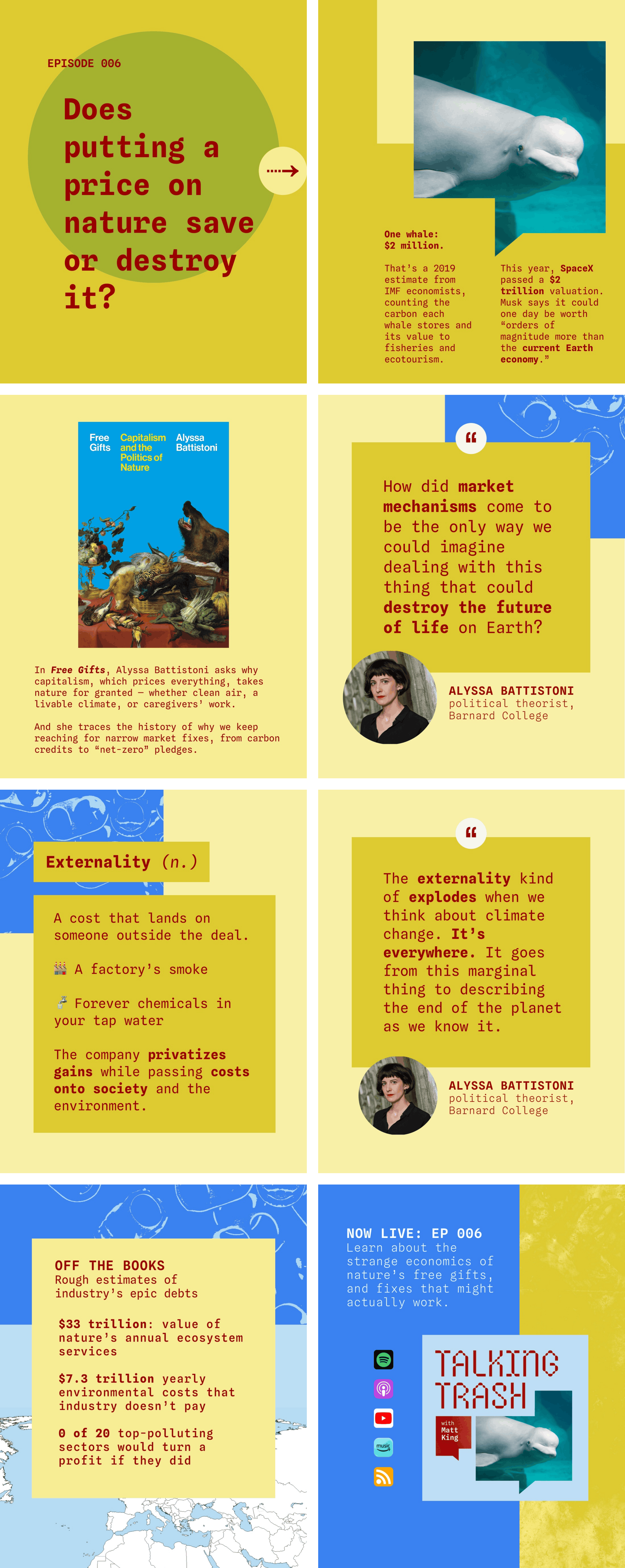
Episode 006 designs for Talking Trash | Art Director: Frances Miller
-
ALYSSA BATTISTONI: Breathing clean air, water filtration, living in an atmosphere where the climate is reasonably livable…
There's a huge amount of things that nature does for us that are not reflected in capitalism's system of value, and that as a result are treated as if they're worthless.
And so we have been having the wrong argument for a long time.
NARRATOR: Welcome to Talking Trash. I'm Matt King. This is a show about the waste we never see and the systems that shape our lives.
Usually that means the biggest messes industry leaves behind. This week, we're looking at what it takes for granted: clean air, a functioning biosphere, and generations of mothers and caregivers.
The market is relentless in putting a price on everything, so why does it so often fail to value nature? Political theorist Alyssa Battistoni untangles this riddle in her latest book, Free Gifts: Capitalism and the Politics of Nature.
We discuss the debated price of a whale, a glass replica of Earth in the Arizona desert that ran out of air, and what Costa Rica has figured out that carbon markets haven't.
The cover of Alyssa's book is an ode to human decadence. The full-bleed photograph displays an oil painting by Frans Snyders of a table feast spread with grapes, vegetables, rabbits, even a boar's head.
ALYSSA BATTISTONI: I wanted to avoid some of the clichés of environmental books, like green anything, trees, leaves, planets. You know, we sort of know the set of clichéd environmental images, which I think are both kind of boring and also didn't really feel like they would speak to what the book was really about. I suggested a couple of other works in this vein, like in the kind of Dutch Golden Age still life painting…
This age of commerce and the bounty of the New World, of the East, of the European nations, sort of, you know, engaging in these early days of not quite capitalism, but going out and plundering the world in a way. And that is often expressed in the abundance of nature piled up in various ways. It's really violent, and kind of almost disgustingly so. It's just like a pile of dead animals, which is funny for me as a vegetarian. And the boar head is so intense and visceral and conveys this violence, but also has something kind of aggressive about it.
NARRATOR: The book started as Alyssa's dissertation, back when she was a grad student watching the world respond to climate change. Then in 2019, the Green New Deal arrived in Congress, and she put her project on hold to co-write a manifesto called A Planet to Win.
ALYSSA BATTISTONI: The Green New Deal book was really trying to track this shift in climate politics away from the kind of purely market mechanism approach to climate policy and solutions. So away from carbon taxes or cap and trade, or these things that are just kind of trying to address the cost of carbon, and towards a more state-interventionist, public-goods-oriented kind of model.
But Free Gifts really, I think, comes out of trying to think about that same moment from a different vantage point, and really trying to get a little deeper on how it was that this world-changing, world-destroying problem, this thing that's set to threaten life on Earth as we know it, existential threat, et cetera, was being addressed only by these sorts of tweaks to prices, by like a carbon tax. How market mechanisms had come to be the only way we could imagine dealing with this thing that people were saying was going to destroy the future of life on Earth, which I found dissatisfying. But I also found a lot of the critiques of those, from a more moral perspective of saying, you know, we shouldn't put a price on nature, to be also unsatisfying.
NARRATOR: It's an absurd thought: that the world might end as the result of an accounting blunder. To understand our lack of imagination, Alyssa goes back to the 18th century and an odd phrase that early economists used for everything nature provides.
ALYSSA BATTISTONI: Classical political economists who are writing in the 18th and 19th century, people like David Ricardo and Jean-Baptiste Say, who talk about these "gratuitous gifts" of nature, and they're just kind of like, wow, look at all this great stuff that nature is doing for us. But yeah, there is something very strange about the idea of a free gift. You know, gifts are kind of definitionally free. You don't pay for them, but you're supposed to either reciprocate them, or it's like, yeah, we're just kind of repeating ourselves and saying it's a free gift, if we think of a gift as something that just isn't paid for. So I think it really designates that capitalist element.
There's a huge amount of things that nature does for us that are not reflected in capitalism's system of value, and that as a result are treated as if they're worthless.
NARRATOR: If the free gift is what capitalism takes from nature, pollution is what it gives back. Alyssa calls it "matter without a price." In economics, it's called an externality: a cost that lands on someone outside the transaction. A factory's smoke, forever chemicals in your tap water, the mental health impacts of social media.
Alyssa has called the externality the most important economic concept of the 20th century.
ALYSSA BATTISTONI: If we think of the free gift as these things that nature does for us that are kind of positive or good, or contributions to human life and economies, that aren't being assessed in terms of price, or costs that aren't being reflected in that form of economic value, we can think of the externality as effects of various actions or activities that are harmful, that are negative, that are also not being reflected in price or exchange value, or just aren't reflected in economic terms.
Arthur Pigou is sort of the first formal theorist of the externality, and he talks about a factory that has a smoky chimney, and the smoke is hurting everyone in the neighborhood, and it's causing harm to trees and parks and air quality and all of these things. But the owner of the factory doesn't have to pay for those costs to other people. And so they're not incorporating that into their decisions about how much smoke to churn out.
NARRATOR: Many economists offer a tidy solution to this sprawling problem: tax the externality. Put a price on every ton of carbon and let the market do the rest. Supporters say it's the most honest climate policy there is. Instead of regulating cars, planes, power plants, factories one by one, a single price nudges every decision in the economy at once.
But a tax can also become a cost of doing business, while the damage keeps piling up.
MATT KING: At one point in the book you make the statement… the idea of an externality is often described as a market failure. You have this bold claim that it's not so much a failure as how markets function, if taken to the extreme.
ALYSSA BATTISTONI: Yeah, I mean, this is something that… I started off with that concept of market failure, thought that was interesting, but also started to think that actually the externality is much more significant than certainly Pigou thought, than later theorists like Coase thought. That it goes from seeming like this marginal thing to describing this phenomenon that's potentially the end of the planet as we know it. And that's the externality, right? Actually, the externality kind of explodes when we think about climate change. It explodes the concept, almost. It's sort of everywhere. They're ubiquitous.
The externality describes something about how the market works, where the point is that you sort of detach intention and consequence. You aren't supposed to be responsible for the effects of the things you do in the market directly, right?
Most of the decisions we make between two parties have consequences beyond those two. Like, maybe they contribute to a rise in prices of a particular good somewhere else, or if you stop buying something, maybe the company closes down and people get thrown out of work. There are a lot of effects of all of our actions, but we're not responsible for them. That's sort of the whole point: you just buy and sell, and the market coordinates.
NARRATOR: You've heard this broken dynamic described going back decades, and across the political spectrum.
ARCHIVAL CLIP: Another day at the coalface, eh? Privatizing profits, mutualizing losses, yeah?
STEVE BANNON: The bailouts were absolutely outrageous. It was the burden of those taxpayers that bailed out the elites. All the upside goes to the crony capitalists.
BERNIE SANDERS: It builds on what Martin Luther King Jr. said in 1968: "This country has socialism for the rich and rugged individualism for the poor."
NARRATOR: How many profitable businesses would go bankrupt if they had to pay these social costs in full? One UN study years ago tallied the environmental damage of the world's biggest industries, from coal plants to cattle ranches, and came up with more than seven trillion dollars a year in unpaid costs. Of the twenty most damaging industries, not one would turn a profit if it had to pay up.
Rather than pay the full bill, many companies have found a cheaper option.
MATT KING: There is this whole growing sustainability market. You alluded to it: carbon credits, ESG investing. The latest one I've heard about is this idea of super pollutants that are also getting these credit markets layered on. But it's an interesting point: how much investment is really going into this space? It really does seem like it's a dozen of the biggest tech companies or consumer companies that are investing in this as kind of a marketing strategy, 'cause it plays into their net-zero narrative… I see more people going into this climate sustainability space, and they have these growth ambitions.
ALYSSA BATTISTONI: It will be interesting. I mean, I will remain skeptical till I see it really pan out. For 20 or 30 years now, there've been waves of interest, and people keep reviving it, and then they're like, hmm, not working that well. I do think there'll be versions of greenwashing, you know, internal carbon credits, companies that are trying to get to net zero on their own balance sheet so they can say that they're a net-zero company, for whoever cares about that.
But I just think they're not going to become large scale. Maybe there'll be some money to be made on them, but I think they're a fairly marginal enterprise. They're a weird commodity. If you did want this to happen, you'd have to have states force people to buy them. 'Cause, you know, you're not gonna buy, to take a really obvious example, oxygen. You can just breathe it. Thank God.
There's a whole sci-fi story about people who live on the moon; they have to pay for oxygen. And I'm sure that if we ever lived on Elon Musk's Mars, we would have to do that. You're not gonna catch me going there. I'm sure if these guys could make us pay for oxygen, they would. But as long as they can't, nobody will.
NARRATOR: Alyssa was joking, but sadly, our tech overlords aren't. In June, SpaceX went public and is now valued at roughly two trillion dollars, more than the annual economic output of Australia, Spain, or Mexico. In a recent post on X, Elon Musk suggested the company could one day, quote, "be worth orders of magnitude more than the current Earth economy."
Given the pressure to financialize everything, some have tried to put Earth onto the balance sheet. In the late 1990s, a team estimated the value of seventeen "ecosystem services," everything from bees pollinating crops to wetlands absorbing storms.
The total came to thirty-three trillion dollars a year, nearly double the entire global economy at the time. Over half the estimated value came from the soil and sea quietly recycling nutrients and nature breaking down our waste.
Two decades later, economists at the International Monetary Fund tried pricing a single species. A great whale, they found, stores about thirty-three tons of carbon over its life, and its waste feeds the plankton that make at least half the oxygen we breathe.
ALYSSA BATTISTONI: This proposal to put a price on whales of about $2 million per whale. This is an IMF proposal. And they're like, you know, whales contribute to carbon sequestration, 'cause whales spread nutrients throughout the sea, and they help generate all of these other forms of marine life that absorb carbon, and their bodies are part of these marine ecosystems… So it was like, well, whales are each worth $2 million. And, you know, how serious is this? Sometimes hard to tell.
But for decades, economists have been coming up with these ways of assessing the value of things that don't have a price, and trying to incorporate those into policy or economic calculations, or make them into some kind of asset and buy and sell them, create credits and these things. And there's been a million programs that do things like this, and they always seemed, you know, on the one hand, offensive, 'cause you're like, well, we're just saying, okay, a whale is $2 million now. But also ludicrous in a way, 'cause it's just this kind of insane proposal to price everything that exists on the planet, in order to incorporate all the prices and get everything right. So both sort of bad and offensive.
MATT KING: It is this kind of paradox. There's a sense of putting a value on nature as a way to try to appreciate it more and try to save it. But then there's also this question you're grappling with, where in some ways it's surprising nature hasn't been valued at all, and maybe that's saved it more than if we were starting to assign value and commodify it and open it up to exploitation.
ALYSSA BATTISTONI: The argument would be, well, we shouldn't do this. This is morally wrong, to put a price on nature. This is something degrading to the status of these beings and creatures.
And I don't even disagree, but it's like, we do that all the time, you know? Everything we use and do was once a tree or a fish or some kind of element of the natural world that was harvested or mined or collected and converted into a raw material, converted into a commodity. We are buying and selling nature all the time in some form. And so it felt very arbitrary to me that people would say, we can't put a price on the Amazon, but I can buy this wooden chair from Ikea.
There's a mistake in some of the debate, because it's all been: should we price nature or not? And in fact, nature is not being priced. Capital is not investing in ecosystem services or natural capital or forest credits, or they're only doing so in very, very small ways, around the margins, 'cause these are not growth sectors. These are not profitable…
They're very hard to turn into property… 'cause a lot of the kinds of gifts of nature that are valuable in this sense are produced by ecosystems. They're not things that you can easily bound, or say, this is where this starts and ends. I own this patch of the air, not that one. They're what economists call "public goods." They're very difficult to own and control in a way that you would have to, to even receive a rent off of something, let alone to make them into value-producing things like a factory.
There's no human labor that goes into them. There's no innovation that you can really do. So at best you could maybe make other people pay you to use them, but even that has been very, very hard.
Because of the nature of these entities, the nature of these natures, basically, they are mostly still just available for free, and that has not protected them from being totally destroyed. So I think that basically both sides of the debate are kind of… I have some sympathy for both of them in a way, but I also think they're just fundamentally kind of getting the problem wrong.
And so we have been having the wrong argument for a long time.
NARRATOR: Another case study came in 1991, when eight people sealed themselves inside Biosphere 2, a glass and steel replica of Earth's ecosystems in the Arizona desert. The complex included all seven biomes, including a rainforest, a savanna, and a tiny ocean, as well as three thousand species of animals and plants.
A massive underground technosphere of pumps, fans, and pipes replicated Earth's, quote, "free services" of circulating carbon, water, waste, and nutrients.
JANE POYNTER (ARCHIVAL, 1991): I take my last breaths of this atmosphere, knowing that I will take breaths from a different atmosphere from all of you for two years.
NARRATOR: The project was bankrolled largely by Ed Bass, a Texas heir whose family fortune began with his great-uncle's oil empire. The total cost: as much as $200 million to keep eight humans alive, just barely, for two years.
Within months, the crops began to fail and the crew was going hungry. Within a year, oxygen levels inside the dome had fallen so far that managers began pumping in air from the outside. By the end, in the words of one of the scientists, they had all suffocated, starved, and gone mad.
Today, the University of Arizona runs Biosphere 2 as an Earth science laboratory, open to the public for tours. When I visited a couple years ago, it was just after the fall semester had ended, and the facility was surprisingly empty. As we toured the open spaces, we almost felt like members of that original crew.
In the gift shop, I found freeze-dried ice cream sandwiches, bracelets made from ocean plastic, and T-shirts with the phrase "A good planet is hard to find."
While environmentalists weigh different policy trade-offs, many leaders in technology and business believe nothing has to change: that invention, not coordination, solves these crises.
MATT KING: An argument I hear from them a lot is that innovation is what really solves externalities.
ALYSSA BATTISTONI: They'll point to some examples, like, in terms of transportation, horse manure used to be this huge problem in streets, and eventually we shifted to cars, and that's what solved that problem. They'll talk about urban fires, and how the rise of steel and concrete was the big reason for that becoming less of an issue. It's a silly argument, because you're replacing one set of externalities with another set of externalities. But I mean, the argument's out there. It resonates. Yeah, definitely, it is an argument. It's not even totally wrong. I think that the way that capitalism by default treats nature as a free gift means that there are different versions of what that problem looks like. There are different kinds of free gifts that become more or less important at different moments, in how production is organized, what kinds of industries are important, et cetera.
The whole question of innovation and how technologies come to replace one another is just so much more complex than some of these guys seem to think. But leaving that aside, you have horse manure, and then you have the car, and then you have CO2.
I think it's possible to manage particular environmental problems within capitalism… or make them less severe, or find ways to address them. But even if you can manage certain problems within capitalism, the free gift problem is going to persist, and will just reappear in some other form.
We should use solar panels and electric, all of these renewable technologies that would make it possible to not use fossil fuels. Great. We should use those. Those also have environmental costs, externalities of their own…
In the same way that it's hard to make someone pay for the forest, it's also hard to make people pay for carbon capture or something. There are a bunch of technologies that might exist, but that we are going to find it quite difficult to put to use at scale. So there's also this question of: do we have certain technologies that are technically capable of helping mitigate the problem? And then are they what is often referred to as economically viable? I.e., can you make a profit? And in some cases, I think the answer will probably be no to the latter, even if these things are technically capable of helping address the problem.
NARRATOR: The most surprising chapter of Free Gifts isn't about forests or factories, but the household. Cooking, cleaning, raising kids, caring for the sick: work critical to life that is rarely paid at all.
ALYSSA BATTISTONI: This is actually kind of where the book started. I was doing a lot of Marxist feminist work and work on social reproduction, and I was thinking about that parallel between the unpaid household work and the unvalued work of nature.
And then I rewrote the whole thing, and now it's like the opposite. I almost inverted the argument, where now I am reading domestic labor, housework, reproductive work, this whole sort of blobby set of activities that tend to appear as free gifts of nature, and asking, well, why is that?
MATT KING: I wanted to read another line I loved of yours: "The kinds of work that sustain and improve both human and non-human life without increasing resource use or generating dangerous byproducts are precisely those that capital is least likely to provide." Which I thought was just really well said, and it's something I had felt. You know, I've taught as an adjunct at the college level. I've worked in writing centers. I have friends who are nurses. And I've had that observation of, why is this super important work so unvalued?
ALYSSA BATTISTONI: I would say feminist analyses and sort of skepticism about nature is very important to the book overall… this kind of suspicion of the ways that nature can legitimize and justify forms of social oppression is very important to the feminist tradition. And so not wanting to, even in an ecological, environmental context, say "nature good." Having a little bit more of a critical distance from that felt important.
NARRATOR: So the market routinely fails to value nature, and attempts to price these ecosystems often lead to shoddy numbers and sometimes even more exploitation. What are we to do? After finishing her dissertation, Alyssa took a celebration trip down south and saw one possible answer firsthand.
ALYSSA BATTISTONI: I went to Costa Rica for a couple weeks, and I went in part 'cause I was very interested in it as both the ecotourism exemplar, but also one of the very few places that is always held up as an example of doing ecosystem service projects… because in the eighties they were sort of the site of, like, we're gonna figure out how to value ecosystem services, and we're gonna make these potentially a source of an industry or something.
And I think it's kind of only worked in Costa Rica. And also there, it's very much not really markets in ecosystem services. It's a very state-run project of subsidies and regulations and support for both forms of agricultural production, but then also preservation of ecosystems that are a revenue source for the country. And I will say, it was all amazing. I had a great time. I loved looking at these beautiful jungles and beaches and cloud forests and creatures. But it was also very interesting to be thinking about it while being there: what is this almost development strategy? How and why have they invested in ecosystem preservation in this way? And whether and how extendable that was.
NARRATOR: In 1996, Costa Rica passed a forestry law that pays landowners to protect and replant forest. About 90 percent of the money comes from a tax on gasoline and diesel. In 1990, forests covered less than a quarter of the country. Today, it's about 60 percent.
ALYSSA BATTISTONI: I think in some ways Bolivia and Ecuador are probably closer on the social side as well, 'cause I think they've had stronger leftist governments, and are trying to really bring those different elements: ecological protection, but also anti-poverty and working-class-led social programs.
NARRATOR: In 2008, Ecuador became the first country to give nature rights in its constitution: the right to exist and regenerate. In 2021, those rights even successfully stopped a mine in a cloud forest called Los Cedros. But this February, a new law fast-tracked mining, and Indigenous groups are back in court.
ALYSSA BATTISTONI: I think the jury is still out on whether the rights of nature, per se, are going to be very effective. You can declare them, but really, it's a matter of how much you can mobilize 'em. And I think, as with, frankly, human rights, the rights of nature are effective to the extent that you can mobilize 'em and put some kind of social force behind them.
I do think that part of the reason that they're enshrined in these countries is that they have strong Indigenous communities and movements, and long histories of Indigenous political action, and large Indigenous populations that have often pushed for these things. Part of the reason that a number of Latin American countries have done this is because of their social makeup and political forces.
That said, the fact that they are willing to at least enshrine them, even in name, is an indicator that this is something that people are willing to fight around, that matters to people. And I think there have been some cases where they have been upheld. Again, how much teeth or how much sticking power that's gonna have in the face of developers or investors is a mixed record so far. Mostly they haven't done a ton, but they're an interesting new tool.
NARRATOR: Alyssa ends her book with a story most of us heard as kids, Shel Silverstein's The Giving Tree.
The tree gives a little boy its apples and then its branches, and as the boy grows up, the tree gives up its trunk, until eventually there's nothing left but a stump to sit on. The story is usually read as a parable about the selfishness of human nature and the sacrifice of a parent's love.
But Alyssa reads it differently, as an illustration of how capitalism compels us to view nature, and even those we love, as free for the taking.
SHEL SILVERSTEIN (READING THE GIVING TREE): "I'm too big to climb and play," said the boy. "I want to buy things and have fun." "I'm sorry," said the tree, "but I have no money. I have only leaves and apples."
NARRATOR: Many thanks again to Alyssa Battistoni for walking us through the strange economics of everything nature provides us. Her book is Free Gifts: Capitalism and the Politics of Nature, out now from Princeton University Press.
For more on the history of the externality, the numbers behind the price of nature, and the countries trying something different, visit our episode page at talkingtrashpod.com. You can support Talking Trash by hitting subscribe in your favorite podcast app and leaving a review, so others can discover these stories.
It's been great having you along. See you next time.
