
Ep. 005: Tracing the hidden afterlives of Philadelphia's trash
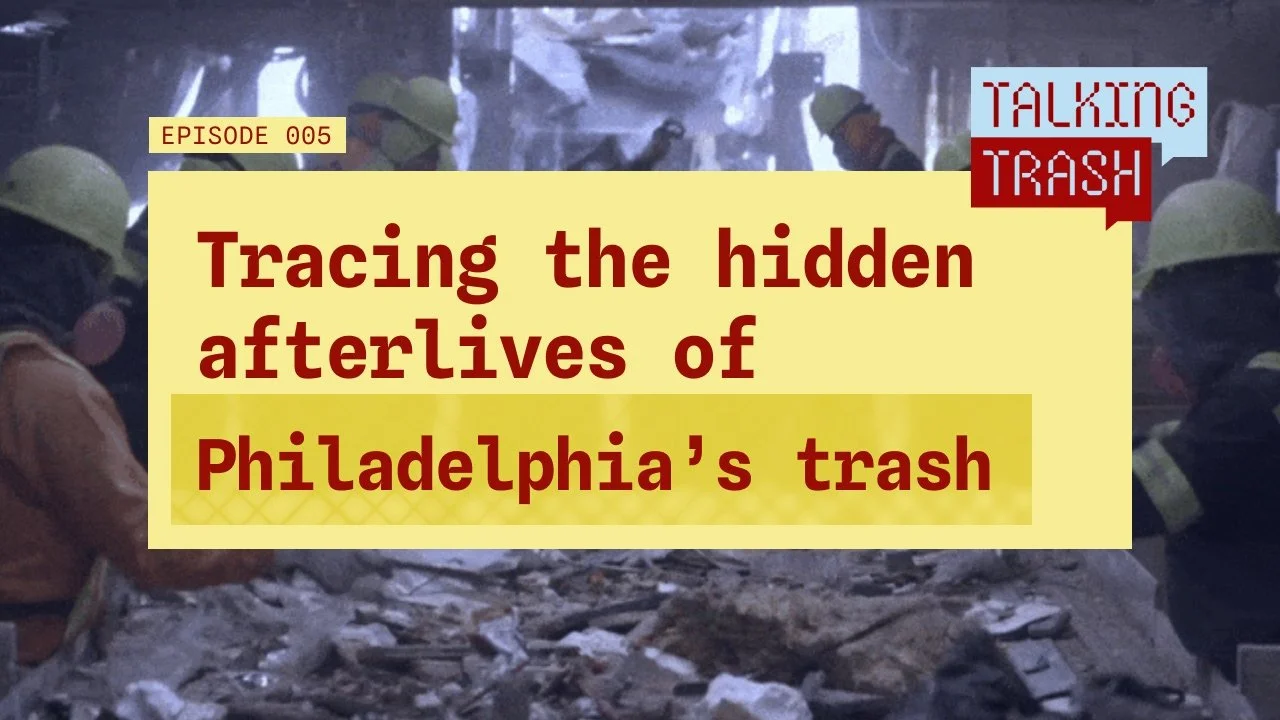
Cover art for Episode 005 on Philadelphia’s decades-old garbage crisis.
A nonfiction film explores Philly's waste, from its sewers and surveillance cameras to the beach in Haiti where its ash ended up.
Philadelphia has been trying to solve its trash problem for decades. The city's answers have included hundreds of surveillance cameras mounted on telephone poles; two-hundred-year-old sewers still catching what washes off the street; and, once, a ship sent out to sea with fourteen thousand tons of incinerator ash to find a country that would take it.
When Melissa Langer moved here in 2017, she was struck by the litter and illegal dumping piled at the roadside, and a quick search turned up the cameras. "I immediately thought how bizarre, mysterious, darkly comedic this phenomenon was," she says. In Excess is her new nonfiction film that follows Philadelphia's waste above ground and below, through streets, sewers, waterways and out to sea, and that is itself built, to a large degree, out of discarded material.
For this episode I spoke with Melissa, archival producer Caitlin Riggsbee, and the sound team of Jonathan Snipes and Christopher Fleeger.
Listen: Apple Podcasts, Spotify, Amazon Music, RSS
Going to the periphery
Melissa found her framework in discard studies — the field that examines how societies decide what counts as garbage and where it goes. "In order to have a clean 'center,'" she says, "you have to send waste to an imaginary 'away' on a periphery. And so I wanted to go to those peripheries." She followed the trash outward, to the people paid to handle it: at pumping stations, on sorting lines, and in surveillance rooms filled with camera feeds. Melissa shot most of it alone, which got her into places a crew couldn't.
For a while the film's center of gravity was Terrill Haigler, better known in Philadelphia as Ya Fav Trashman: a former sanitation worker who built an online following documenting the city's trash, then ran for City Council. A campaign finance story produced a bad headline and he eventually dropped out. "I hope you add that to the documentary," he tells her. "How hard it is to actually make change in Philly. Especially if you're not rich."
Two people, hundreds of cameras
The surveillance program Melissa found in that first search leads to a small office with two computers and a pair of employees watching over 370 cameras posted across the city. They're good at it, and so are the dumpers, who swap trucks, cover plates, and move one corner over when a camera appears. Even when someone is caught, the fine is $5,000.
Much of what gets dumped isn't household trash. It's construction and demolition debris, nearly a fifth of Philadelphia's waste stream. It's abandoned cars and the clean-outs of homes whose occupants moved or were evicted. And where it lands isn't random: as Caitlin Riggsbee points out, the debris in Rittenhouse Square is nothing next to Grays Ferry or Kensington — a question, she says, of "where we decide what's okay, who's okay to dump on."
What a sewer sounds like
Much of the film was shot at Revolution Recovery, a construction and demolition recycling plant in Northeast Philadelphia that has housed the nonprofit studio RAIR (Recycled Artist in Residency) since 2010. Melissa did a residency there; Fleeger and Snipes came to record, bringing sixteen microphones to arrange across the machinery. This is all highly unusual. Most low-budget documentaries put all their effort into shooting new footage, Snipes says, "and then the sound team is essentially working from stock footage,” or purchased libraries.
At a sewage pumping station, Fleeger and Snipes found a grate that strains debris out of the sewage. The noise was piercingly loud and horrible to stand near, but surprisingly musical. It became the film's score. Months later, the film went to captioner Storm Miguel Flores, who had never met the sound team. Describing that scene for a deaf viewer, he wrote: Gate tone continues, similar to a sustained trumpet note.
A ship no port would take
The film's historical footage replays Philadelphia's waste crisis of the mid-1980s, when landfills closed to the city's trash and it burned more instead, leaving mountains of toxic incinerator ash. One solution was to put the ash on a boat. The Khian Sea left in 1986 with fourteen thousand tons and spent two years being turned away from port after port. In January 1988, the crew unloaded four thousand tons onto a beach in Haiti and called it fertilizer; ordered to remove it, the ship left in the night with the rest aboard, changed names twice, and turned up empty that November. The remaining tonnage went into the Atlantic and Indian Oceans.
Almost none of this history existed on film. Caitlin started at Temple University's Urban Archives, tried local Facebook groups, and eventually got Greenpeace to turn up forgotten boxes of VHS tapes they'd never digitized. Much of it was unusable by any conventional standard — desaturated, warbled, three pixels wide — but Melissa and editor Julian Turner used it anyway. "It's trash archival," Caitlin says. "But it does actually move the story along."
There is no away
Today, Philadelphia recycles less of its trash than any other major American city, and the region is running out of room, again: of the 33.5 million tons the Northeast disposed of in 2024, roughly 23 percent went to landfills expected to close within five years, and another 12 million tons left the region entirely. Waste companies are now building rail networks to move garbage to Ohio, Virginia and Alabama.
When asked in Q&As how her waste habits have changed, Melissa tries to shift the idea away from personal narratives and towards ideas like extended producer responsibility (EPR). She knows many viewers arrive expecting an environmental film with "a nice bow on the end." But her aim is the opposite: that they leave "surprised, unsettled, maybe even a little bit confused in a productive way," having assembled the meaning themselves rather than received it.
Additional resources
Start by watching In Excess, then follow the threads: the emerging academic field that gave Melissa her framework, the literature around sanitation work, the shrinking landfill capacity pushing Northeast waste further from home, and the local organizing happening in Philadelphia right now. If the ghost of the Khian Sea stuck with you, the last section has ways to act on what it revealed.
READ
Max Liboiron and Josh Lepawsky, Discard Studies: Wasting, Systems, and Power (MIT Press, 2022) — the field Melissa names as her point of departure. Its argument is that social, political and economic systems maintain power by discarding certain people, places and things, and it takes direct aim at the myth that most waste is household trash.
Robin Nagle, Picking Up (FSG, 2013), and Simon Paré-Poupart, Trash! A Garbageman's Story (Melville House, 2026) — two sociologists who took the job, in New York and Montreal respectively. Great reading companions to what In Excess does with labor, and both are funnier than you'd expect.
Where it’s all going today: Megan Quinn's 2026 Waste Dive report on the Northeast’s shrinking disposal capacity has the numbers: a region that threw away 33.5 million tons in 2024 and is now laying rail to ship its garbage to Ohio and Alabama. Jen Kinney's "Seven Days At The Bin Store" (Defector, 2025) offers a quirky look at a West Philly shop selling Amazon returns, at prices that fall a dollar a day until what's left is worth nothing.
WATCH
In Excess, directed by Melissa Langer — available on physical drive from Video StoreAge, which also carries an extended, hour-long cut of this “Talking Trash” conversation.
Greenpeace, "Toxic Ash in Haiti" archive — the organization's own documentation of the Khian Sea ash pile, from the same body of material Caitlin spent months trying to get digitized.
Nikolaus Geyrhalter, Matter Out of Place (2022) — a wordless observational documentary that visits landfills, incinerators, and dumping grounds across the world. A close cinematic sibling to In Excess, and a useful contrast: where Geyrhalter goes global and silent, Melissa goes local and listens.
ACT
Report illegal dumping wherever you live — in most US cities through a 311 line or public works department.
Trash Academy — a Philadelphia youth-led project out of Mural Arts that maps dumpsites, campaigns on construction and demolition waste, and runs the Clean Philadelphia Now petition.
RAIR (Recycled Artist in Residency), the nonprofit studio inside Revolution Recovery, an active construction and demolition recycling plant in Northeast Philadelphia, challenging the perception of waste culture. It's been running residencies since 2010, and it's where much of Melissa’s film was shot.
Basel Action Network, which works to end the toxic waste trade, named for the 1989 treaty that was catalyzed in part by public outrage over the Khian Sea. Today it mostly tracks e-waste, discarded ships, and plastic exports.
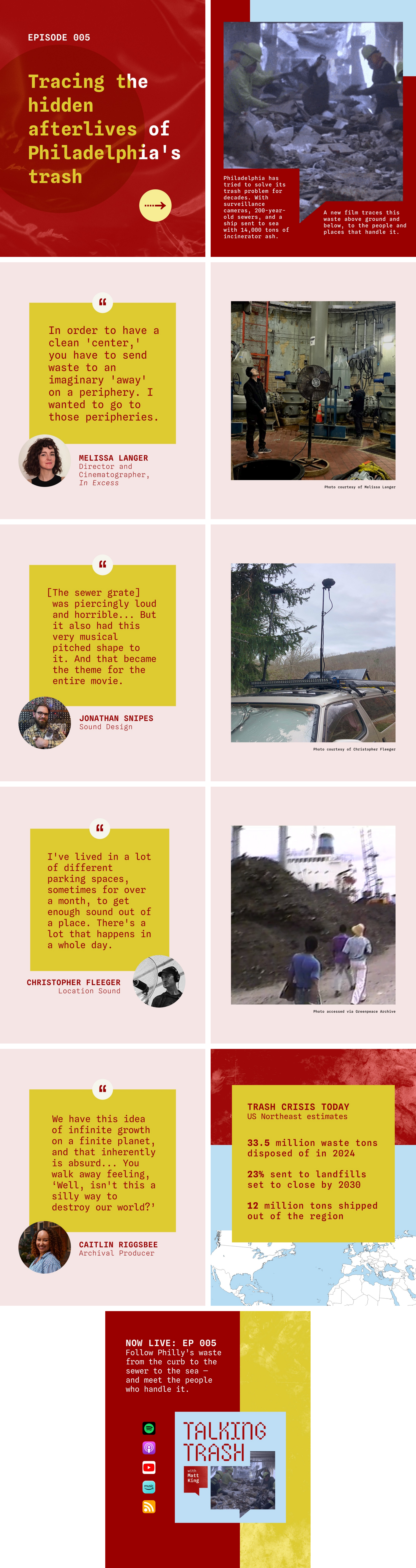
Episode 005 designs for Talking Trash | Art Director: Frances Miller
-
MELISSA LANGER: In order to have a clean, quote, “center,” you have to send waste to an imaginary “away.” I wanted to go to those peripheries.
CHRISTOPHER FLEEGER: It’s also good just seeing people working in the sorting facilities, in the sewage pumping stations. It lets me think of this whole infrastructure as much less abstract.
JONATHAN SNIPES: It’s really hard to exist in the world without consuming plastic and making waste, though I know we should have a different relationship to it.
CAITLIN RIGGSBEE: We have this idea of infinite growth on a finite planet, and that inherently is absurd.
MATT KING: Welcome to Talking Trash. I’m Matt King. This is a show about the waste we never see and the systems that shape our lives.
This week, we’re looking at the problem of trash in Philadelphia. Melissa Langer’s nonfiction film, “In Excess,” traces the city’s waste across time and space, through streets, sewers, waterways, and even out to sea. And the film is made of waste too — discarded footage, surveillance cameras, and archival newsreels that others might overlook.
I talked with Melissa and three of her key collaborators: archival producer Caitlin Riggsbee, who uncovered some incredible VHS tapes in a Greenpeace basement, and the sound design duo of Jonathan Snipes and Christopher Fleeger, who ventured into Philly’s hidden waste infrastructure to capture location sound.
We talked about the inspirations for this project, what it took to get inside Philadelphia’s sewers and surveillance rooms, and why “In Excess” stands apart from most environmental documentaries that talk at audiences rather than involving them.
The problem of trash in Philadelphia is nothing new.
MAYOR W. WILSON GOODE SR. (archival): We can’t collect the trash if we have no place to put it. We are told over and over by people outside of our borders, “Philadelphia trash not wanted here.”
MATT KING: That was Mayor Wilson Goode Sr. back in the mid-1980s. Nearly half a century later, the problem persists. Today, Philadelphia recycles less of its trash than any other big American city, and the Northeast at large is running out of landfill space, again. The region already exports around thirty percent of its waste, and a quarter of it goes to landfills scheduled to close in the next five years.
When Melissa Langer moved to Philadelphia in 2017, it wasn’t long before she stumbled across this crisis.
MELISSA LANGER: I was just driving around different neighborhoods as a way to familiarize myself with the new city that I had moved to, and was pretty immediately struck by the amount of litter and illegal dumping that I was seeing in different neighborhoods. A quick internet search revealed that the city started installing surveillance cameras as a way to catch illegal dumpers.
I sort of immediately thought how bizarre, mysterious, darkly comedic this phenomenon was — that you install new infrastructure, new technology, as a way to monitor trash.
MATT KING: Caitlin Riggsbee had lived in Philly for years before she came onto the project.
CAITLIN RIGGSBEE: Everyone who I’ve explained this film to who has even just driven through Philadelphia is like, “Oh, I understand.” Because we do have a reputation for being a dirty city. And if you live here, people complain about it in Center City, but you know that the amount of debris in Rittenhouse Square is nothing compared to Grays Ferry or Kensington. It’s much worse in several neighborhoods, for a variety of social reasons — where we decide what’s okay, who’s okay to dump on.
MATT KING: On a recent drive through Philly, I saw a billboard that advertised the city’s illegal dumping problem. It showed a dark, grainy photograph of roadside rubbish and a URL where people could find proper disposal options. The fine for illegal dumping: just $5,000.
MELISSA LANGER: When I started the project, I tried to familiarize myself with different theories of waste. And one that immediately comes up is discard studies.
One of the things that it talks about is that, in order to have a clean, quote, “center,” you have to send waste to an imaginary “away” on a periphery. I wanted to go to those peripheries, see what they were like, see who and what was there.
Labor just became a very natural umbrella for studying this. The more that I delved into this topic, the more I understood it was truly a labyrinth, and that I would just be scratching the surface. I wanted to get really specific about who was doing this labor — who exactly is working at a sewage pumping station, who exactly is looking at the cameras that are high up on the telephone poles. I think that specificity is really necessary for understanding these huge, really complex systems that we’re talking about.
MATT KING: “In Excess” offers an astonishing tour of the city’s waste infrastructure. We dive through two-hundred-year-old sewers and peer into a sewage pumping station. We visit a materials recovery facility and watch the busy sorting line. We see a circle of sanitation workers do warm-up stretches before their shift. And we sit in a small room with the two women who watch hundreds of surveillance cameras posted across the city, searching for illegal dumpers.
MELISSA LANGER: Each person I filmed with was a different relationship, a different length of engagement. I knew from the beginning that I wanted to film people at their place of work and sort of respect the limits on representation. I didn’t need to go back to their home and meet their family and all this.
A lot of workers in these municipal departments were really receptive and open to someone filming with them, because they were like, “Look at what we deal with every day. We want people to see what this looks like.”
SEWER MAINTENANCE WORKER (archival): If it washes into the inlet and comes through with the runoff, it’s gonna wind up in the sewer, and it could sit there for 20 years.
SURVEILLANCE INVESTIGATOR (archival): Most people that dump don’t think it’s cameras. The bigger ones come from people that’s maybe rehabbing a house or gutting out a house. We’re starting to get a lot of abandoned cars, a lot of pickup trucks just dumping trash.
MATT KING: It helps that Melissa shot most of the documentary footage alone, managing both camera and microphone. Christopher Fleeger, who later captured location sound, noted how unusual this is.
CHRISTOPHER FLEEGER: There’s something very disarming in the way that Melissa juggled so many jobs at once to make this film. Story producer, she ran sound. Jonathan and I did not do dialogue on this film. We’re grabbing ambient sound.
So she had so much access, and I think part of what made it so easy and disarming for people is just that it was just her and a camera, and not with a big crew.
MELISSA LANGER: I would throw a lav on them. And much to Jonathan’s dismay — even though he made it sound incredible in the end — the lavs that I used weren’t the highest quality, but he was able to make it sound incredible. I didn’t have the money to bring on a sound person for all of the filming, but it ended up being beneficial in some ways for it just to be me.
MATT KING: Jonathan Snipes led the film’s sound design.
JONATHAN SNIPES: In one of my other lives, I teach production and post-production sound at UCLA in the film department there. And I think this film is a great example of: the right sound is better than the right gear. To capture the sound of these people talking perfectly — with the most incredible crew and equipment — would have over-complicated the production in such a way that you wouldn’t have gotten the conversations that we get.
MATT KING: For a while, the movie’s center of gravity was Terrill Haigler, better known in Philadelphia as Ya Fav Trashman. A former sanitation worker turned online organizer, he built a following documenting the city’s trash and leading volunteer cleanups. Then he decided to run for city council.
TERRILL HAIGLER (archival): I want to make the beautification of Philadelphia a priority on city council, and I am the only candidate that can talk trash the way I do.
MATT KING: Unfortunately, a campaign finance mix-up led to a bad headline, which became a fatal blow — for now, at least — causing him to drop out. Melissa’s camera sticks with him as he picks up rideshare shifts to make ends meet while continuing his community cleanup work.
TERRILL HAIGLER (archival): Well, I hope you add that to the documentary. How hard it is to actually make change in Philly. Especially if you’re not rich.
MATT KING: Much of the film takes place at a recycling center in Northeast Philadelphia, Revolution Recovery. The facility recycles construction and demolition debris, which accounts for nearly one-fifth of Philly’s waste stream, more than any other waste category. And since 2010, it has also been home to RAIR — Recycled Artist In Residency — a nonprofit studio co-founded by artist Billy Dufala, who runs it as creative director.
MELISSA LANGER: Most artists who have that residency are more interested in objects, pulling objects from the waste stream and making art from it. And mine was a little bit different, in that I just wanted to be there and film and observe. Fleeger and Jonathan were able to come for a couple days and record sounds and film with me, which was just a dream.
CHRISTOPHER FLEEGER: The RAIR facility is gorgeous for sound, but there is so much going on. There’s so much machinery. So it’s a lot of trying to frame your sound and isolate the best that you can.
We went all out on the recording of this. We weren’t just taking a stereo microphone rig out there. We had these spatial systems — we each had our own multi-microphone setup, in addition to specialty microphones, seismic microphones, devices that measure earthquake activity, contact mics that we would place on machines and get the vibrations, the internal sounds.
MATT KING: If you had to ballpark the number of mics in the RAIR facility on that day — dozens?
CHRISTOPHER FLEEGER: About 16 between the two of us.
JONATHAN SNIPES: I had two rigs running and about eight to ten mics between them. Three rigs running, sorry.
CHRISTOPHER FLEEGER: Sound design is often something you do in post-production, but a lot of it is the decisions you make during production, as to what you’re framing with your microphones and what position you’re standing in.
I have a Japanese domestic import van that I can sleep in. And I’ve done all these modifications to it to where I can hang mics on the roof rack. I’m glad that Jonathan is still talking to me, because I was turning in just 24-hour recordings of some of these spaces. I’ve also got microphones inside the cab that record me and my own body sounds as I sleep, so I know what to edit out.
I’ve lived in a lot of different parking spaces, sometimes for over a month, to get enough sound out of a place in this world. And there’s a lot that happens in a whole day.
JONATHAN SNIPES: On a typical documentary, dialogue is king. The sonic landscape of the environments that these people are in is sort of secondary. And in many cases, especially on low-budget, short-turnaround movies, that material is all built from library sounds — sounds that other people have recorded and released that you can purchase. And every sound designer has a massive collection of these things. I do too, and they’re extremely useful.
But I do think it’s sort of fascinating that on movies, all of this effort has been put into generating all of this new material, and then the sound team is essentially working from stock footage.
CHRISTOPHER FLEEGER: Sound has a lot of similarities with the way waste is treated, particularly on film sets. I don’t wanna trauma dump too much, but sound is invisible, and I think there’s a similar desire for both things to remain invisible. Sound and waste.
MELISSA LANGER: Part of what I was trying to do in this film is not continuing to desensitize people to these images. We know what trash looks like. I’m trying not to add to the saturation, but sort of disorient us, and make trash and waste systems kind of eerie and unfamiliar.
Both Fleeger and Jonathan have this very particular attunement to the underbelly of an environment — the sounds that I honestly don’t even hear. We’re in a room and they’re off in the corners putting mics everywhere, and I wasn’t even aware that a sound was being made from a particular direction. So the sound really helped to add mystery to waste systems, and therefore make it more alluring to a viewer.
MATT KING: During one visit to a sewage pumping station, Fleeger and Jonathan noticed a sound nobody else seemed to care about. It came from a grate that dips into the flow of sewage to strain out larger pieces of trash.
JONATHAN SNIPES: They’re like, “Oh, this is this really nasty, loud, piercing, horrible sound, we don’t really care about.” And we’re like, “Well, let’s go check it out. Let’s hear it.”
And that sewer grate — I mean, it was piercingly loud and horrible to be in the room with, but it had this very sort of musical pitched shape to it. And that became the musical theme for the entire movie.
CHRISTOPHER FLEEGER: Jonathan and I were just in awe from the sound of the sewage pumping station. When we got there, we were hearing the tones of the machines and the ambience of everything running. But when the grate started, and the friction that it made, all the metal on metal, that just blew us away. I think Melissa even wondered if we were okay afterwards, because we were just dumbstruck by how gorgeous it was.
MELISSA LANGER: I know. I was worried they were never gonna work with me again.
JONATHAN SNIPES: You hear a sound like that and you forget you’re wearing your good shoes that you don’t wanna get in the sewer. You just kinda forget where you are, put yourself in filthy and sometimes dangerous situations, because you’re just listening.
If you have this preconceived idea of what you’re gonna record when you go in, you miss things like that. You don’t record what you expect. You record what’s there.
MATT KING: The sewer grate’s eerie sound became a motif throughout the film, often playing beneath edited surveillance footage. At times, it blooms into a full choral arrangement.
Melissa’s attention to detail extended to every aspect of the film. For the on-screen captions, she worked with Storm Miguel Flores, who had never met the sound team. He watched the pumping station scene and had to describe the noise in words for a deaf viewer.
MELISSA LANGER: The caption that he made for that particular scene, he said: “Gate tone continues, similar to a sustained trumpet note.”
And I just love that, because it’s musical. This grate can be really satisfying. And there are other examples — he captioned a debris pile as “debris pattering, reminiscent of rainfall.”
So it was just really satisfying to see two people in creative roles in a film, having never met, never hearing the same thing at the same time, and yet having the same experience of the sound in the film.
MATT KING: While the location sound immerses us in these present waste landscapes, the film also brings in historical narratives through found archival footage. Melissa tapped Caitlin Riggsbee to research Philadelphia’s waste crisis of the mid-1980s.
Landfills were reaching capacity, so the city burned more of its trash, fouling the air in nearby neighborhoods and leaving mountains of toxic ash behind.
NEWS REPORTER (archival): City Council leaders have promised to have a final solution for the trash crisis by the end of this year. They’re still exploring for possible alternatives, including talk of shipping raw trash to some location in the Middle East.
MATT KING: Another solution they landed on? Put the ash on a boat and see who will take it.
One infamous ship, the Khian Sea, left Philadelphia in 1986, and for two years it roamed the seas, no country willing to take its toxic cargo. Some was left on a beach in Haiti, the rest later dumped into the Atlantic and Indian Oceans. Sixteen years after it set sail, the ash from that beach in Haiti was returned to Philadelphia and buried just a few hours from where it started.
Almost none of this history was readily available on film.
CAITLIN RIGGSBEE: It was pretty intimidating. I realized pretty early on that at the same time there was another trash barge situation in New York, so I’d get a lot of false hits with news reports.
MATT KING: Apparently it was a craze sweeping the nation — just sending your trash out to sea.
Caitlin started at Temple University’s Urban Archives, which had absorbed the libraries of multiple Philadelphia news organizations. But news footage only goes so far. She tried some crowdsourcing, looking at local social media groups, but that was a dead end. Finally, she found a breakthrough with Greenpeace, which had been on the case before anyone else.
CAITLIN RIGGSBEE: Greenpeace ended up having a fantastic archive they’d only partially digitized. So after a lot of back and forths with them, we were like, “Hey, are you sure this is everything you have?” And they were like, “Yes.” And we were like, “But have you looked again?” And they were like, “Okay, there are some files, some VHS tapes that we haven’t digitized.”
Could we get them digitized? What would the cost be? And it ended up being incredible, because they were really the first people on the ground responding to this. They had footage from the day after all the ash was dumped in Haiti. Behind-the-scenes footage of press conferences held by Mayor Goode. They had sort of been on Philadelphia’s case, it seems, for a while. They were anti-incinerator before anyone else got hip to this might be a problem.
It seems like they were trying to make a documentary initially. So they had interviews in Panama, where the barge was initially going to go. They had great footage in Haiti with local reporters and activists who were like, “What is this?”
MATT KING: The Greenpeace footage is really incredible. There’s the sequence where you can see the boat captain trying to communicate to these locals, and he’s trying to say, “This is not harmful at all.” The plan is to put the ash over an open field as some weird kind of fertilizer. But then the locals are pointing out that the stuff inside the ash is glass and metal, and one of them pulls out a newspaper that you can still read the date on.
One theme that’s come up in a couple of different interviews I’ve done is this defense mechanism that power goes back to, where they claim to eat the stuff. At one point, he puts the ash into his mouth. The first episode we aired on the podcast was about a coal ash spill in Tennessee, and there was a safety officer on the site who did the same exact thing: “This stuff is so safe, you can eat it.” Now this is gonna be something I’m looking for at all these different disaster sites.
MELISSA LANGER: First of all, that’s disturbing and funny at the same time. The guy that you see in the archival footage — the locals describe him as the captain, but he’s not actually the captain. He was sort of like this person sent out to do PR. Just to clarify that.
CAITLIN RIGGSBEE: When you do archival work, you discover how the concept of archiving audiovisual materials is relatively new. There are a lot of fantastic shows — talk shows, late night shows — and the first three seasons are gone, because they wrote over them. There wasn’t a preciousness.
So often when you’re looking at VHS materials, you’re watching something, and then boom, all of a sudden we’ve jumped six years, and it’s like, “Oh. Oh, we reused the tape.” When you have stuff that’s sort of just chilling in a storage closet, you lose sometimes the actual record of what is on this tape. There’s no getting around it — you have to put eyeballs to the stuff.
MATT KING: And much of what Caitlin found was, by any normal standard, unusable.
CAITLIN RIGGSBEE: Archival is often not pretty. Like all of us, it’s only good for like 100 years, and then stuff gets a little weird. Different formats degrade in different ways. The color desaturates, the sound gets all warbled and muffled.
I watch everything and I’ll make notes about what stood out to me. A lot of the times, part of that job is flagging: “Oh, this is so good, but the sound is atrocious.” Or, “Oh, this is so good, but it’s like three pixels.”
What was fun to watch, as the different cuts kept coming in, is that Melissa and Julian were not afraid to use the offcuts — the archival offcuts, the stuff that normally, like, they’re saying something really interesting, but let’s slap some B-roll on top of that, because woo boy, we are blown out. The color looks like it’s been tie-dyed.
I had a friend who — we were talking about something else film-related, and she said, “All parts of the buffalo,” and now that’s the only thing that I’m hearing in my head. But kind of, yeah, using all parts of the buffalo. Using the parts of the archival that a lot of other editors, directors would sort of shy away from, because it doesn’t look incredible. But it is still emotionally moving. It’s something that other people would discard. It’s, you know, trash archival. But it does actually move the story along.
MATT KING: I love that idea of trash archival — an aesthetic that could extend beyond just films explicitly about trash.
In one scene, Melissa includes a long shot from one of the forgotten Greenpeace tapes. We watch, second by second, as a car slowly approaches the beach where the Khian Sea is unloading its toxic ash.
MELISSA LANGER: Julian and I decided that we wanted to keep the whole shot, to sort of help include the audience in this discovery that’s happening, have it take place in real time.
The sound was really bad — just this faulty mic that you hear the whole time. Initially I was sorta like, “Oh, Jonathan, Fleeger, can we massage this? Make it sound better or whatever?” And I think Jonathan was like, “This is what it is. This is source material and it’s not pretty. Let’s lean into it.”
And so when that moment happens in the film, he cuts all of the surround mics and the sound just comes from the front speaker. And it’s this really grating on-camera mic. And you can see some people, they watch it in the theater like, ugh! But I love it, because it’s what it is. It’s an archive. It’s something somebody would normally throw away.
JONATHAN SNIPES: You can’t make what you wish it would be, right? Which is part of this idea of hearing what’s there, and not recording what you wish was there, because then you’ll be constantly disappointed.
When you hear that, you’re not hearing the scene. It’s a reminder that we are hearing a microphone that was in the scene. We are hearing an imperfect document of this moment. It’s this impression left on this membrane that was vibrating in that particular way at that particular time.
We did make the rule early on, all of the archival stuff is in mono, and it’s in the center speaker, and that helps separate it from the more spatial surround recordings we were able to do. But it also reminds us that we are looking at this stuff through this lens, right? That this is not objective. This is a subjective slice of this thing.
MATT KING: The team also had to score much of this archival footage. Ambience, room tone, texture — none of which was on the original tapes with their barely usable audio. So Jonathan had to source period sound.
JONATHAN SNIPES: This guy Craig Smith from CalArts, who’s now retired, has been doing this incredible work archiving old optical film sound libraries, and making them freely available on Freesound. That stuff was hugely, hugely important, as were a handful of other vintage libraries.
So those sounds in the archival section are actually 40, 50 years older than the footage, a lot of the time. But it has that feeling of being from the past and being old. I think if we used authentic ’80s and ’90s sounds from sound libraries, they would’ve sounded a little too good. A little too crisp and a little too close. So we’re using stuff, in many cases, we recorded in the ’40s and ’50s.
MATT KING: The story of Philadelphia’s trash crisis has repeated itself across generations, and it’s the story of every major city that’s grappling with an unsustainable approach to waste management. I wondered how Melissa found the right tone for such a grim subject.
MELISSA LANGER: It’s a complicated question, because you’re making a movie, but you’re also filming with real people, and you have to be careful, because you wanna respect how they are represented.
My point of departure was sort of this bizarre dark comedy. Like, how is this the state of the world? How are these the solutions that have been created for trash? But the film hopefully strikes many different tones, and you go on sort of an emotional journey while you’re watching it.
I think people might come to the film expecting to see an “environmental film,” whatever that means to you, with a nice bow on the end, that they’ll feel good at the end of the movie. But my actual hope is that they’re left feeling surprised, unsettled, maybe even a little bit confused in a productive way.
We met at New/Next Festival, and Eric Hatch is the director there, and I was reading an article with him, and he was talking about how nonfiction and documentary are becoming increasingly these conveyor belts of information. And so how do you fight that? How do you make something that disarms people, is a little bewildering, that the audience has to participate in making meaning while they’re watching the film and sort of piece it together, rather than a passive viewing experience?
MATT KING: The metaphor reminds me of the literal conveyor belts in the film, snaking through the material sorting facility, carrying trash streams that have only gotten larger.
CAITLIN RIGGSBEE: We have this idea of infinite growth on a finite planet, and that inherently is absurd. The way that societies increase the surveillance so that people don’t do the wrong thing — all these concentric circles are increasingly absurd.
And I think it is a really immersive look at the way that we contribute to it. Any of the trash featured in the film could have been my trash. I haven’t thrown something out of a window, but some trash from my garbage can definitely has flown out of the can and wandered into the sewers.
It’s not pretty, but it’s not supposed to be. And I think that it straddles the line really nicely, so that you don’t walk away feeling ashamed, but you do walk away feeling like, “Well, isn’t this silly?” What a silly way to destroy our world.
CHRISTOPHER FLEEGER: Just echoing what Caitlin talked about. If I was living in Philadelphia at the same time period of the archival footage, I would’ve had my trash on the boat. So I think Melissa’s particularly careful about not attacking people in this film, because we’re all real guilty of it.
Industrial factories more so, but we’re all a part of this, and this is the way that people have jobs. This is quite the infrastructure. It’s hard to get away from this problem. It’s very complicated, and not something we can run away with and be innocent about.
MATT KING: It is a tricky balance, where we are all complicit, but also we are parts of these systems that are designed above us and away from us, and we only have so much power to buy, consume, care for ourselves within those poorly designed systems. You want individuals to feel some responsibility, but we also need to be focused on where change can really matter.
And I think the film does both. It’s kind of revealing these consumer waste streams, but we also see the hidden aspects of how it’s handled. Even incineration, I think, is something a lot of people don’t know about — or even if they know it’s a thing, maybe they think it’s just a simple solution. We burn it, we get some energy from it, problem gone. And there’s a lot of ash, there’s a lot of pollution.
MELISSA LANGER: The film hopefully is contributing to this shift in idea away from personal narratives of responsibility, and more towards ideas like extended producer responsibility, where the people, the corporations that make the products should be responsible for the end of its life cycle.
These materials are flooding our communities, and we’re responsible for disposing of them, cleaning up, all of this. A lot of people ask me in Q&As, “What have you done personally to change your habits?” And I do understand the question, and it’s a valid question, and I am mindful. But the more that we look up and punch up and not down, then that will benefit everyone in the future.
And one thing that I think about is, bringing it back to discard studies, that there is no away — you know, quote, “away.” That the away is a real place, with an environment and real people.
JONATHAN SNIPES: I moved during this process to a house, as opposed to a shared apartment. We are now solely responsible for what goes into our bins. We have what’s allowed in the recycling bin posted on the refrigerator, and we’re teaching our toddler how to sort what goes where.
It coincides with me working on this film. And I also know that it gets dumped into a truck in which not everybody has exercised that care. Every time I’m very carefully washing my recycling and putting it in the blue bin, I’m reminded of hanging out at RAIR, recording the conveyor belt of all of that stuff and that sorting line. And every time a plastic bottle filled with urine would go by on the belt, Billy would nudge me and point at it and give me a big thumbs up. And I’m like, “Well, I’m doing my due diligence here, but at some point this is getting mixed in with the urine bottles, and somebody’s gonna have to sort those.”
And so it feels nice to do something, but it also feels futile. But also, what else are you gonna do?
CHRISTOPHER FLEEGER: It’s also good just seeing people working in the sorting facilities, in the sewage pumping stations, in all these different areas. It lets me think of this whole infrastructure as much less abstract. There’s humans running this. When I put my waste out there, it’s coming across people, not just this invisible thing.
MELISSA LANGER: Circling back to that specificity — the cultivation of a person’s infrastructural intimacy with their own city is something I’m really interested in, and hope to keep doing. Hopefully someone who doesn’t live in Philadelphia watches the movie and says, “I wonder what my sewage pumping station looks like? I wonder what my sanitation center looks like?” And as they’re driving around, maybe they notice a nondescript building that they’ve never noticed before, and get curious about who exactly is working inside of those buildings.
MATT KING: Many thanks again to Melissa Langer, Caitlin Riggsbee, Jonathan Snipes, and Christopher Fleeger for taking us behind the scenes and into the many afterlives of Philadelphia’s waste streams.
A physical copy of the film, “In Excess,” is available now at VideoStoreAge.com. That copy also includes an extended cut of this conversation, with deeper dives into the sound design, archival work, and creative inspirations.
“In Excess” was produced by Nora Wilkinson and edited by Julian Turner, with captions by Storm Miguel Flores.
For more on the film, the Khian Sea, and municipal trash at large, visit our full episode page at talkingtrashpod.com. You can support Talking Trash by hitting subscribe in your favorite podcast app and leaving a review so others can discover these stories.
It’s been fun having you along. See you next time.
